Athlete Mindset HQ Institute

A Blog for health, wellness and mindfulness information…

  • by John J. Schessler MS, CPT, SPC

    Long before an athlete takes the shot, steps onto the mat, approaches the starting line, or enters the weight room, a conversation has already begun.

    It is not happening between the athlete and the coach. It is not coming from the crowd, an opponent, or a teammate.

    It is happening inside the athlete’s own mind.

    That internal conversation—known as self-talk—can influence confidence, concentration, emotional control, motivation, and performance. It can help an athlete respond to pressure with purpose, or it can allow one mistake to become a complete mental collapse.

    The most important voice an athlete hears during competition is often their own.

    What Is Self-Talk?

    Self-talk refers to the words, thoughts, and internal messages athletes direct toward themselves. Sometimes it is deliberate:

    “I am prepared for this.”

    “Stay patient.”

    “Next play.”

    Other times, it happens automatically:

    “I always mess this up.”

    “I’m not good enough.”

    “Everyone can see me failing.”

    These thoughts may seem harmless because they remain inside the athlete’s mind, but the brain and body often respond to internal language as if it were an instruction.

    When an athlete repeatedly thinks, “Don’t mess up,” attention becomes centered on the possibility of failure. Muscles may tighten, breathing may become shallow, and decision-making may become hesitant. The athlete is no longer fully responding to the competition—they are responding to the threat created within their own mind.

    Self-talk is not simply background noise. It helps shape the athlete’s emotional and physical state.

    Self-Talk Influences Attention

    Athletic performance requires athletes to focus on information that matters while filtering out everything that does not.

    Effective self-talk can serve as an attentional cue. Short phrases such as “eyes up,” “quick feet,” “breathe,” or “finish strong” direct the athlete toward a controllable action.

    Ineffective self-talk does the opposite.

    After making a mistake, an athlete may begin thinking:

    “I can’t believe I did that.”

    “What is my coach thinking?”

    “What if I do it again?”

    At that point, the athlete’s attention is no longer in the present. It is trapped between the mistake that already happened and the mistake they fear might happen next.

    A strong performance cue brings the athlete back to the current moment:

    “Reset.”

    “Next possession.”

    “Win this point.”

    These phrases are powerful because they give the mind somewhere productive to go.

    Self-Talk and Confidence

    Confidence is not the absence of doubt. It is the belief that you can still respond effectively when doubt appears.

    Athletes sometimes believe confident self-talk means making exaggerated statements such as:

    “I am unstoppable.”

    “I am the greatest athlete here.”

    Those phrases may work for some people, but self-talk is usually most effective when it is believable, specific, and connected to preparation.

    Instead of saying, “I cannot fail,” an athlete might say:

    “I have prepared for this moment.”

    “I can handle the pressure.”

    “Trust the work.”

    “I know how to respond.”

    This type of language creates grounded confidence. It does not deny the difficulty of the situation. It reminds the athlete that they possess the preparation and skills required to face it.

    The goal is not to convince yourself that competition will be easy. The goal is to remind yourself that you are capable when competition becomes difficult.

    The Problem With Negative Self-Talk

    Negative self-talk is not always loud or dramatic. It often appears in subtle statements:

    “I’m having a bad day.”

    “Nothing is working.”

    “I always choke under pressure.”

    “I’m just not confident.”

    The danger is that these statements turn temporary experiences into permanent identities.

    There is a major psychological difference between saying, “I made a mistake,” and saying, “I am a failure.”

    One describes an event. The other defines the person.

    When athletes repeatedly label themselves according to their worst moments, they strengthen a negative mental pattern. The brain begins searching for evidence that supports the belief. One missed shot becomes proof that the athlete “cannot perform under pressure.” One poor practice becomes evidence that they are “losing their ability.”

    That is how one thought can become a belief—and how a belief can begin influencing behavior.

    Productive Self-Talk Is Not Toxic Positivity

    Developing better self-talk does not mean athletes must ignore frustration, disappointment, fear, or pain.

    An athlete does not need to pretend that everything is fine when it is not.

    Productive self-talk acknowledges reality while directing the athlete toward an effective response:

    “That mistake was frustrating, but I can recover.”

    “I feel nervous because this matters. Breathe and begin.”

    “This is difficult, but I can stay composed.”

    “I do not control the result. I control my next action.”

    This is not fake positivity. It is psychological flexibility—the ability to experience difficult thoughts and emotions without allowing them to dictate the next decision.

    Athletes do not need to win every internal argument. They need to stop giving every thought authority.

    A thought can be present without being followed.

    Three Types of Self-Talk Athletes Can Use

    1. Instructional Self-Talk
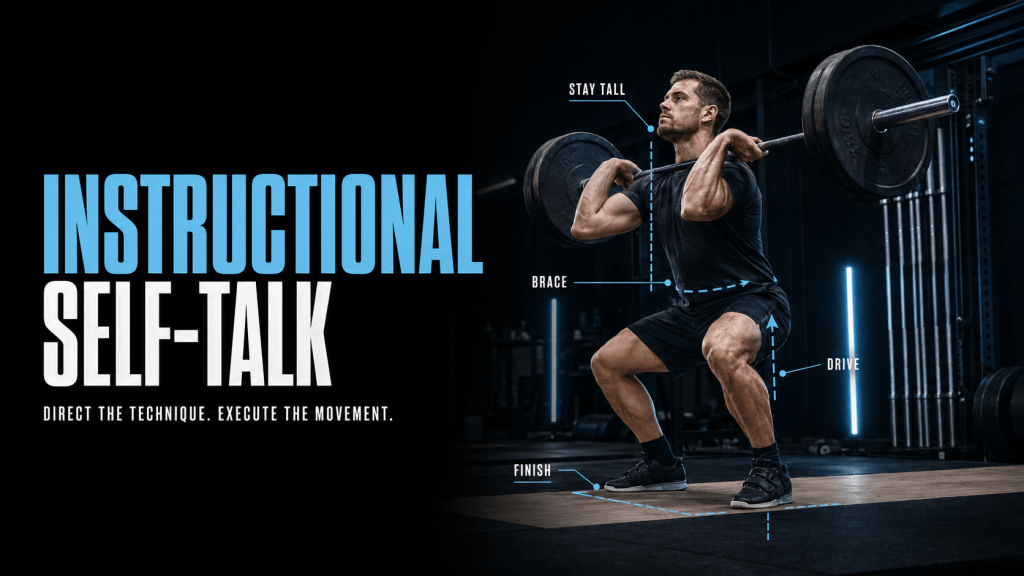
    Instructional self-talk directs attention toward technique, positioning, or execution.

    Examples include:

    • “Keep your hands up.”
    • “Drive through the floor.”
    • “Stay low.”
    • “Follow through.”
    • “See the target.”

    This type of self-talk is especially useful when learning a skill or correcting technique. During competition, however, cues should remain short. Too much technical thinking can create paralysis by analysis and interrupt automatic movement.

    2. Motivational Self-Talk

    Motivational self-talk helps athletes maintain effort, confidence, and intensity.

    Examples include:

    • “Keep pushing.”
    • “You are ready.”
    • “One more rep.”
    • “Stay aggressive.”
    • “Finish strong.”

    These statements can be especially effective during fatigue, adversity, or moments when an athlete’s energy begins to drop.

    3. Reset Self-Talk
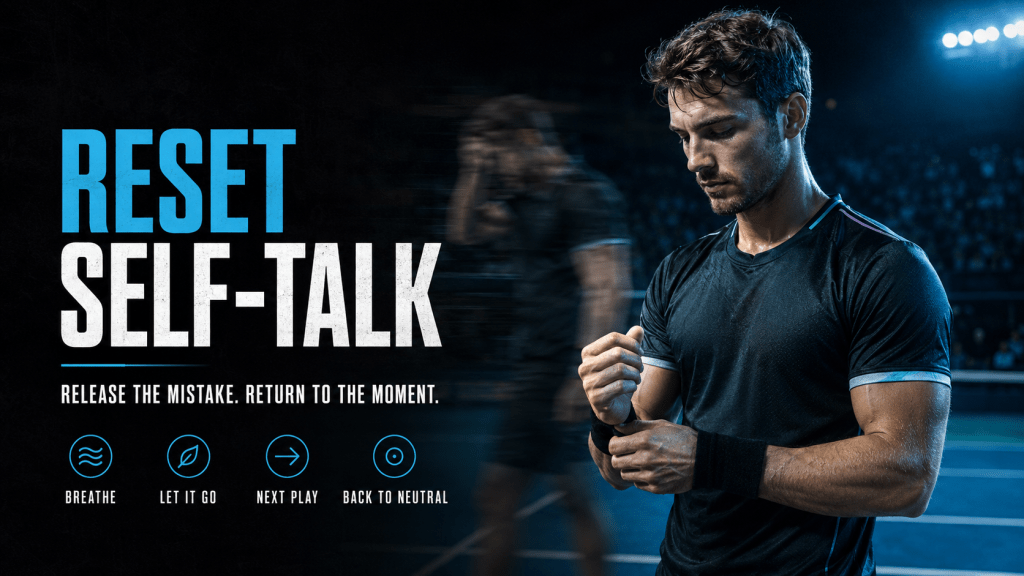
    Reset self-talk helps athletes recover after mistakes, setbacks, or emotional reactions.

    Examples include:

    • “Next play.”
    • “Let it go.”
    • “Reset and respond.”
    • “Back to neutral.”
    • “Control the next moment.”

    Every athlete makes mistakes. Mentally strong athletes are not necessarily those who make fewer mistakes—they are often the ones who recover more quickly.

    The Self-Talk Reset

    Athletes can use a simple process when they notice their internal dialogue becoming destructive.

    Step 1: Recognize the Thought

    Pay attention to the exact language running through your mind.

    What are you saying to yourself?

    Would you speak to a teammate this way?

    Step 2: Challenge the Message

    Ask whether the thought is completely accurate or simply an emotional reaction.

    “I missed that shot” is a fact.

    “I always fail when it matters” is an interpretation.

    Learning to separate facts from interpretations prevents one moment from controlling the entire performance.

    Step 3: Replace It With a Performance Cue

    Choose a phrase that is believable, brief, and actionable.

    Instead of “Don’t mess up,” use “Trust your technique.”

    Instead of “I’m terrible today,” use “Adjust and compete.”

    Instead of “I can’t handle this pressure,” use “Breathe and execute.”

    Step 4: Reconnect With the Body
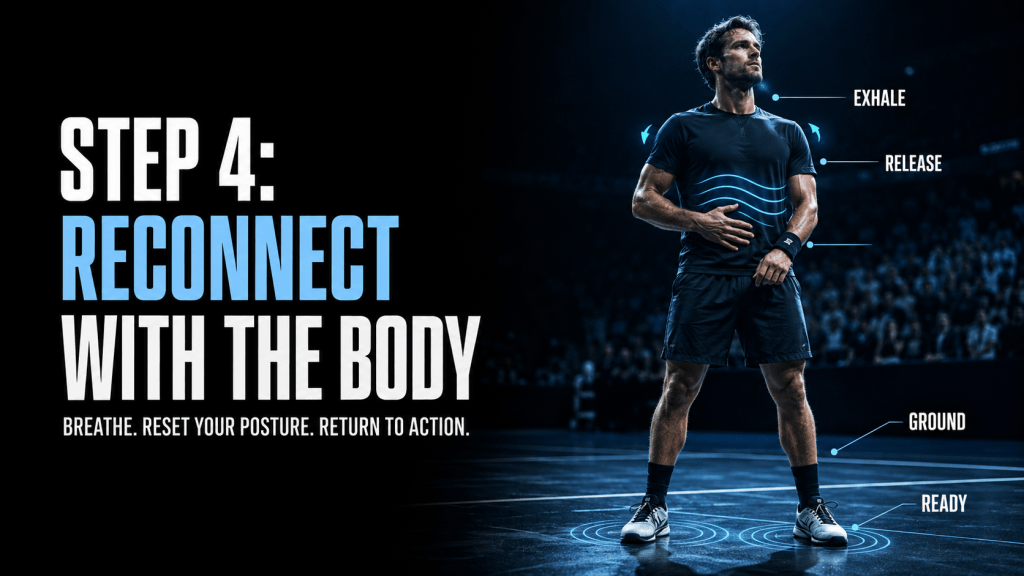
    Combine the new phrase with a physical reset—a deep breath, a shoulder release, an equipment adjustment, or a return to the starting position.

    This connects the mental cue to a consistent action and helps the athlete transition back into the present.

    Coaches Shape an Athlete’s Inner Voice

    Athletes do not develop self-talk in isolation.

    Over time, the voices of coaches, parents, teammates, and other influential people can become part of an athlete’s internal dialogue. If an athlete is repeatedly told that mistakes are unacceptable, they may eventually begin punishing themselves for every error. If they are taught that mistakes provide information, they are more likely to respond with curiosity and adjustment.

    This does not mean coaches should avoid accountability or difficult feedback. Athletes need honesty. But effective feedback addresses behavior without attacking identity.

    “You lost focus on that possession” encourages correction.

    “You are mentally weak” creates a label.

    One teaches. The other wounds.

    Strong coaching helps athletes develop an internal voice that is demanding without being destructive, confident without being unrealistic, and compassionate without eliminating accountability.

    Train Your Inner Voice

    Athletes train strength, speed, endurance, and technique. Self-talk deserves the same intentional practice.

    Do not wait until the championship game to decide what you need to hear.

    Write down the negative phrases that appear most often during practice and competition. Then develop a specific replacement for each one. Practice those new phrases during training so they become familiar under pressure.

    Your self-talk will not always be perfect. Negative thoughts will still appear. Doubt will still show up. Pressure will still challenge you.

    Mental strength is not controlling every thought that enters your mind.

    It is choosing which thoughts deserve to guide your actions.

    The voice within can become your harshest critic or one of your strongest competitive tools. Train it with the same discipline you bring to your body and your sport.

    Because when the pressure rises, the crowd gets louder, and the outcome remains uncertain, your inner voice may be the one that determines what happens next.

    You do not have to believe every thought you have. But you do have the power to choose the voice you follow.

    About John J. Schessler, M.S.
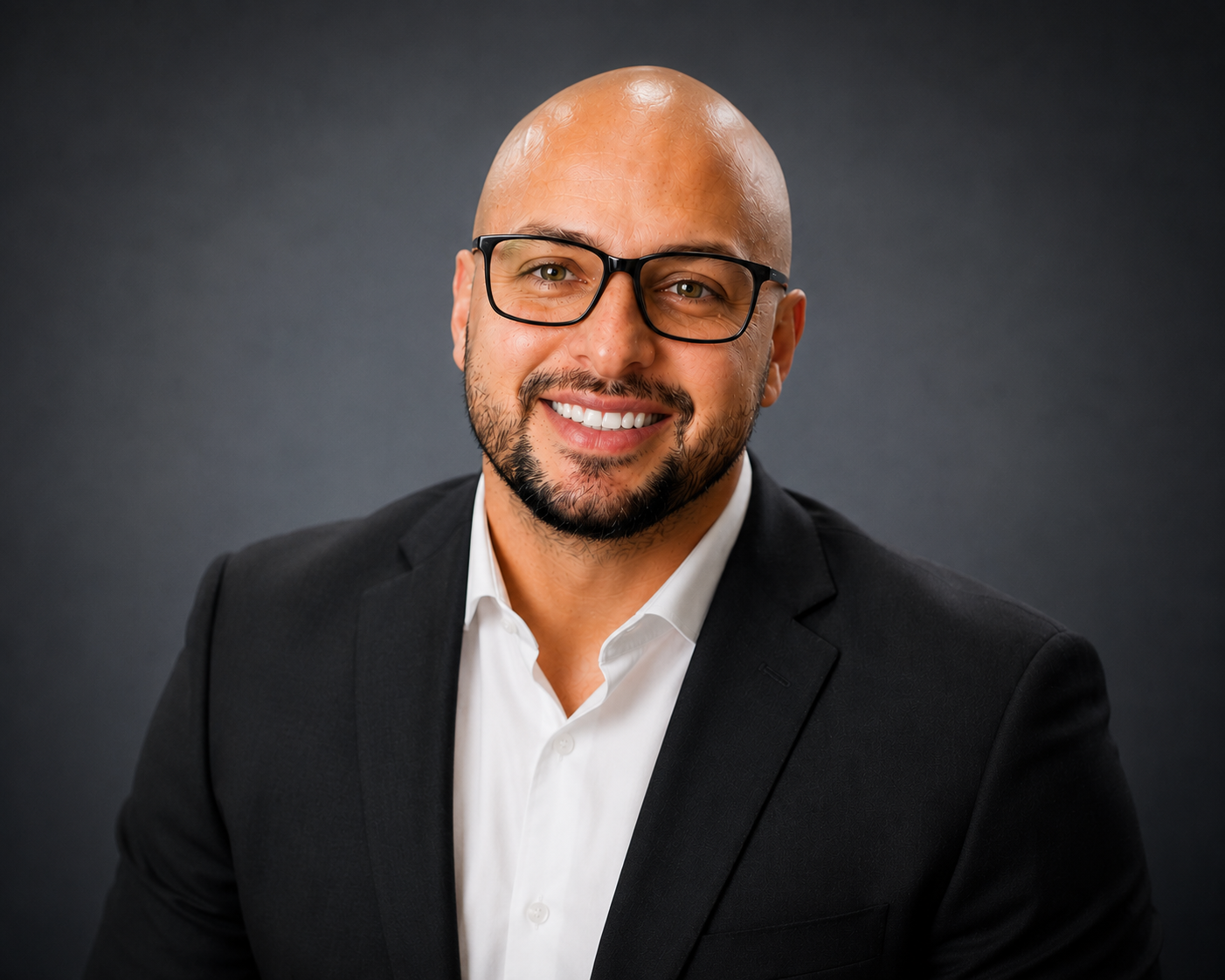
    John J. Schessler, M.S., is a Mental Performance Coach, Behavior Interventionist, speaker, and founder of Athlete Mindset HQ—a high-performance coaching platform dedicated to helping athletes, professionals, and everyday individuals develop the mindset needed to thrive under pressure and perform at their highest potential.

    John earned his Master of Science in Sport Psychology from Capella University and his Bachelor of Arts in Child & Adolescent Psychology from Southern New Hampshire University. His work bridges the gap between psychology, human performance, behavioral science, and personal development, combining evidence-based strategies with practical coaching that people can immediately apply in sport, work, and everyday life.

    His passion for helping others is rooted in his own journey. As a child, John survived Guillain-Barré Syndrome, spending weeks in a coma before fighting through rehabilitation to reclaim his life. That experience shaped his belief that resilience isn’t something you’re born with—it’s something you build through adversity, discipline, and purpose.

    Today, John works with individuals from all walks of life, helping them strengthen confidence, improve emotional resilience, overcome obstacles, and develop the habits that lead to lasting success. Whether coaching athletes, mentoring students, speaking to organizations, or creating educational content, his mission remains the same: to help people become mentally stronger than the challenges they face.

    John is also the host of The Follow Through Podcast, where he explores sports psychology, leadership, men’s mental health, motivation, resilience, and human performance through practical conversations that inspire listeners to move beyond intention and into action.

    His philosophy is simple:

    Mental strength isn’t about never struggling. It’s about developing the confidence, discipline, and resilience to keep moving forward—especially when life gets difficult.

    Because success isn’t built by what you intend to do.

    It’s built by what you follow through on.
    John J. Schessler, M.S. is dedicated to helping people unlock their potential by strengthening the one asset that influences every area of life—the mind. Through education, coaching, and authentic conversation, he empowers others to develop confidence, resilience, and the discipline to follow through on their goals.
  • by John J. Schessler, MS

    “You don’t experience life exactly as it happens—you experience life through the meaning you give it.”

    Every single day, your brain is telling you a story.

    You miss a shot in the final seconds.

    “I let everyone down.”

    You don’t get the promotion.

    “I’m obviously not good enough.”

    Your relationship ends.

    “I’ll never find someone else.”

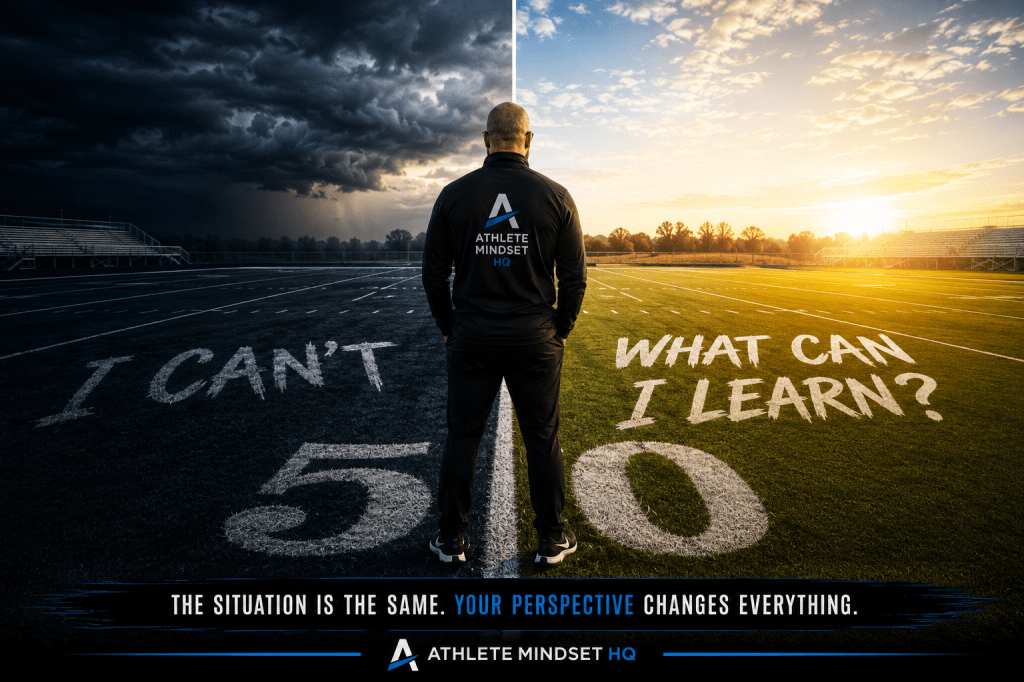
    The event isn’t what determines how you feel.

    The meaning you assign to the event does.

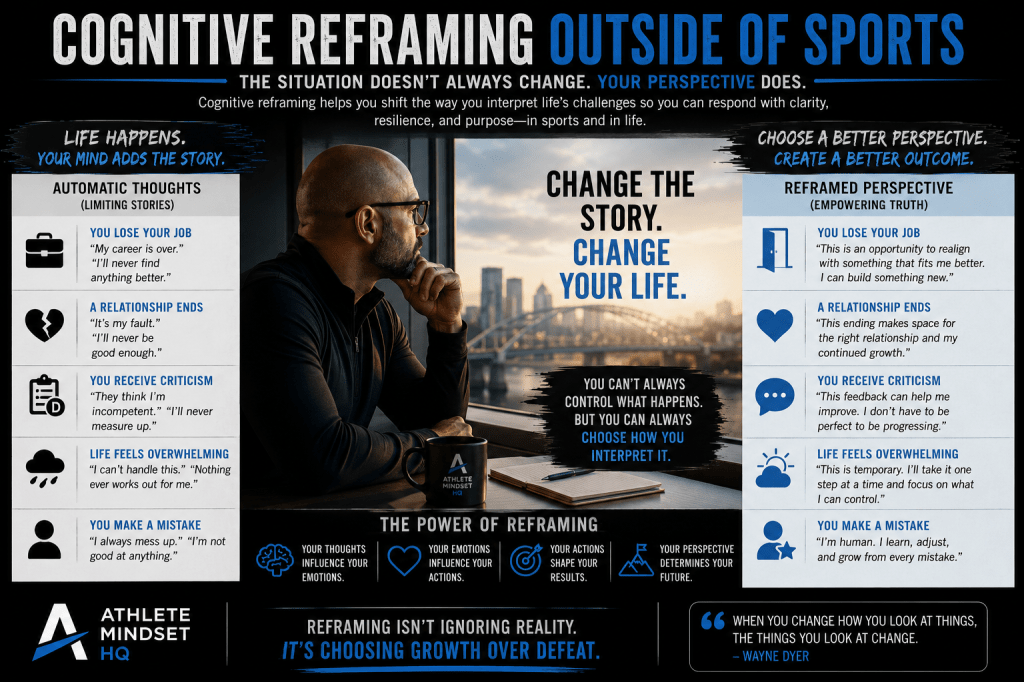
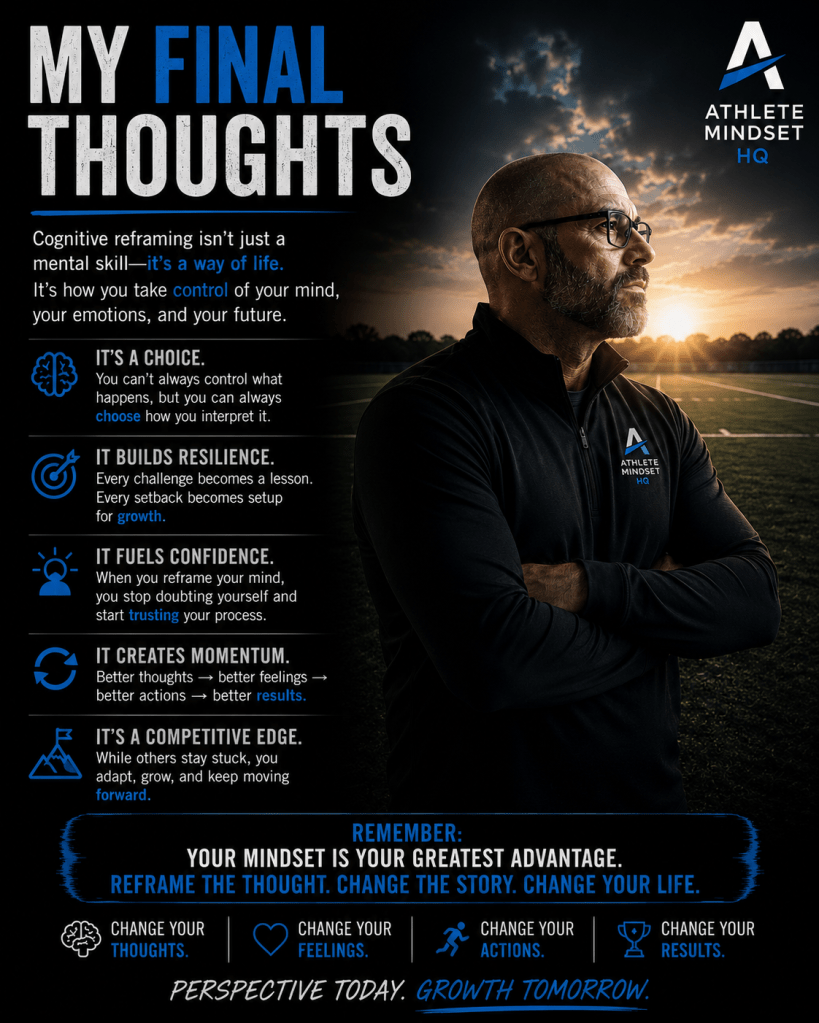
    That process is called cognitive reframing, and it’s one of the most powerful psychological skills available—not just for athletes, but for anyone trying to perform, grow, and navigate life’s inevitable challenges.


    What Is Cognitive Reframing?

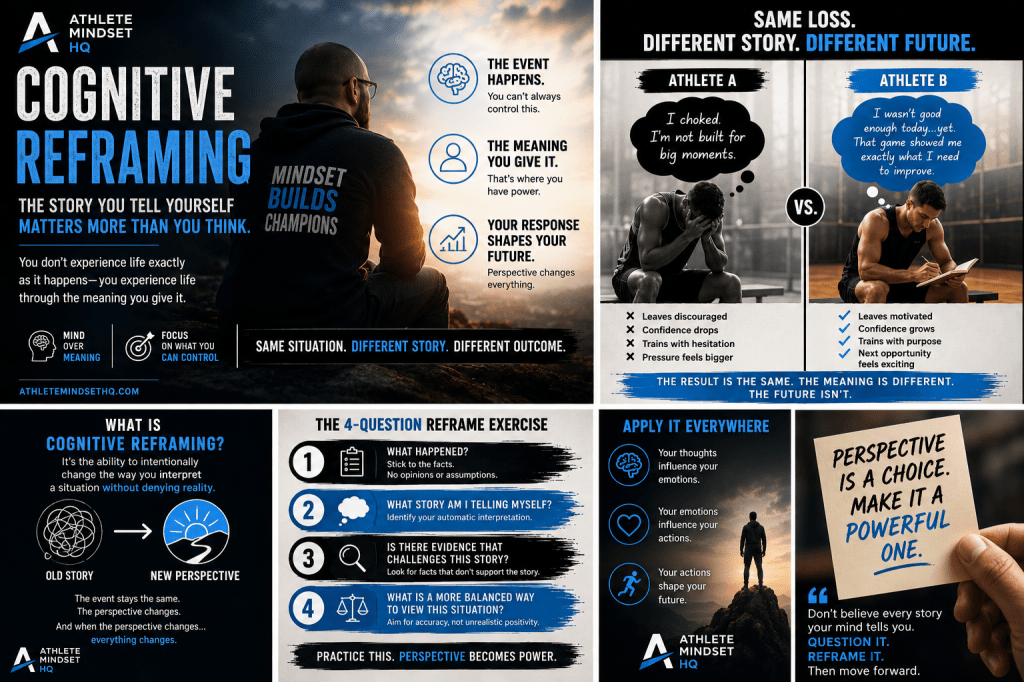
    Cognitive reframing is the ability to intentionally change the way you interpret a situation without denying reality.

    Notice what it isn’t.

    It isn’t pretending everything is fine.

    It isn’t toxic positivity.

    It isn’t convincing yourself something bad is actually good.

    Instead, cognitive reframing asks one simple question:

    “Is there another way to look at this?”

    The event stays the same.

    The perspective changes.

    And when the perspective changes…

    Your emotions change.

    Your behaviors change.

    Your outcomes often change.


    The Brain Believes the Story It Repeats

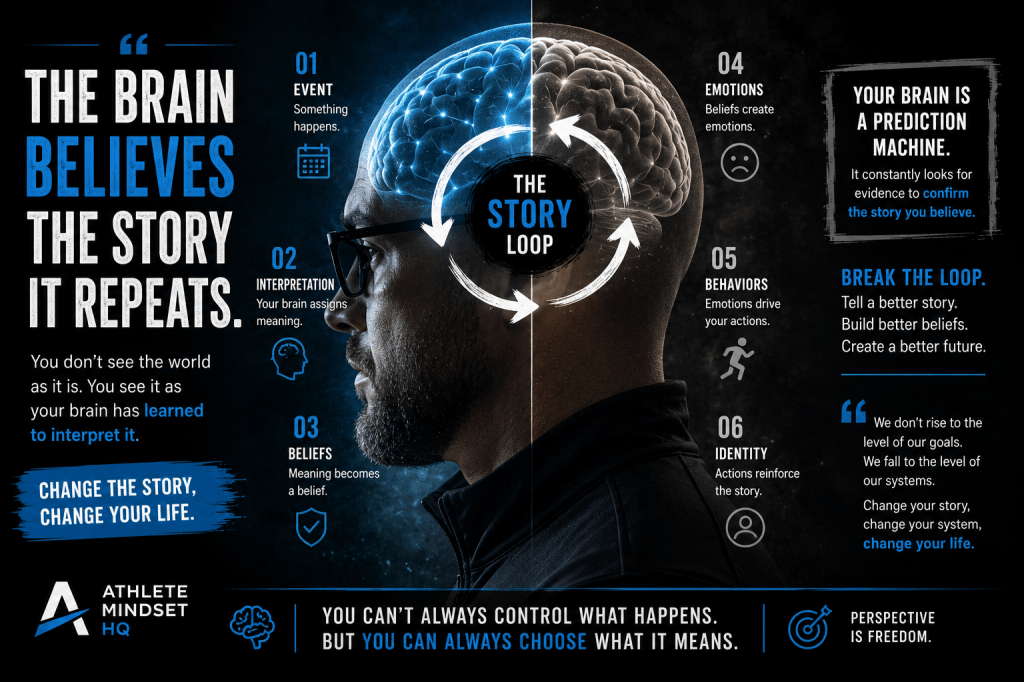
    Our brains are incredible prediction machines.

    When something happens, your brain immediately tries to explain it.

    Those explanations become beliefs.

    Those beliefs influence emotions.

    Those emotions influence behavior.

    Behavior eventually becomes identity.

    It often happens so quickly that we never question the story in the first place.

    Imagine two athletes who both lose a championship game.

    Athlete A says:

    “I choked. I’m not built for big moments.”

    He leaves discouraged.

    His confidence drops.

    He trains with hesitation.

    The next pressure moment feels even bigger.

    Athlete B says:

    “I wasn’t good enough today…yet. That game exposed exactly what I need to improve.”

    Same loss.

    Completely different future.

    Neither athlete changed the result.

    They changed the meaning.


    Reframing Isn’t About Lying to Yourself

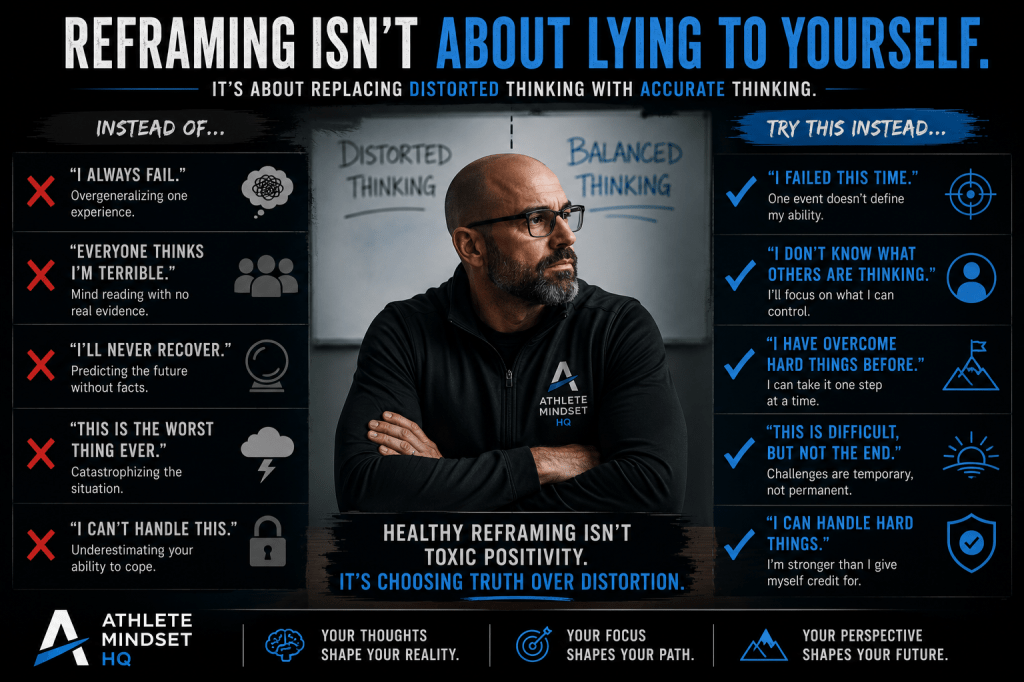
    One of the biggest misconceptions in psychology is that reframing means replacing every negative thought with a positive one.

    That’s not accurate.

    Healthy reframing replaces distorted thinking with accurate thinking.

    Instead of:

    “I always fail.”

    You recognize:

    “I failed this time.”

    Instead of:

    “Everyone thinks I’m terrible.”

    You ask:

    “What evidence do I actually have for that?”

    Instead of:

    “I’ll never recover.”

    You remind yourself:

    “I’ve overcome difficult things before.”

    That’s not optimism.

    That’s perspective.


    Why Athletes Benefit So Much

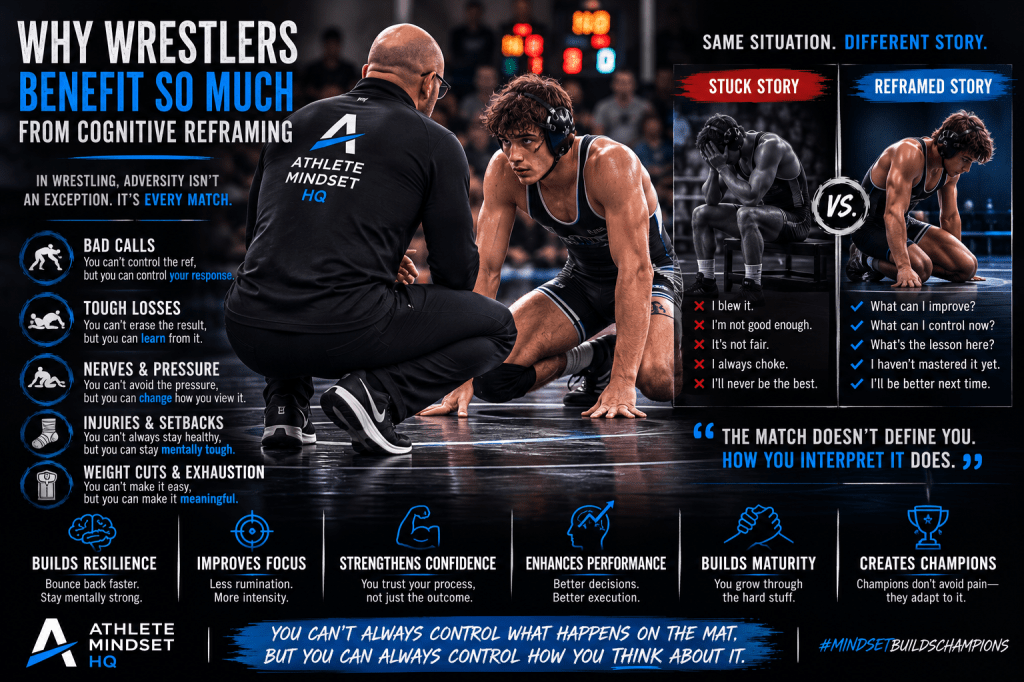
    In sports, mistakes are guaranteed.

    Missed tackles.

    Dropped passes.

    Turnovers.

    Bad calls.

    Injuries.

    Losing streaks.

    Championship losses.

    If athletes attach catastrophic meaning to every setback, performance becomes fragile.

    The best competitors aren’t fearless.

    They’re adaptable.

    Elite performers don’t spend less time facing adversity.

    They spend less time getting stuck in it.

    They learn to ask:

    • What can this teach me?
    • What is still under my control?
    • How do I respond next?
    • What opportunity exists because of this challenge?

    Those questions shift the brain from emotional reaction to intentional action.


    Cognitive Reframing Outside of Sports

    This skill extends far beyond athletics.

    Maybe your child is struggling in school.

    Instead of thinking:

    “I’m failing as a parent.”

    Try asking:

    “What support does my child need right now?”

    Maybe you’re laid off.

    Instead of:

    “My career is over.”

    Consider:

    “What doors does this unexpectedly open?”

    Maybe you’re facing anxiety.

    Instead of:

    “Something is wrong with me.”

    Try:

    “My mind is trying to protect me—even if it’s overestimating the danger.”

    That single shift changes everything.


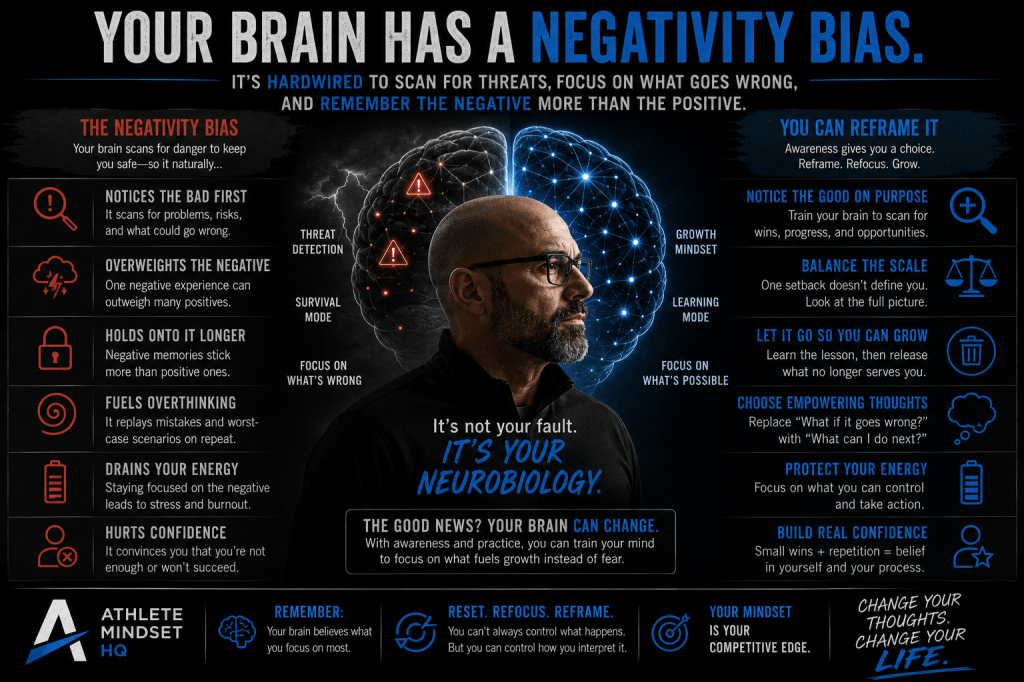
    Your Brain Has a Negativity Bias

    Here’s something important to understand.

    Your brain is designed to notice threats before opportunities.

    Thousands of years ago, that kept humans alive.

    Today?

    It often keeps us anxious.

    We naturally remember criticism longer than compliments.

    Failures longer than successes.

    Embarrassing moments longer than achievements.

    Your brain isn’t broken.

    It’s doing what evolution designed it to do.

    Cognitive reframing teaches your brain to slow down long enough to ask:

    “Is my first interpretation the only interpretation?”

    Usually…

    It isn’t.


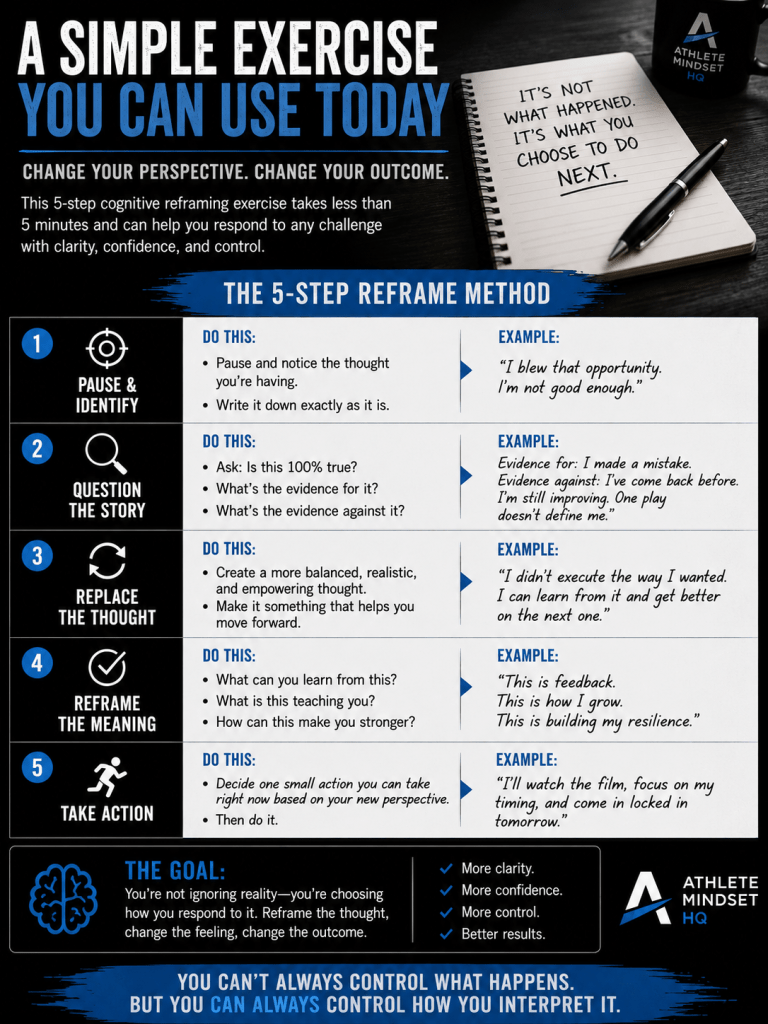
    A Simple Exercise You Can Use Today

    The next time something frustrating happens, write down these four questions.

    1. What happened?

    Just the facts.

    No opinions.

    No assumptions.

    2. What story am I telling myself?

    This is where you’ll discover your automatic interpretation.

    3. Is there evidence that challenges this story?

    Most of the time, there is.

    4. What is a more balanced way to view this situation?

    Not unrealistically positive.

    Simply more accurate.

    Practice this consistently, and you’ll begin catching negative thought patterns before they become negative identities.


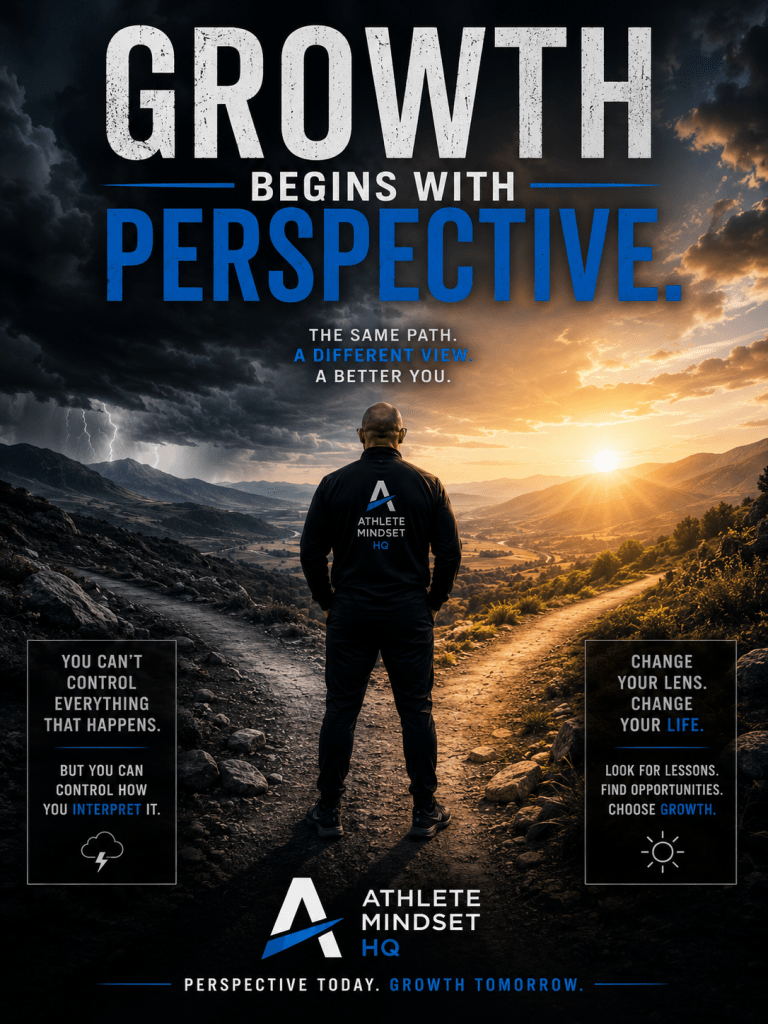
    Growth Begins With Perspective

    Some of the strongest people I’ve ever met weren’t the ones who avoided hardship.

    They were the ones who learned to reinterpret hardship.

    Failure became feedback.

    Criticism became information.

    Pressure became privilege.

    Setbacks became preparation.

    Adversity became opportunity.

    The circumstance didn’t always change.

    But the meaning did.

    And that changed everything.


    Final Thoughts

    Life will continue throwing obstacles in your path.

    That’s inevitable.

    What isn’t inevitable is the story you choose to tell yourself afterward.

    Your thoughts influence your emotions.

    Your emotions influence your actions.

    Your actions shape your future.

    So the next time life doesn’t go according to plan, pause before accepting your first interpretation as truth.

    Ask yourself:

    “Is there another way to see this?”

    That single question may become the difference between staying stuck and moving forward.

    Because sometimes the most powerful change you can make isn’t changing your circumstances—

    it’s changing the lens through which you see them.

    At Athlete Mindset HQ, we believe mental strength isn’t about avoiding adversity. It’s about developing the skills to face it with clarity, resilience, and purpose. Cognitive reframing is one of those skills—and it’s one that can transform not only how you perform, but how you live.

    About John J. Schessler, M.S.

    John J. Schessler, M.S., is a Mental Performance Coach, Behavior Interventionist, speaker, and founder of Athlete Mindset HQ—a high-performance coaching platform dedicated to helping athletes, professionals, and everyday individuals develop the mindset needed to thrive under pressure and perform at their highest potential.

    John earned his Master of Science in Sport Psychology from Capella University and his Bachelor of Arts in Child & Adolescent Psychology from Southern New Hampshire University. His work bridges the gap between psychology, human performance, behavioral science, and personal development, combining evidence-based strategies with practical coaching that people can immediately apply in sport, work, and everyday life.

    His passion for helping others is rooted in his own journey. As a child, John survived Guillain-Barré Syndrome, spending weeks in a coma before fighting through rehabilitation to reclaim his life. That experience shaped his belief that resilience isn’t something you’re born with—it’s something you build through adversity, discipline, and purpose.

    Today, John works with individuals from all walks of life, helping them strengthen confidence, improve emotional resilience, overcome obstacles, and develop the habits that lead to lasting success. Whether coaching athletes, mentoring students, speaking to organizations, or creating educational content, his mission remains the same: to help people become mentally stronger than the challenges they face.

    John is also the host of The Follow Through Podcast, where he explores sports psychology, leadership, men’s mental health, motivation, resilience, and human performance through practical conversations that inspire listeners to move beyond intention and into action.

    His philosophy is simple:

    Mental strength isn’t about never struggling. It’s about developing the confidence, discipline, and resilience to keep moving forward—especially when life gets difficult.

    Because success isn’t built by what you intend to do.

    It’s built by what you follow through on.
    #sportspsychology #rebuildyourlife #athletemindsethq #mentalperformance #moveforward

  • By John J. Schessler Jr., M.S.

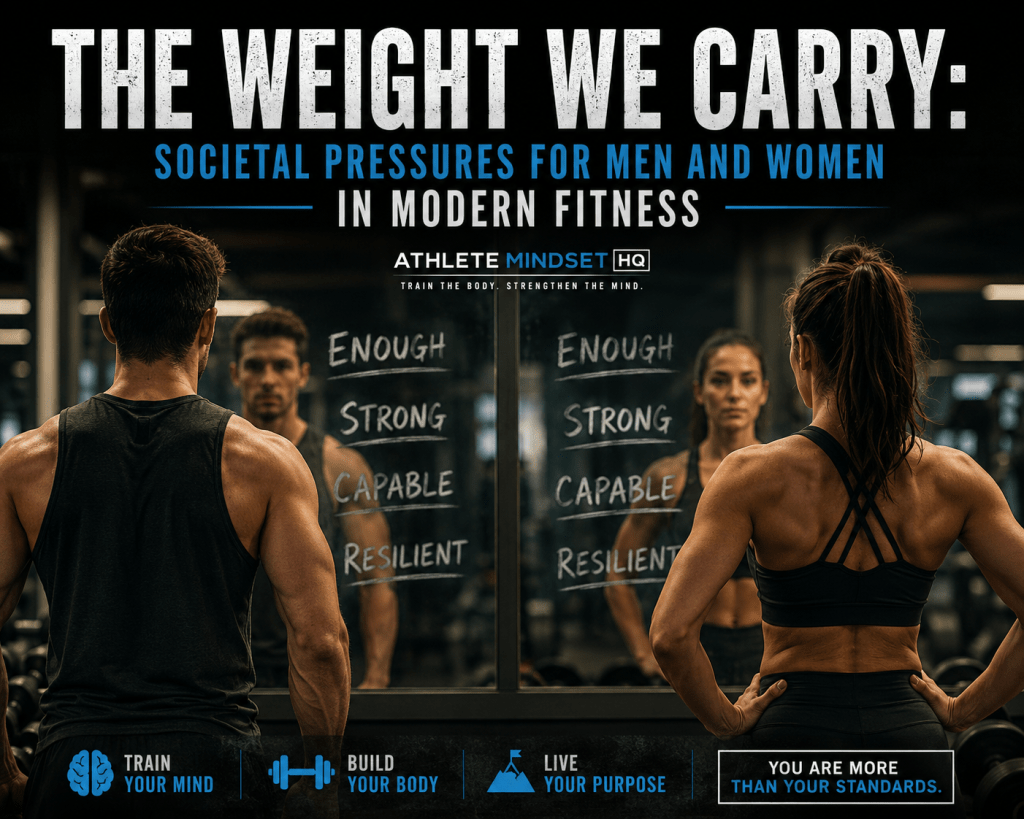
    Walk into almost any gym today, scroll through social media for five minutes, or open your favorite fitness app, and you’ll notice something.

    Everyone is chasing an ideal.

    For some, it’s six-pack abs. For others, it’s a smaller waist, bigger glutes, broader shoulders, or an impossibly lean physique that seems effortless. The fitness industry has never had more information, more technology, or more opportunities to improve our health. Yet, despite all of these advances, many people have never felt worse about their bodies.

    The question isn’t whether societal pressure exists.

    The question is whether we’re allowing it to define our worth.

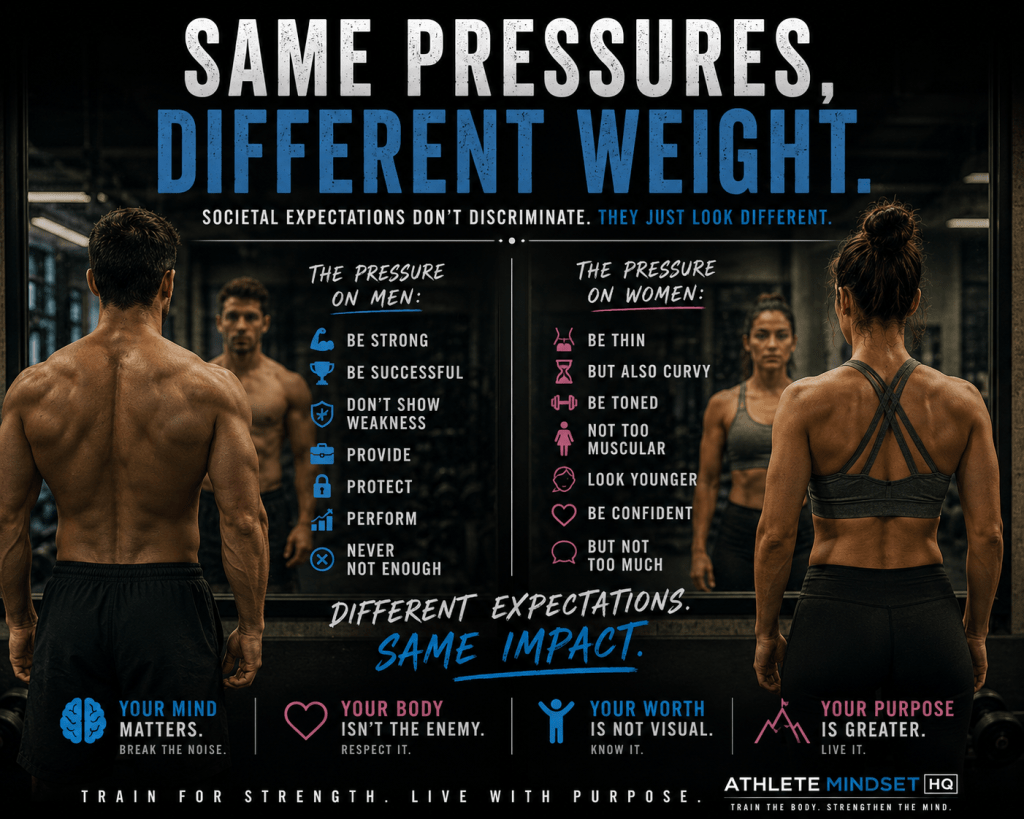
    Different Pressures, Same Weight

    Men and women often experience different expectations, but the emotional burden is remarkably similar.

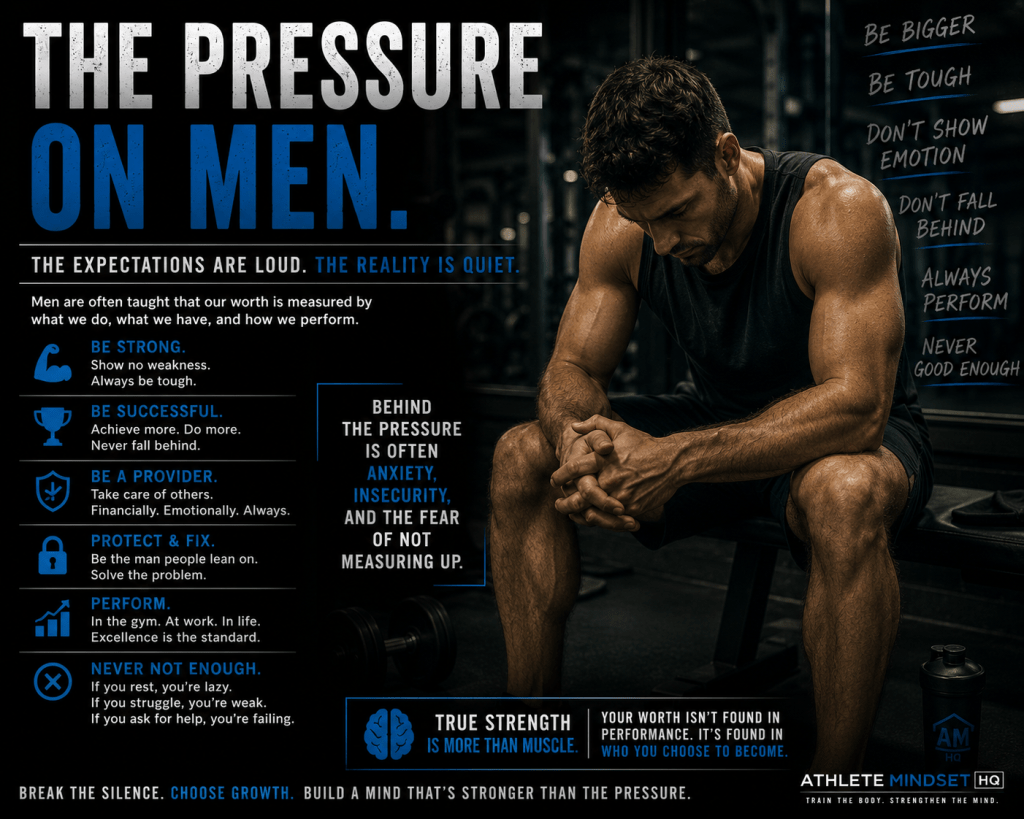
    The Pressure on Men

    Men are frequently taught that strength equals value.

    Be muscular.

    Be confident.

    Never show weakness.

    Always be productive.

    Provide.

    Protect.

    Perform.

    The message is subtle but constant: if you’re not getting bigger, stronger, richer, or more successful, you’re falling behind.

    Many men begin lifting weights because they want to improve their health. Somewhere along the way, that healthy goal can become an obsession with looking “big enough.”

    Social media only amplifies the comparison.

    Every scroll showcases professional lighting, perfect angles, enhanced physiques, filters, and sometimes performance-enhancing drugs presented as “hard work.” Young men compare themselves to unrealistic images, wondering why years of dedication don’t produce the same results.

    Behind many impressive physiques are anxiety, body dysmorphia, restrictive eating, overtraining, poor self-esteem, or the constant fear of not measuring up.

    Strength should build confidence—not become the source of insecurity.

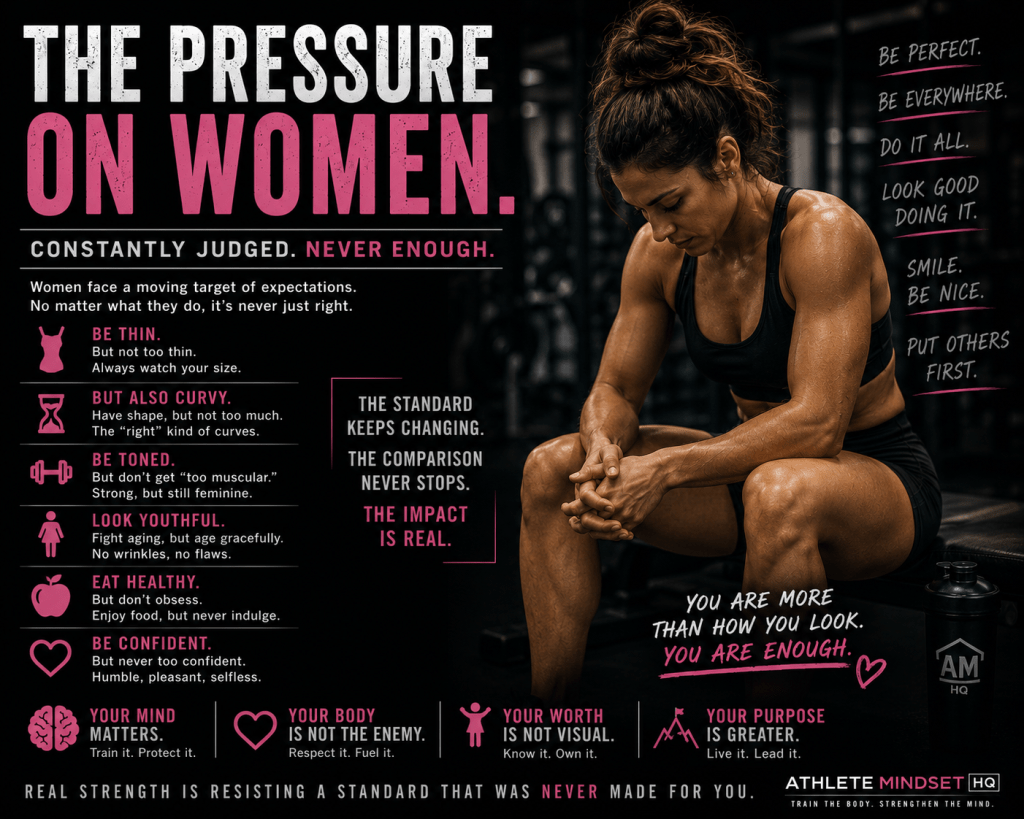
    The Pressure on Women

    Women often face a different—but equally exhausting—set of expectations.

    Be thin.

    But also be curvy.

    Be toned.

    Don’t get “too muscular.”

    Look youthful.

    Age gracefully.

    Eat healthy—but don’t obsess.

    Be confident—but stay humble.

    The standard seems to change every few years.

    One decade celebrates ultra-thin physiques.

    The next celebrates curves.

    Then athletic bodies.

    Then “clean girl” aesthetics.

    The target keeps moving, leaving many women feeling like they’re constantly chasing an impossible finish line.

    It’s no surprise that many women develop an unhealthy relationship with exercise—not because they dislike movement, but because every workout feels tied to appearance instead of health.

    Exercise becomes punishment instead of celebration.

    Food becomes guilt instead of fuel.

    The body becomes something to fix instead of something to appreciate.

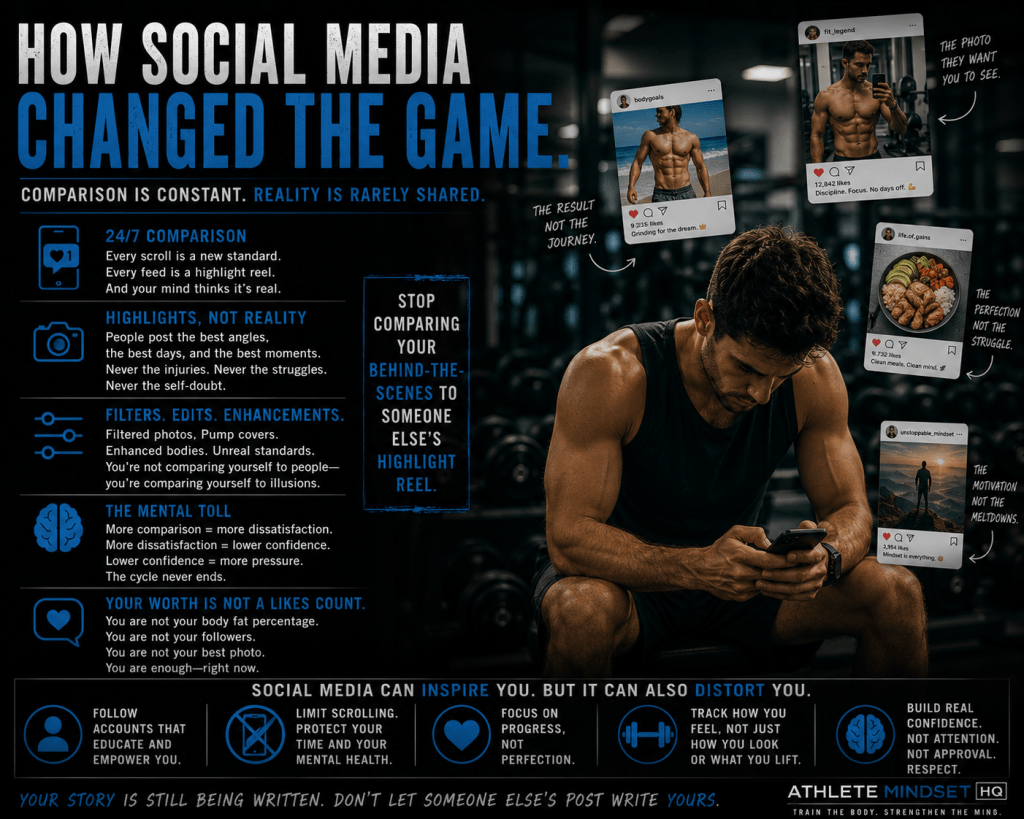
    Social Media Changed the Game

    Comparison has always existed.

    Today, it’s available 24 hours a day.

    Algorithms reward perfection.

    People post highlights, not struggles.

    They share transformations, not setbacks.

    They celebrate victories while hiding injuries, burnout, failed diets, and the countless ordinary days in between.

    We compare our behind-the-scenes reality to someone else’s carefully edited highlight reel.

    That isn’t motivation.

    That’s a recipe for chronic dissatisfaction.

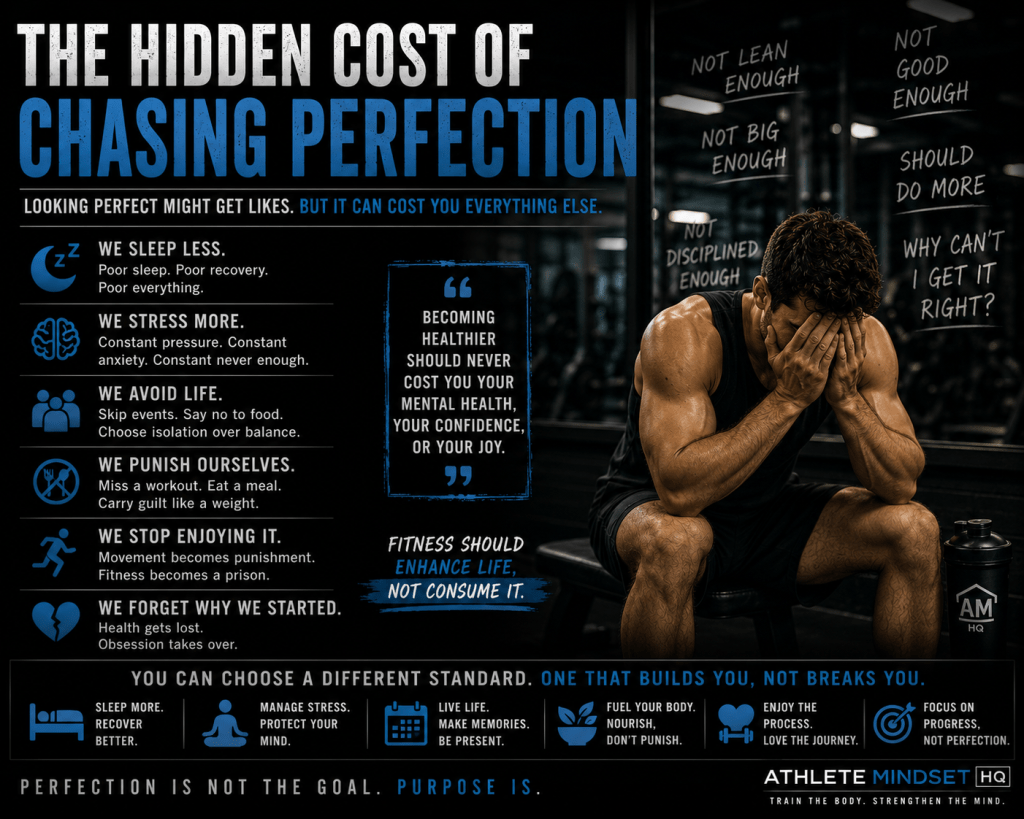
    The Hidden Cost of Chasing Perfection

    When appearance becomes our primary goal, we often sacrifice the very things fitness was supposed to improve.

    We sleep less.

    We stress more.

    We avoid social events because of food.

    We punish ourselves after eating.

    We stop enjoying movement.

    We forget why we started.

    Ironically, becoming healthier can begin to make us mentally less healthy.

    Fitness should enhance life—not consume it.

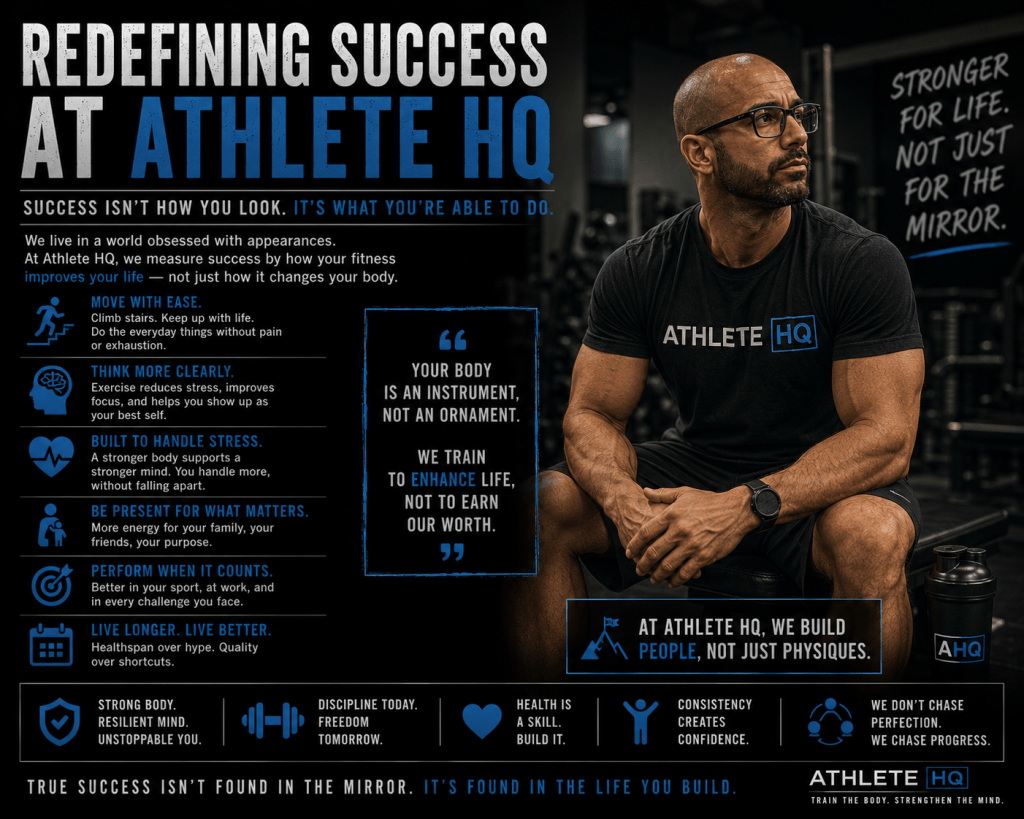
    Redefining Success

    At Athlete Mindset HQ, I believe fitness should first answer one simple question:

    What does this allow you to do?

    Can you play with your kids without getting winded?

    Can you climb stairs comfortably?

    Can you recover from stress more effectively?

    Can you perform better in your sport?

    Can you think more clearly?

    Can you live longer and feel better doing it?

    Those outcomes matter far more than whether your abs show in perfect lighting.

    Your body is an instrument—not an ornament.

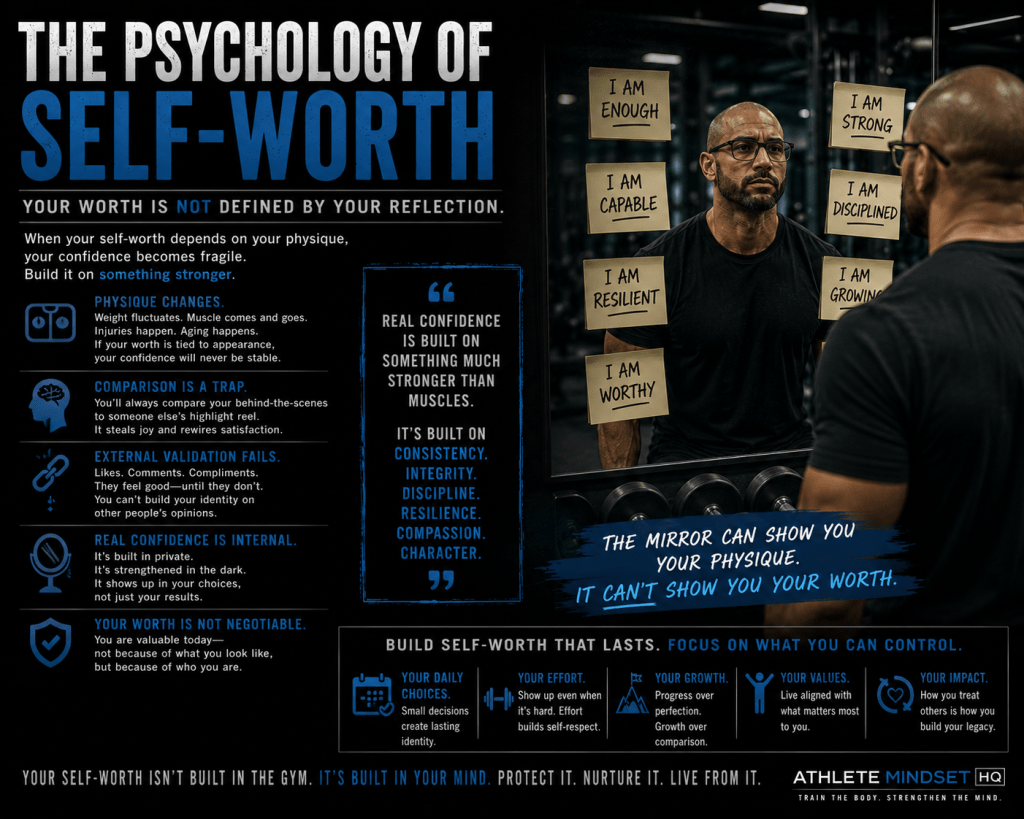
    The Psychology of Self-Worth

    One of the most dangerous beliefs we can adopt is attaching our value to our appearance.

    When our identity depends entirely on how we look, confidence becomes fragile.

    Gain five pounds?

    Confidence drops.

    Miss the gym for a week?

    You feel like a failure.

    Get injured?

    Your identity crumbles.

    Real confidence is built on something much stronger.

    It’s built through consistency.

    Integrity.

    Discipline.

    Resilience.

    Compassion.

    Character.

    These qualities don’t disappear when your physique changes.

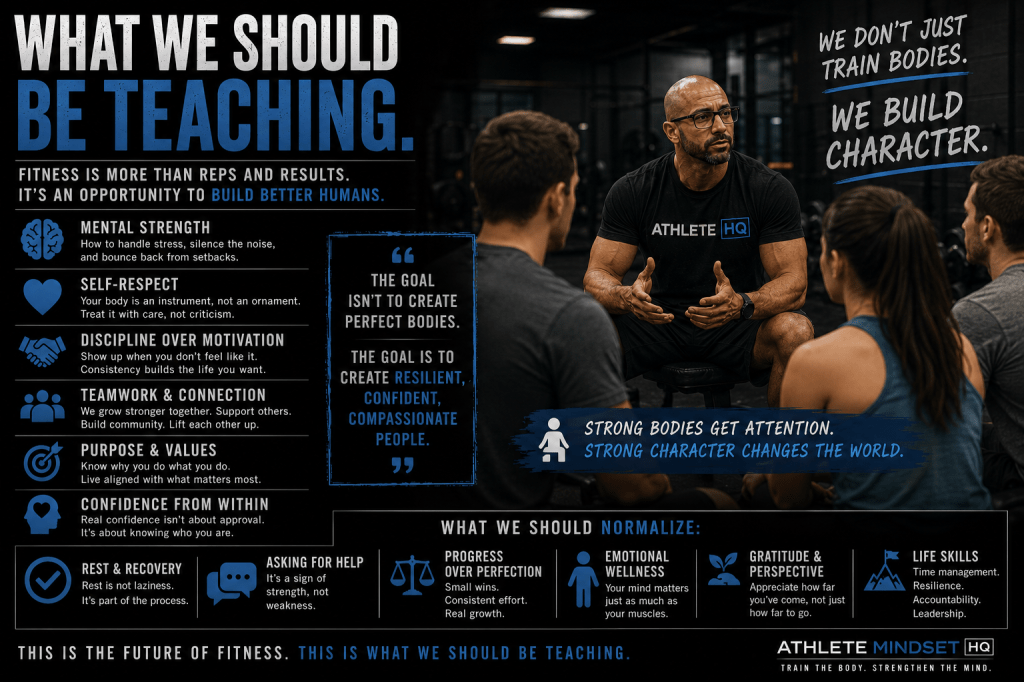
    What We Should Be Teaching

    Imagine if we praised effort as much as aesthetics.

    Imagine complimenting someone’s discipline before their abs.

    Imagine celebrating consistency instead of perfection.

    Imagine teaching children that movement is something to enjoy—not something to earn.

    The healthiest people I know aren’t obsessed with looking perfect.

    They’re committed to feeling capable.

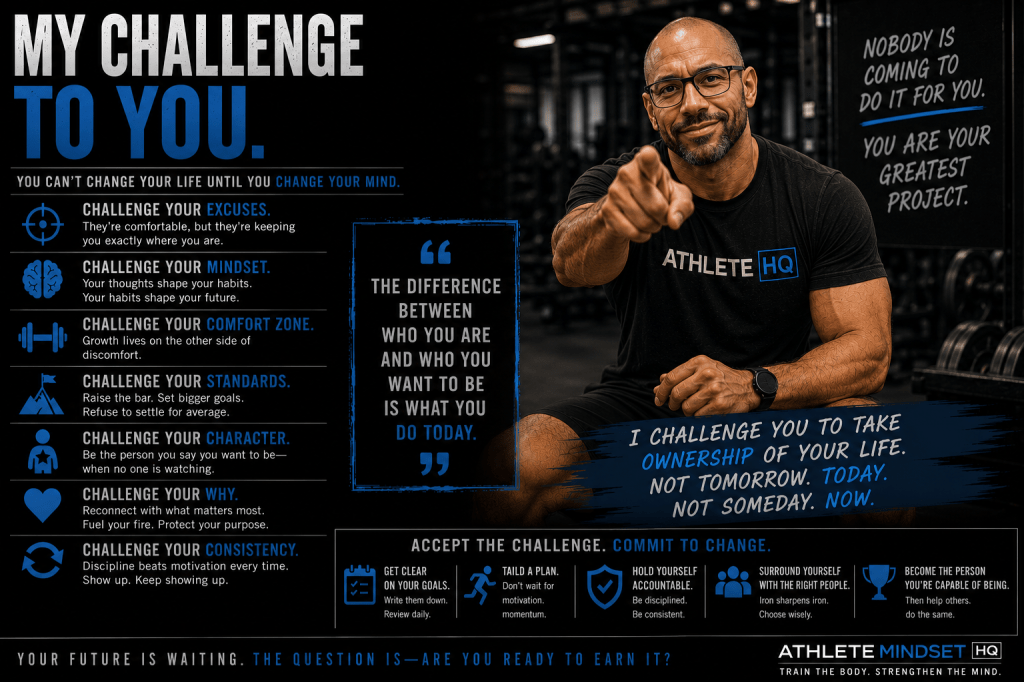
    My Challenge to You

    The next time you step into the gym, ask yourself one question:

    Am I training because I love my body—or because I hate it?

    That single question can completely change your relationship with fitness.

    Move because your body deserves care.

    Eat because your body deserves fuel.

    Rest because your body deserves recovery.

    Grow because your future self deserves your effort.

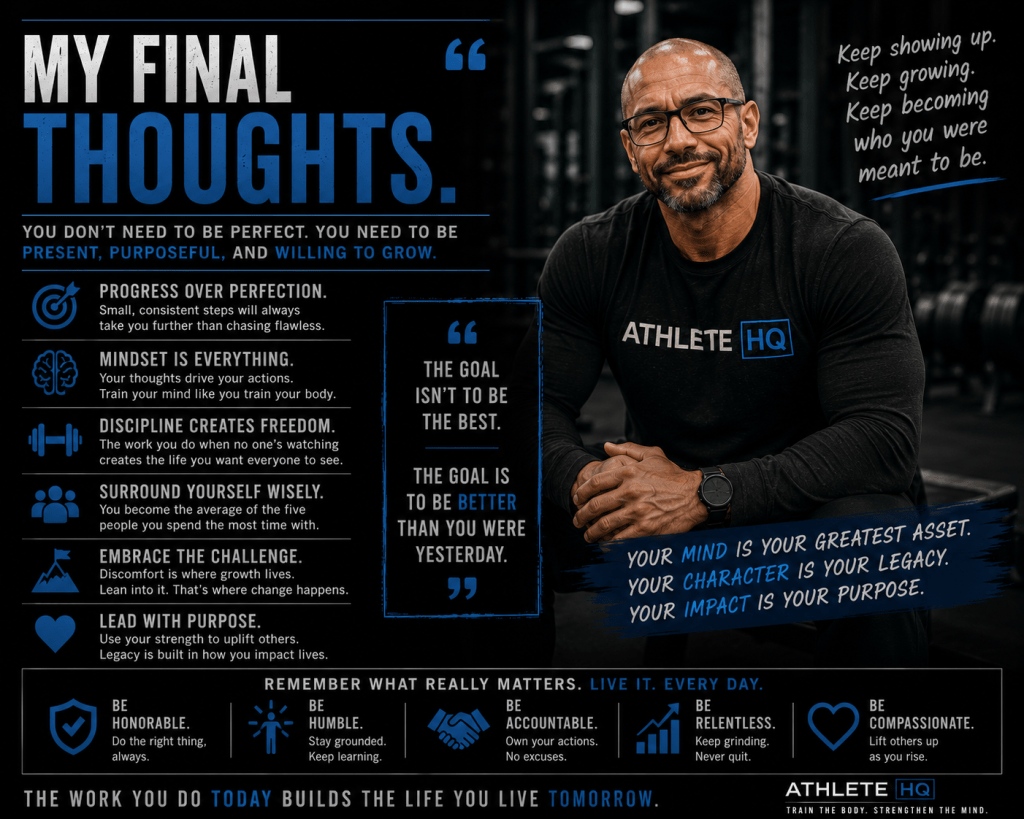
    Final Thoughts

    The mirror can tell you what you look like.

    It cannot tell you your worth.

    Your value isn’t measured by body fat percentage, clothing size, bench press numbers, or the opinions of strangers online.

    Fitness should never become another prison built from unrealistic expectations.

    It should become one of the greatest expressions of self-respect.

    Train hard.

    Take care of yourself.

    Support others.

    And remember…

    The strongest people aren’t always the ones with the biggest muscles.

    They’re the ones who know their worth long before anyone notices their physique.


    About John J. Schessler, M.S.

    John J. Schessler, M.S. is a Human Performance Specialist, Behavior Interventionist, speaker, and founder of Athlete Mindset HQ, a high-performance platform dedicated to helping people become the strongest version of themselves—mentally, emotionally, and physically.

    John earned his Master of Science in Sport Psychology from Capella University and his Bachelor of Arts in Child & Adolescent Psychology from Southern New Hampshire University. His work combines evidence-based psychology with practical coaching to help athletes, students, professionals, and individuals facing life’s challenges develop resilience, confidence, discipline, and lasting mental strength.

    His passion for this work is deeply personal. Having overcome significant adversity early in life, John understands that real strength isn’t measured by what happens to us—it’s measured by how we respond. That perspective shapes every conversation, coaching session, presentation, and piece of content he creates.

    Through Athlete Mindset HQ and The Follow Through Podcast, John shares practical strategies, meaningful conversations, and real-world tools that empower people to perform at their best—not only in competition, but in everyday life. Whether discussing sports psychology, behavioral health, leadership, men’s mental health, or personal growth, his goal remains the same: to educate, encourage, and equip others with the mindset needed to overcome obstacles and pursue excellence with purpose.

    Because success isn’t built by what you intend to do.

    It’s built by what you follow through on.
    #sportspsychology #athletemindsethq @thefollowthroughpodcast @athletemindsethq #behavioralhealth #personalgrowth #mensmentalhealth #womensmentalhealth


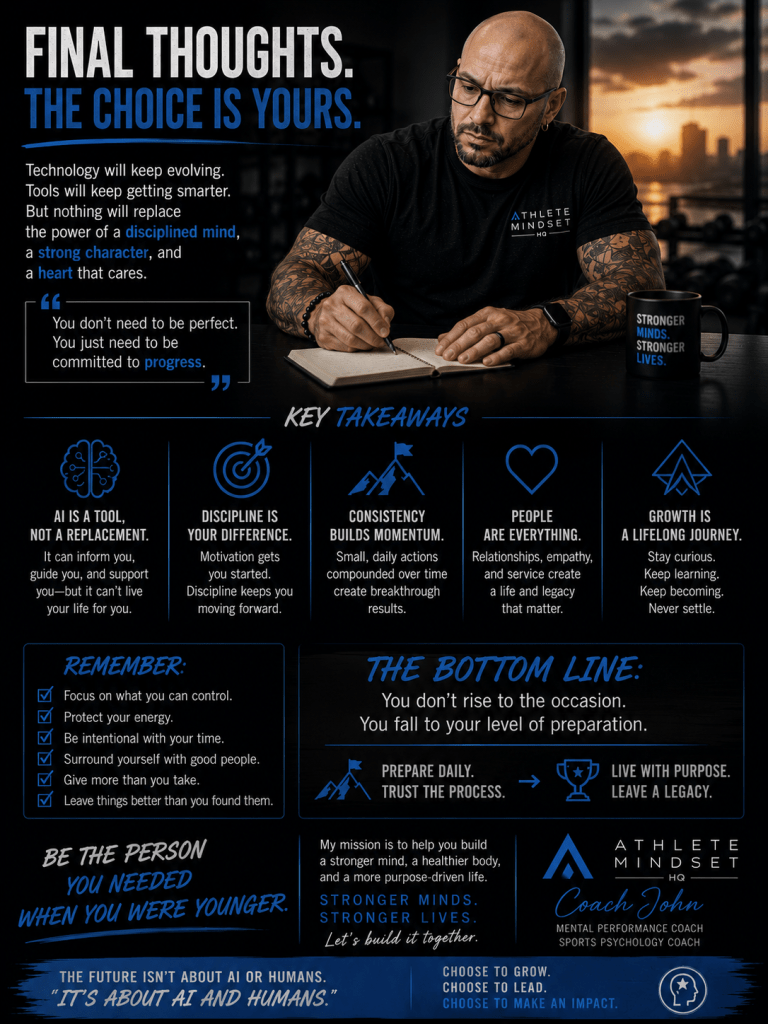
  • “The future of fitness won’t belong to those who fear AI. It will belong to those who know how to use it wisely.”

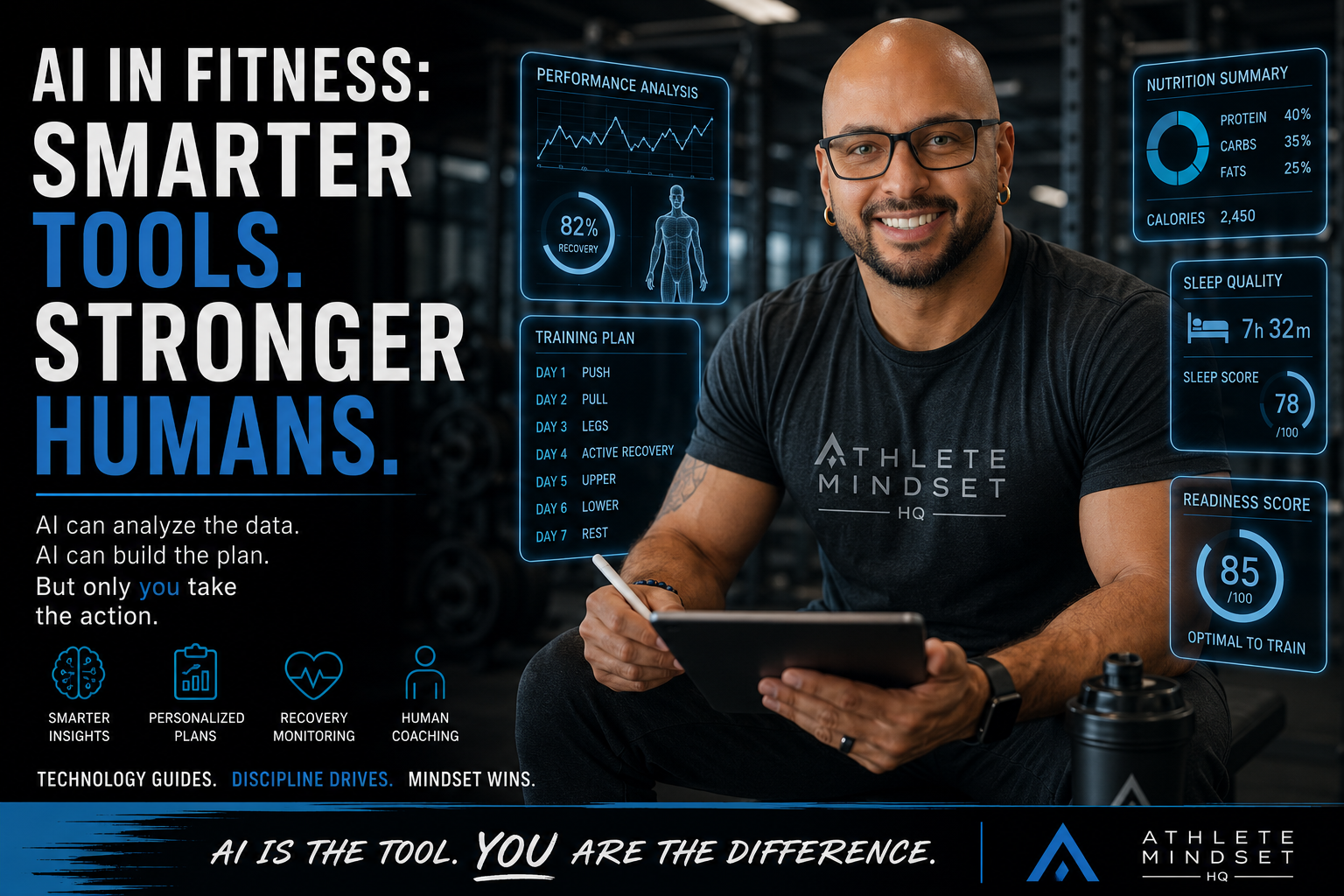
    Walk into almost any gym today, and you’ll hear someone talking about artificial intelligence.

    AI is writing workout programs.
    AI is counting calories.
    AI is analyzing form.
    AI is predicting recovery.
    AI is creating meal plans.
    AI is answering health questions in seconds.

    It’s everywhere.

    Some coaches see it as a threat.

    Others see it as the future.

    I believe they’re both partially right.

    The question isn’t whether AI belongs in fitness.

    The real question is whether we’re using it to become healthier—or simply more dependent.


    AI Isn’t Replacing Coaches…

    It’s Replacing Guesswork.

    For decades, fitness has been plagued by misinformation.

    One magazine says carbs are evil.

    Another says fat is the enemy.

    One influencer tells you to squat every day.

    Another says never squat at all.

    The average person has been drowning in conflicting advice for years.

    AI has changed that.

    Within seconds, it can explain:

    • Exercise technique
    • Nutrition science
    • Progressive overload
    • Recovery strategies
    • Mobility routines
    • Injury prevention
    • Sleep optimization

    Instead of spending hours searching random websites, people can receive evidence-informed guidance almost instantly.

    That is incredibly powerful.

    Knowledge has never been more accessible.


    Personalized Fitness Is Finally Possible

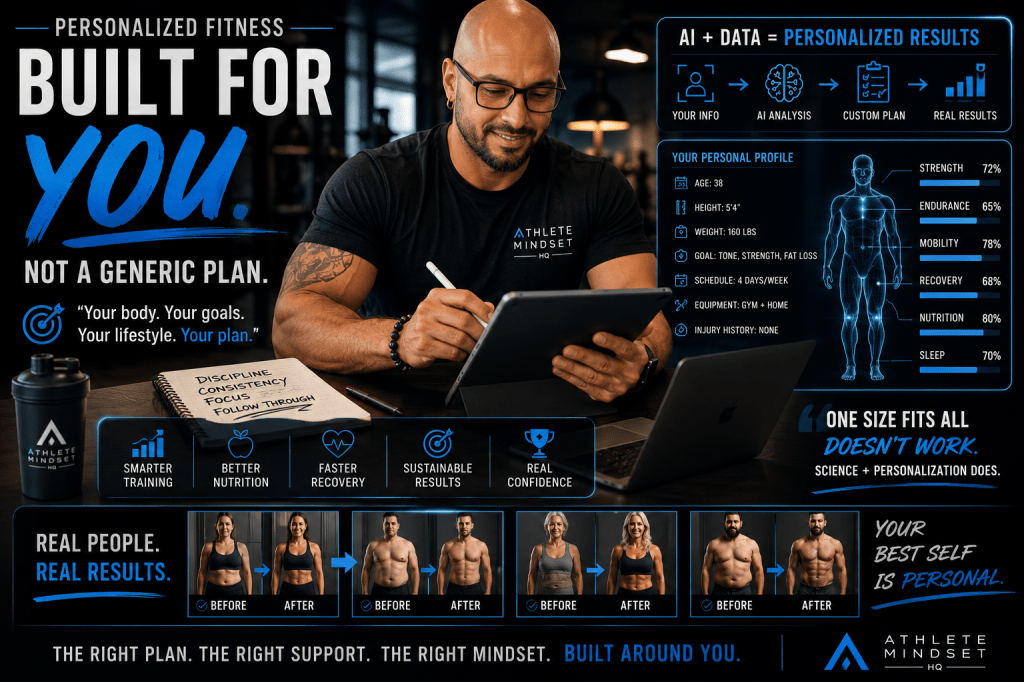
    One of AI’s greatest strengths is personalization.

    Imagine entering:

    • Age
    • Height
    • Weight
    • Medical history
    • Injuries
    • Goals
    • Available equipment
    • Training schedule
    • Food preferences
    • Sleep habits

    Within moments, AI can generate a customized starting point.

    Not a generic “beach body workout.”

    Not a celebrity routine.

    Not an influencer’s favorite exercises.

    Something built specifically for you.

    That has enormous potential to help beginners who often feel overwhelmed by where to start.


    AI Can Help Coaches Become Better Coaches

    This may surprise people…

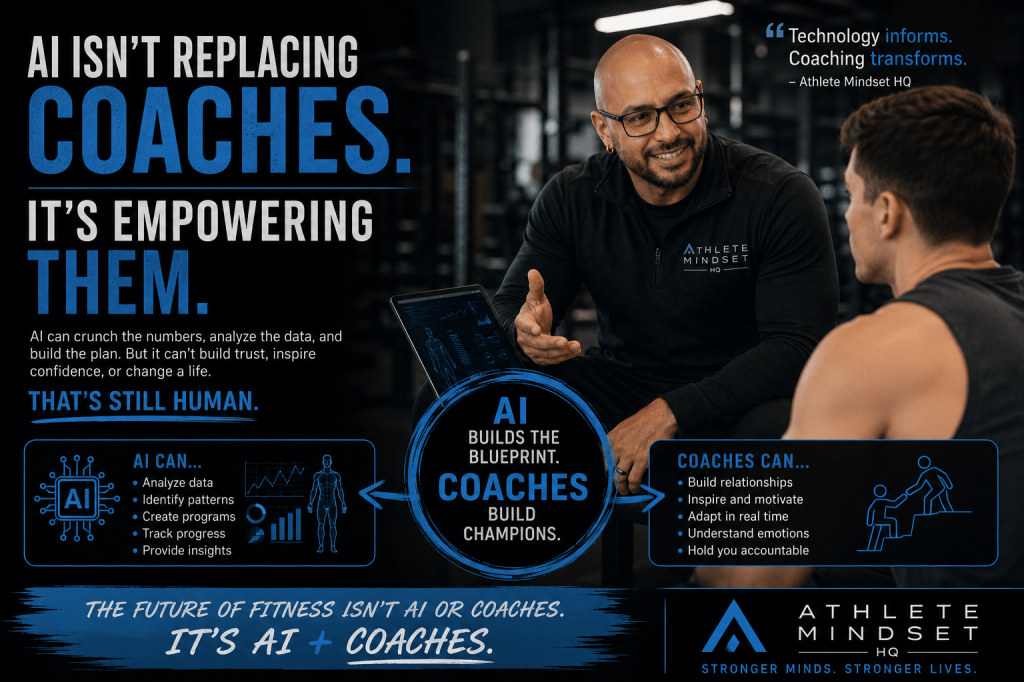
    I don’t think AI replaces great trainers.

    I think it makes them better.

    Instead of spending hours formatting workout programs…

    Writing emails…

    Creating nutrition guides…

    Analyzing spreadsheets…

    Or building educational materials…

    Coaches can spend more time doing what matters most:

    Helping people.

    Listening.

    Motivating.

    Teaching.

    Encouraging.

    Holding clients accountable.

    Technology should remove busy work—not human connection.


    Data Is Becoming Smarter

    Wearable technology has exploded.

    Smart watches.

    Heart-rate monitors.

    Sleep trackers.

    Recovery scores.

    VO₂ estimates.

    Blood glucose monitors.

    Daily readiness scores.

    AI can combine these data points and identify trends that humans might overlook.

    Maybe your recovery is consistently poor after less than six hours of sleep.

    Maybe your resting heart rate spikes before you feel sick.

    Maybe your strength decreases after several consecutive stressful workdays.

    Those patterns become easier to recognize with AI-powered analysis.

    When used responsibly, this allows for smarter training decisions.


    The Danger of Blindly Trusting AI

    Here’s where things become more complicated.

    AI is incredibly intelligent.

    But it is not infallible.

    It doesn’t watch you move.

    It doesn’t hear your breathing during a heavy set.

    It doesn’t notice your shoulder compensating because of an old injury.

    It doesn’t know when you’re emotionally exhausted.

    It doesn’t recognize the fear someone has walking into a gym for the very first time.

    It processes information.

    It doesn’t truly experience people.

    That difference matters.

    Blindly following AI without critical thinking can lead to poor exercise selection, unrealistic expectations, or advice that doesn’t fit your unique situation.

    Technology should inform your decisions—not make them for you.


    Motivation Cannot Be Automated

    The hardest part of fitness has never been writing a workout.

    It’s showing up.

    Anyone can generate a perfect program.

    Very few people consistently follow one.

    That’s because success isn’t built on information.

    It’s built on behavior.

    Habits.

    Identity.

    Confidence.

    Purpose.

    Resilience.

    No chatbot can look someone in the eyes after they’ve failed for the tenth time and convince them they’re capable of trying again.

    No algorithm can replace genuine belief in another human being.

    That is where coaching will always matter.


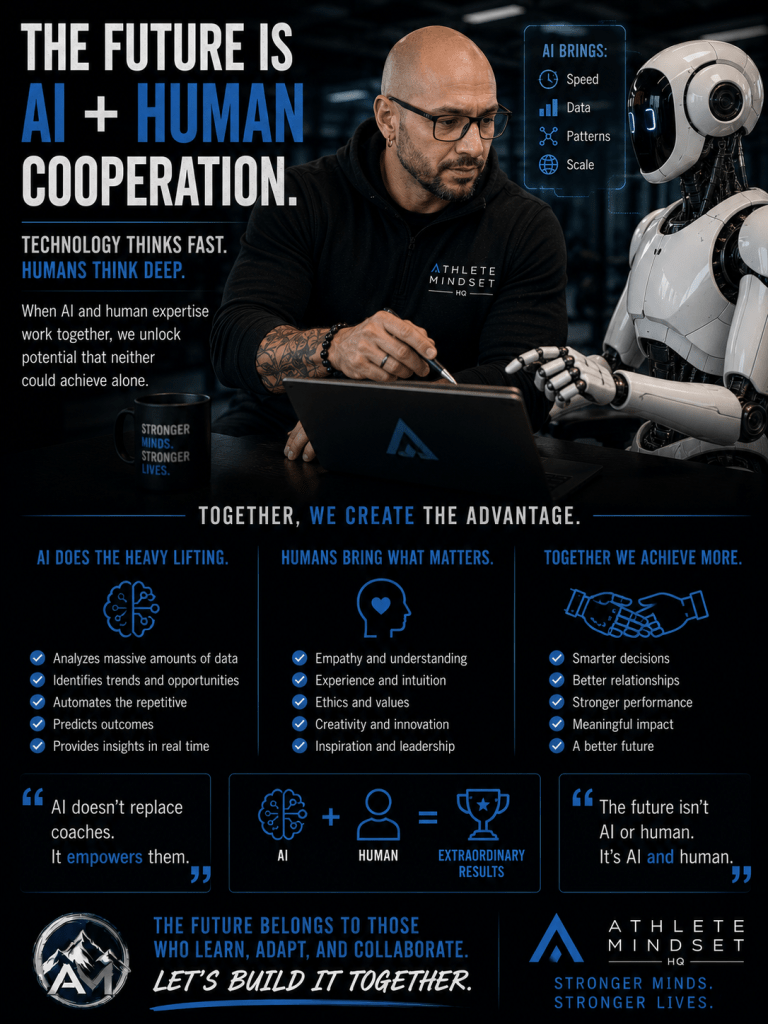
    The Future Is Human + AI

    The best coaches won’t compete against AI.

    They’ll collaborate with it.

    Imagine a coach who can instantly research new scientific findings.

    Create customized training plans in minutes.

    Monitor recovery trends.

    Generate educational resources.

    Spend less time behind a computer.

    Spend more time changing lives.

    That’s the future I hope we build.

    One where technology amplifies human expertise rather than replaces it.


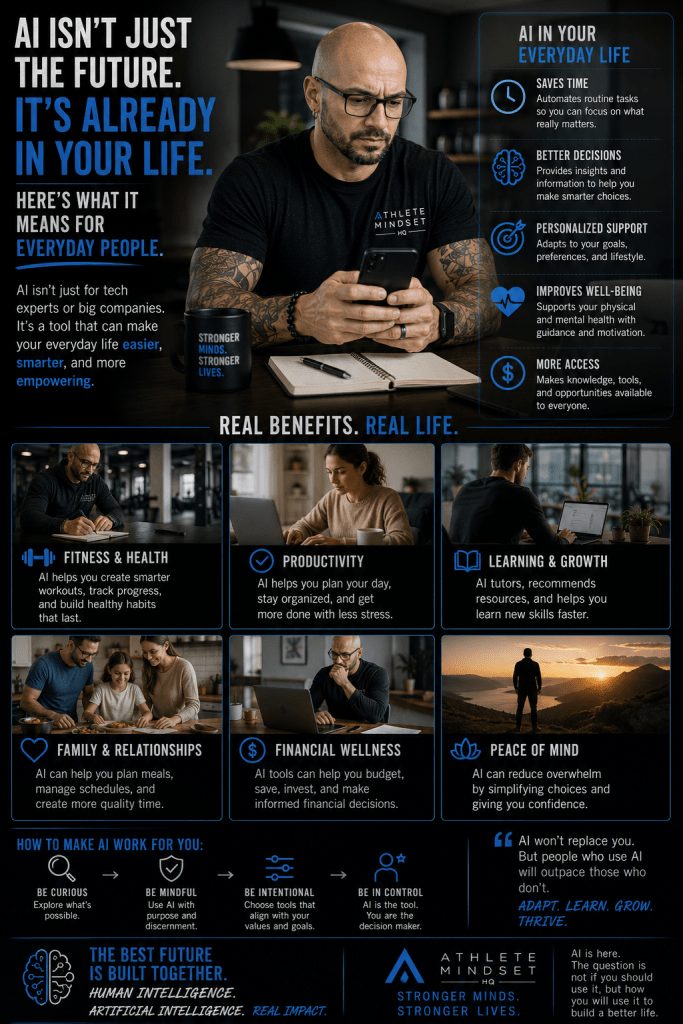
    What This Means for Everyday People

    If you’re someone trying to improve your health, AI can be an incredible resource.

    Use it to:

    • Learn proper exercise technique.
    • Understand nutrition.
    • Build structured workout plans.
    • Track progress.
    • Stay organized.
    • Explore new ideas.

    But don’t let AI become your only source of truth.

    Ask questions.

    Seek qualified professionals.

    Listen to your body.

    Remember that health isn’t just data—it’s also experience, emotion, and context.


    My Philosophy

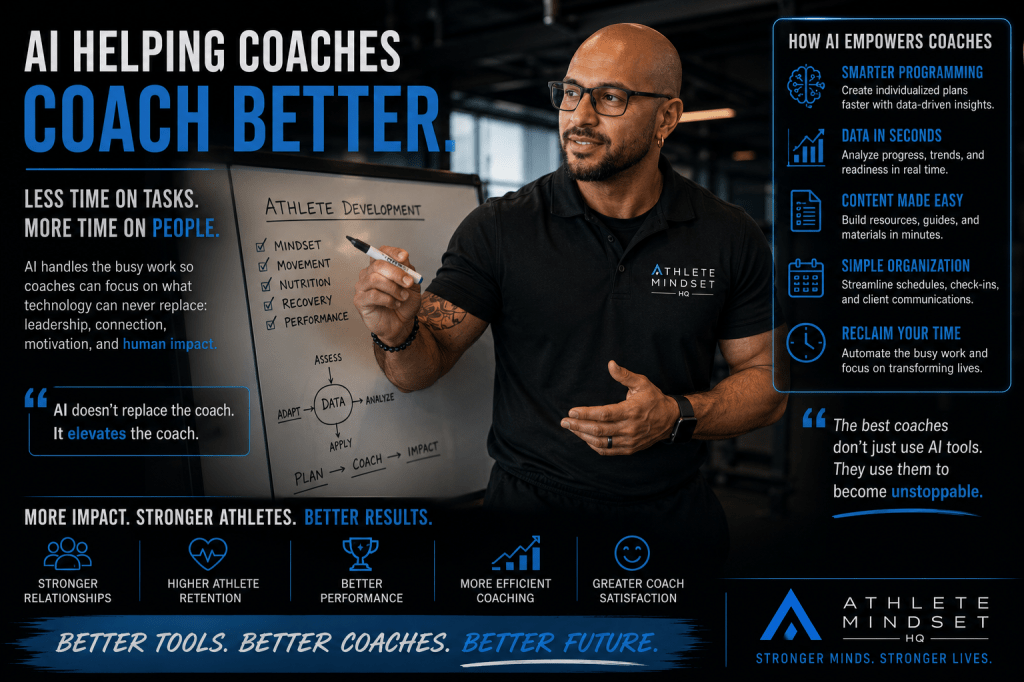
    As someone passionate about mental performance, psychology, and fitness, I see AI the same way I see a barbell.

    A barbell is just a tool.

    In the right hands, it builds strength.

    In the wrong hands, it causes injury.

    Artificial intelligence is no different.

    Used wisely, it can educate, motivate, and accelerate progress.

    Used carelessly, it can create confusion, unrealistic expectations, and overconfidence.

    The goal shouldn’t be to replace coaches with machines.

    The goal should be to empower coaches—and the people they serve—with better tools.


    Final Thoughts

    Fitness has always evolved.

    We moved from handwritten workout logs to smartphone apps.

    From stopwatches to GPS watches.

    From paper nutrition journals to calorie-tracking software.

    Artificial intelligence is simply the next evolution.

    It isn’t the future of fitness by itself.

    People are.

    AI may provide the roadmap.

    But discipline walks the path.

    Consistency keeps moving.

    And character determines where the journey ends.

    Because at the end of the day, no technology can do your push-ups, lift your weights, prepare your meals, or choose your mindset.

    That part will always belong to you.


    About the Author

    John J. Schessler Jr., M.S., CMT, SPC is the founder of Athlete Mindset HQ, a human performance platform dedicated to helping athletes, coaches, leaders, and everyday people become the strongest version of themselves—physically, mentally, and emotionally.

    With a Master’s degree in Sports Psychology, a background in Child & Adolescent Psychology, and more than two decades of experience in coaching, education, fitness, and behavioral development, John combines evidence-based science with practical strategies that people can actually use.

    His work goes far beyond motivation. Through articles, videos, coaching, and public speaking, he explores the psychology behind confidence, resilience, discipline, leadership, mental toughness, men’s mental health, performance, and long-term personal growth.

    John believes that lasting transformation isn’t built through shortcuts or hype. It’s built through consistent action, meaningful relationships, and learning how the mind and body work together.

    Whether he’s discussing sports psychology, artificial intelligence in fitness, human behavior, or the science of peak performance, his mission remains the same:

    Help people think better, live healthier, and perform at their highest potential.

    When he’s not coaching or creating content, John continues researching emerging topics in psychology, neuroscience, performance science, and technology to bring readers practical insights they can apply immediately.


    Athlete Mindset HQ

    Stronger Minds. Stronger Lives.

    Helping athletes, coaches, and everyday people unlock their potential through psychology, performance science, fitness, and purposeful living.

    #athletemindsethq #johnschesslerjr #aiinfitnesscoaching #transformationmindset #physicaltraining #development #selfefficacy #maslowshierarchy

  • Untitled post 2248

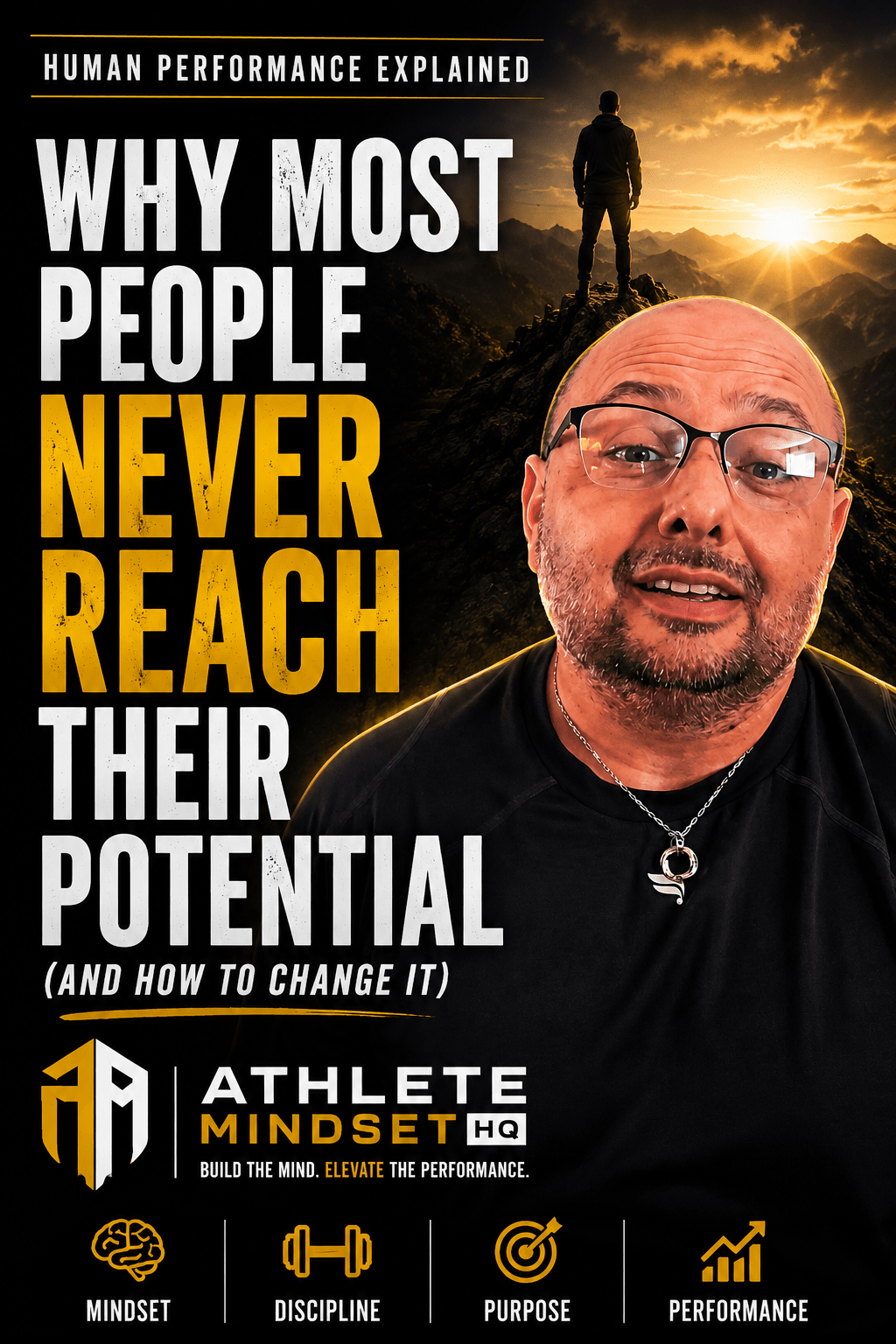
    🎥 NEW SERIES PREMIERE: Human Performance Explained

    Why do some people seem to thrive while others stay stuck?

    Is it talent?

    Intelligence?

    Luck?

    Or is there something deeper?

    In the very first episode of my new series, Human Performance Explained, we’re diving into one of the most important questions you’ll ever ask yourself:

    👉 Why do most people never reach their potential?

    The answer might surprise you.

    As someone who’s spent years studying psychology, coaching athletes, working with individuals through life’s toughest challenges, and rebuilding my own life after adversity, I’ve learned this:

    Potential isn’t something you’re born with. It’s something you build.

    In this episode, we’ll explore:
    🧠 The psychology that keeps people stuck.
    💪 Why discipline beats motivation.
    🎯 How your identity shapes your future.
    🔬 What neuroscience teaches us about growth and change.
    ✅ Three practical steps you can start using today to move closer to the person you’re capable of becoming.

    This series isn’t just for athletes.

    It’s for parents.
    For coaches.
    For students.
    For leaders.
    For anyone who’s ever wondered if they’re capable of more.

    Because I believe every one of us has untapped potential waiting to be developed.

    I’d love to hear from you after you watch:

    What’s one thing that’s held you back from reaching your potential—and what’s one step you’re willing to take this week to change that?

    ⬇️ Watch the premiere and join the conversation.

    Welcome to Human Performance Explained by Athlete Mindset HQ.

    Build the Mind. Elevate the Performance.

    #AthleteMindsetHQ #HumanPerformanceExplained #Mindset #MentalPerformance #SportsPsychology #Leadership #PersonalGrowth #Resilience #Discipline #Purpose #Psychology #HighPerformance #GrowthMindset #Success #BecomeYourBest

  • The Strength to Keep Going When Life Gets Hard

    If you spend enough time in sports—or in life—you’ll eventually discover an uncomfortable truth:

    No one gets through life without adversity.

    Championship teams lose.

    Elite athletes get injured.

    Students fail exams.

    Businesses struggle.

    Relationships end.

    Dreams are delayed.

    The question isn’t if you’ll face adversity.

    The question is:

    How will you respond when it happens?

    At Athlete Mindset HQ, resilience isn’t just something we admire.

    It’s something we intentionally develop.

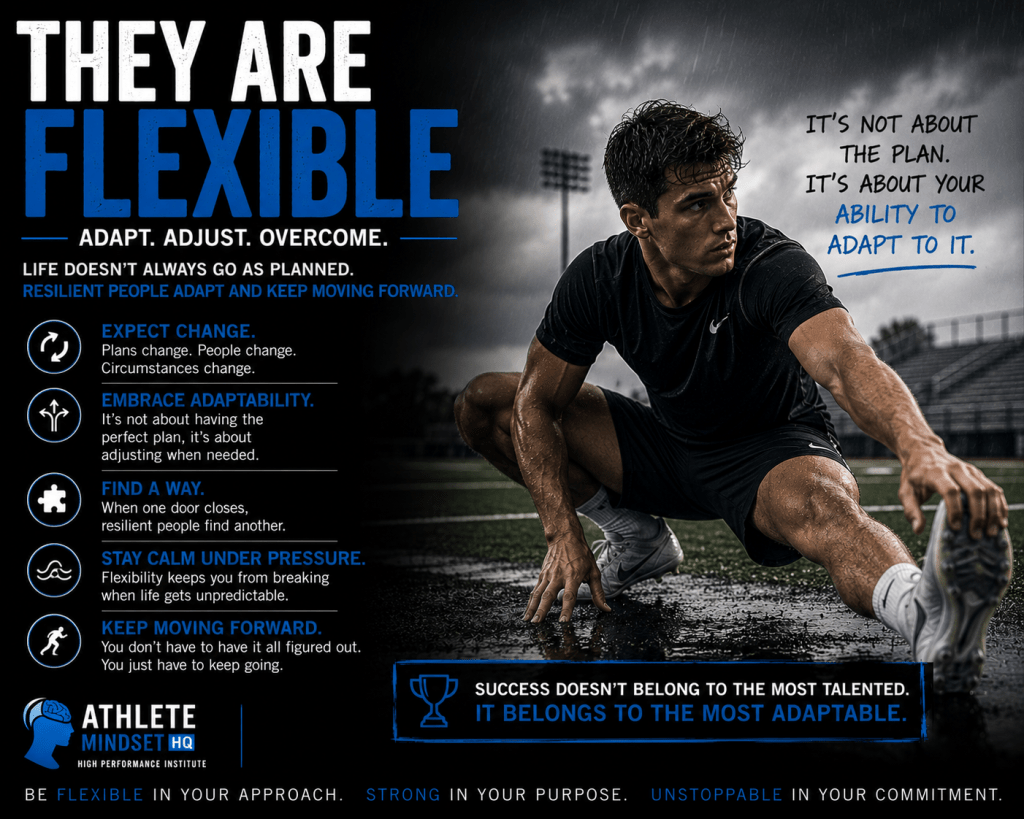
    Because resilience isn’t about avoiding hardship.

    It’s about becoming stronger because of it.


    What Is Resilience?

    People often confuse resilience with toughness.

    They’re not the same thing.

    Mental toughness is the ability to perform under pressure.

    Resilience is the ability to recover after pressure has taken its toll.

    It’s your ability to adapt.

    To learn.

    To grow.

    To get back up after you’ve been knocked down.

    Every athlete will experience failure.

    Not every athlete will choose to grow from it.


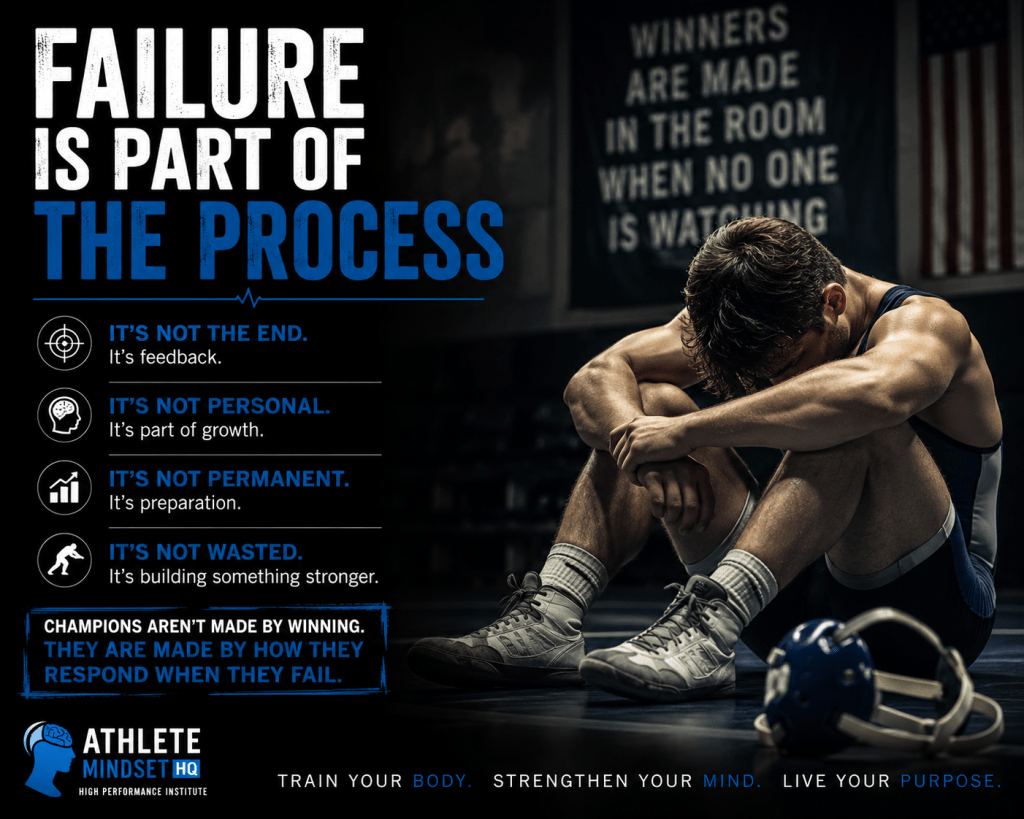
    Failure Is Part of the Process

    One of the biggest misconceptions in sports is that successful people somehow avoid failure.

    Nothing could be further from the truth.

    The athletes we admire most have all experienced disappointment.

    They’ve lost championships.

    Missed game-winning shots.

    Been cut from teams.

    Questioned their abilities.

    Wondered if they should quit.

    The difference isn’t that they failed less.

    The difference is that they refused to let failure become their identity.

    Failure became feedback.

    And feedback became fuel.


    Resilience Is Built Daily

    Resilience isn’t created during the championship game.

    It’s developed long before anyone is watching.

    It’s built when you:

    • Show up after a bad practice.
    • Choose effort over excuses.
    • Learn from constructive criticism.
    • Stay committed when motivation fades.
    • Continue believing in yourself despite temporary setbacks.

    These small decisions accumulate over time.

    They shape your confidence.

    They strengthen your character.

    And eventually, they define who you become.


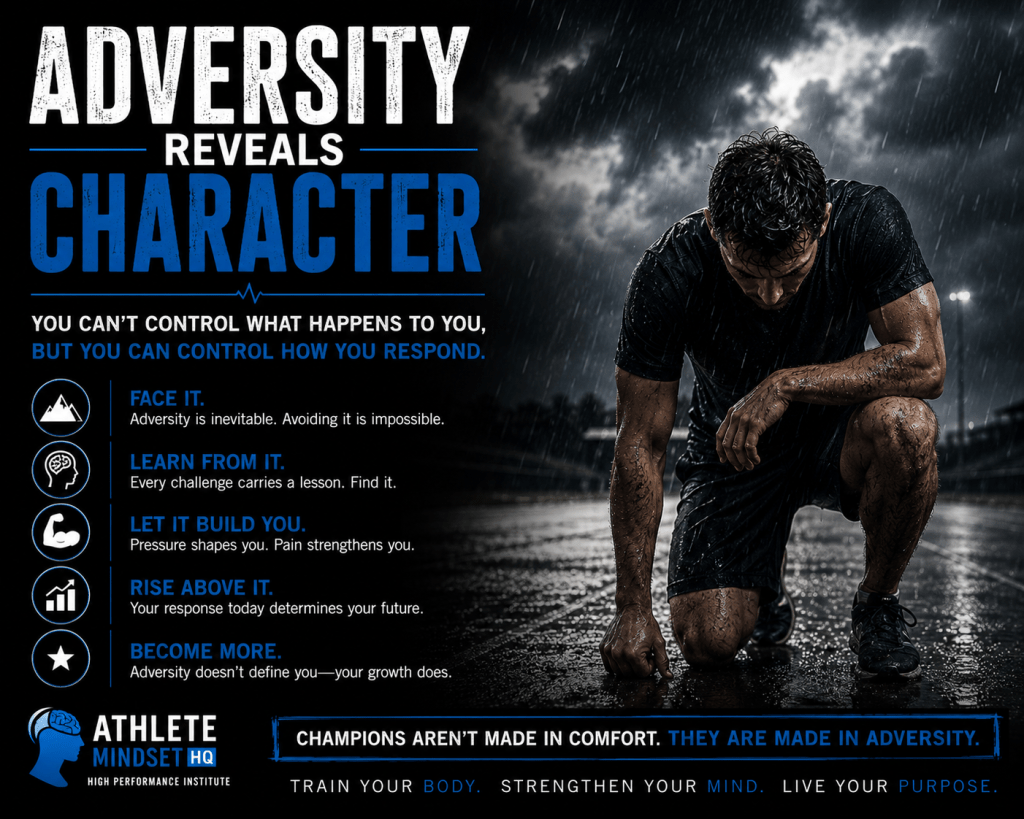
    Adversity Reveals Character

    Pressure has a way of exposing what already exists beneath the surface.

    When life becomes difficult, we often discover who we really are.

    But adversity doesn’t just reveal character.

    It also builds it.

    Every obstacle presents a choice.

    You can become bitter.

    Or you can become better.

    You can focus on what you’ve lost.

    Or you can focus on what you’re becoming.

    That choice belongs to you.

    Every single day.


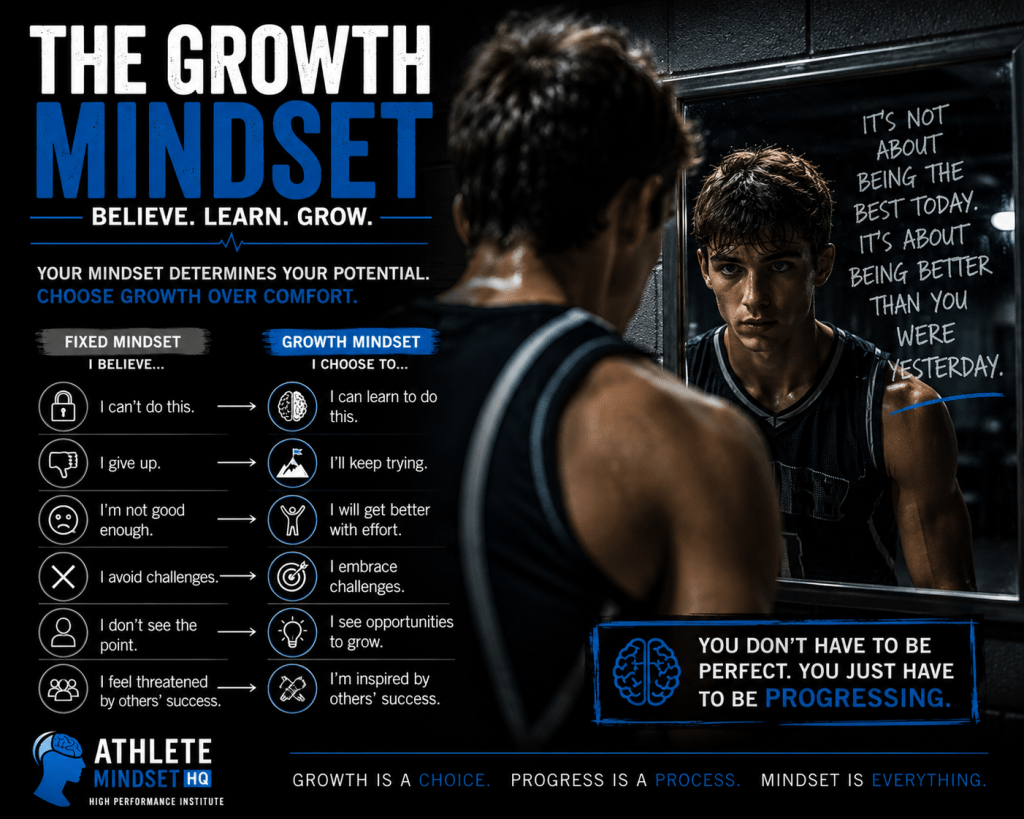
    The Growth Mindset

    Psychologist Carol Dweck introduced the concept of a growth mindset—the belief that our abilities can be developed through effort, learning, and persistence.

    Resilience and a growth mindset go hand in hand.

    Instead of saying:

    “I can’t.”

    The resilient athlete asks:

    “What can I learn from this?”

    Instead of thinking:

    “I failed.”

    They think:

    “I haven’t succeeded yet.”

    That subtle shift changes everything.


    Five Habits of Resilient People

    1. They Accept Reality

    Resilient people don’t waste energy denying difficult situations.

    They acknowledge them.

    Then they ask,

    “What can I control?”


    2. They Stay Flexible

    Plans change.

    Injuries happen.

    Life rarely unfolds exactly as expected.

    Adaptability is a competitive advantage.


    3. They Keep Perspective

    Today’s setback is one chapter—not the whole story.

    Every season has highs and lows.


    4. They Learn Continuously

    Every mistake contains information.

    Resilient people become students of their own experiences.


    5. They Keep Moving Forward

    Sometimes progress is dramatic.

    Sometimes it’s one small step.

    Both count.

    Forward is forward.


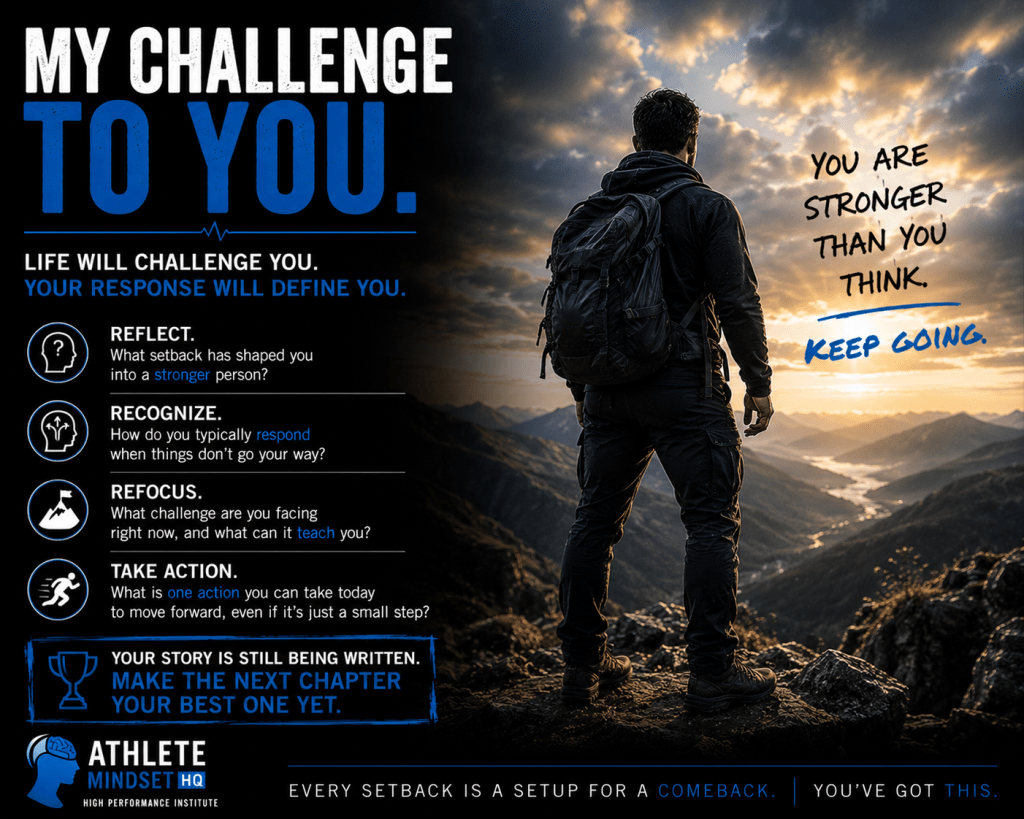
    My Challenge to You

    Think about the hardest challenge you’ve ever faced.

    Now ask yourself:

    What did it teach me?

    Chances are, the person you’ve become today was shaped far more by your struggles than by your successes.

    That’s the power of resilience.


    Final Thoughts

    At Athlete Mindset HQ, we don’t believe resilience means pretending everything is okay.

    We believe it means having the courage to face reality, the discipline to keep showing up, and the faith to believe that today’s struggle can become tomorrow’s strength.

    Because the strongest competitors aren’t the ones who never fall.

    They’re the ones who refuse to stay down.

    Every setback is an invitation to grow.

    Every obstacle is an opportunity to become stronger.

    And every challenge is another chance to write the next chapter of your story.

    So keep going.

    Keep learning.

    Keep believing.

    The best version of you may be waiting on the other side of the obstacle you’re facing today.


    Reflection Questions

    • What setback has shaped you into a stronger person?
    • How do you typically respond when things don’t go your way?
    • What is one challenge you’re facing right now, and what can it teach you?
    • What is one action you can take today to move forward, even if it’s just a small step?

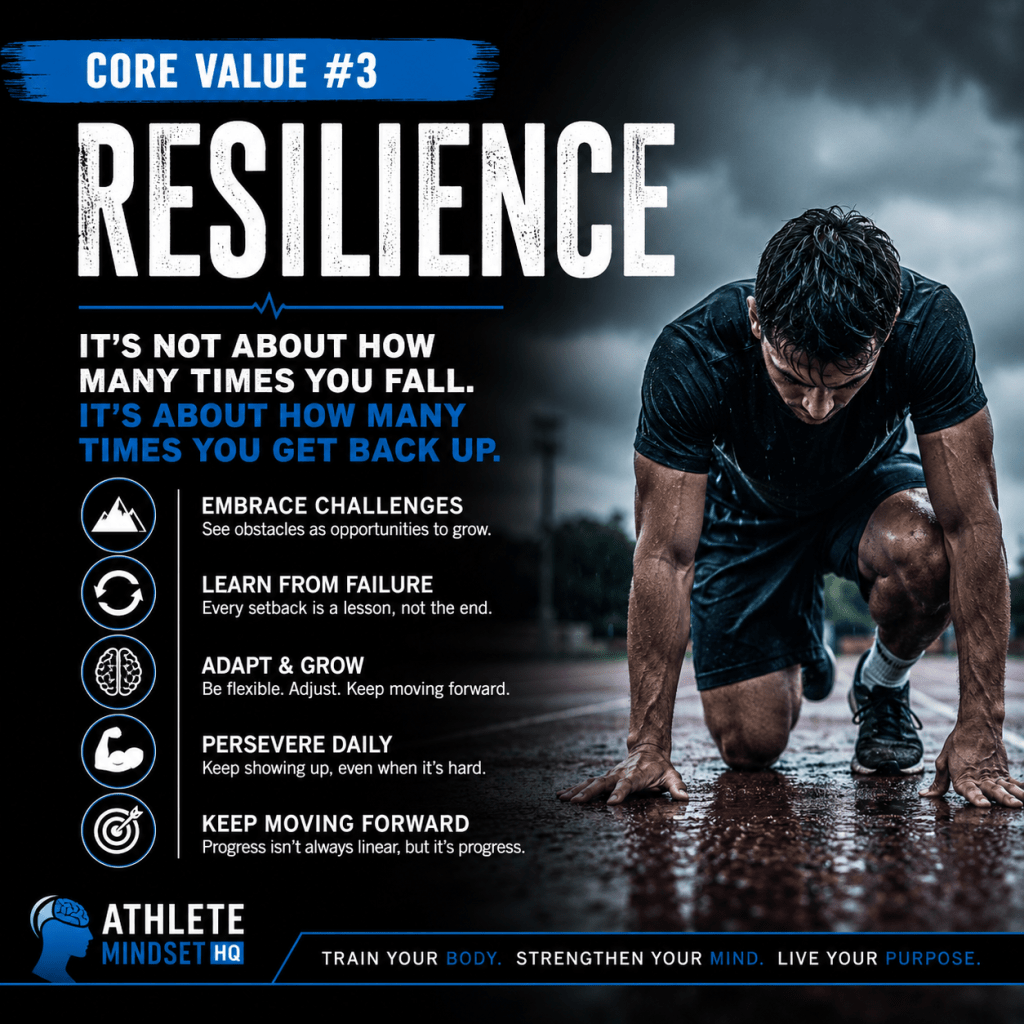
    💙 Athlete Mindset HQ Core Values Series

    Core Value #3: Resilience

    “Adversity may reveal who you are today—but resilience determines who you become tomorrow.”

    Train Your Body. Strengthen Your Mind. Live Your Purpose.

    About John J. Schessler, M.S.

    John J. Schessler, M.S. is a Mental Performance Coach, Behavior Interventionist, speaker, and founder of Athlete Mindset HQ, a high-performance platform dedicated to helping people become the strongest version of themselves—mentally, emotionally, and physically.

    John earned his Master of Science in Sport Psychology from Capella University and his Bachelor of Arts in Child & Adolescent Psychology from Southern New Hampshire University. His work combines evidence-based psychology with practical coaching to help athletes, students, professionals, and individuals facing life’s challenges develop resilience, confidence, discipline, and lasting mental strength.

    His passion for this work is deeply personal. Having overcome significant adversity early in life, John understands that real strength isn’t measured by what happens to us—it’s measured by how we respond. That perspective shapes every conversation, coaching session, presentation, and piece of content he creates.

    Through Athlete Mindset HQ and The Follow Through Podcast, John shares practical strategies, meaningful conversations, and real-world tools that empower people to perform at their best—not only in competition, but in everyday life. Whether discussing sports psychology, behavioral health, leadership, men’s mental health, or personal growth, his goal remains the same: to educate, encourage, and equip others with the mindset needed to overcome obstacles and pursue excellence with purpose.

    Because success isn’t built by what you intend to do.

    It’s built by what you follow through on.
  • If we’re going to have an honest conversation about men, we need to begin with a simple truth:

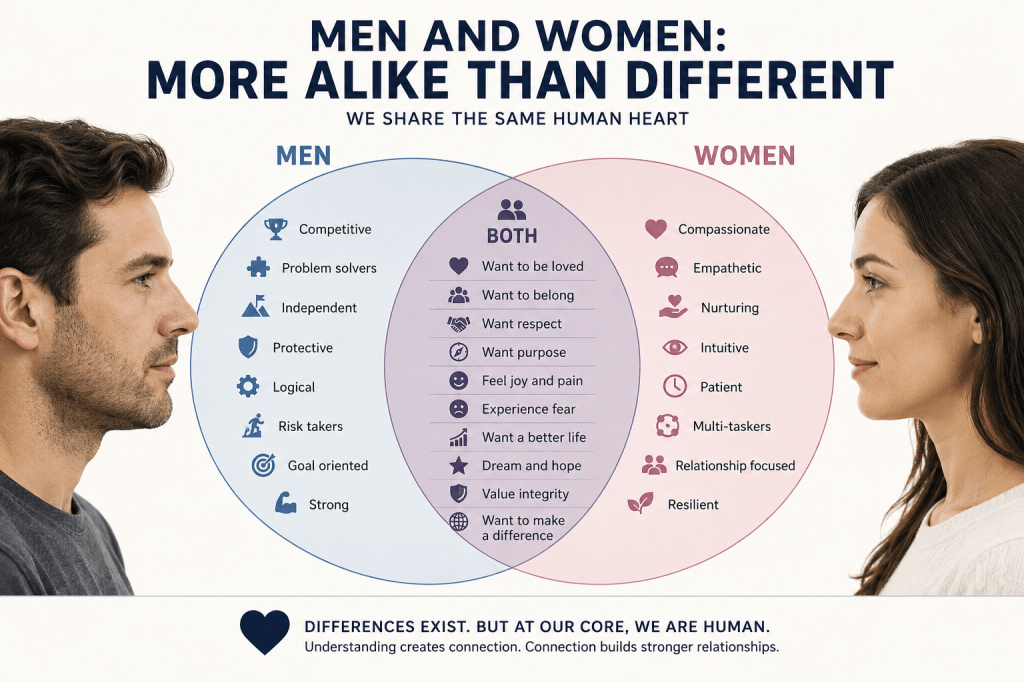
    Men and women are far more alike than they are different.

    We all experience joy, fear, grief, love, hope, disappointment, and pain. We all long to belong, to matter, and to be loved. Those are fundamentally human experiences.

    At the same time, biology isn’t meaningless.

    Our hormones, brain development, genetics, and evolutionary history all influence how we experience the world. They don’t dictate our choices or determine our character, but they do create tendencies that deserve to be understood rather than ignored.

    Understanding those tendencies isn’t about giving men a free pass.

    It’s about giving everyone a clearer picture of why certain patterns emerge—and how greater awareness can lead to healthier lives and stronger relationships.

    More Similar Than Different

    One of the biggest misconceptions in popular culture is that men and women are so fundamentally different that they might as well be different species.

    The science doesn’t support that.

    Psychological research consistently shows that men and women overlap on most personality traits, cognitive abilities, and emotional experiences. The differences that do exist are often averages, not absolutes. There are highly nurturing men, highly competitive women, emotionally expressive men, and emotionally reserved women.

    Every individual is exactly that—an individual.

    Still, averages matter because they help us understand patterns across large groups of people.

    That’s where biology enters the conversation.

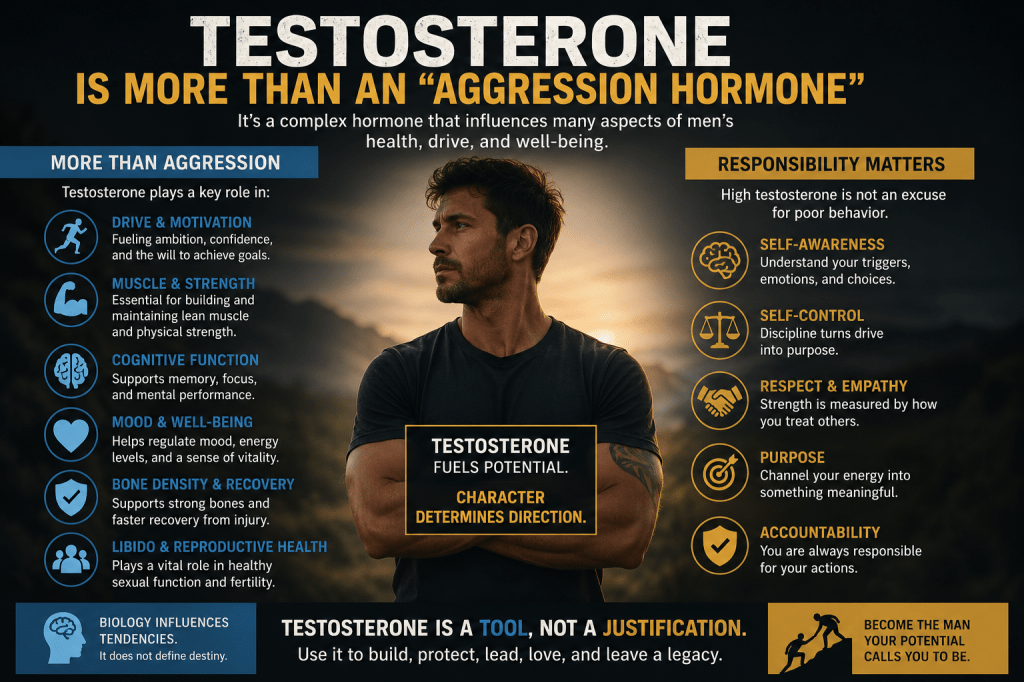
    Testosterone: More Than an “Aggression Hormone”

    Few hormones have been misunderstood more than testosterone.

    When most people hear the word, they immediately think of aggression.

    The reality is much more nuanced.

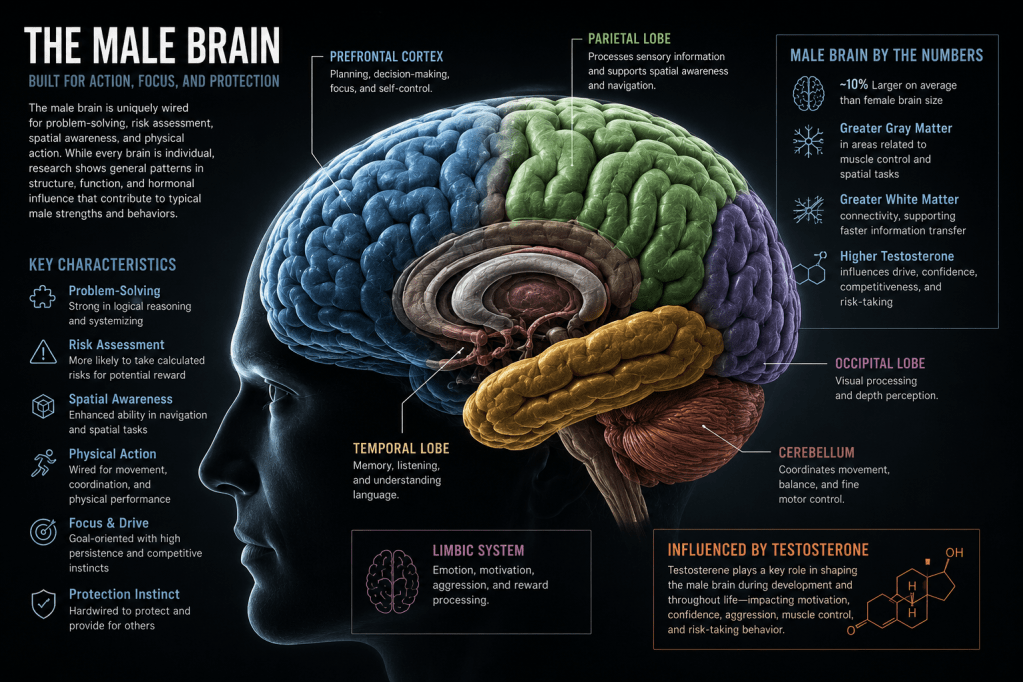
    Testosterone certainly influences competitiveness and assertiveness, but it also affects confidence, motivation, energy, muscle development, libido, recovery, and even aspects of mood and cognition.

    Think of testosterone less as an “anger hormone” and more as a status-seeking hormone.

    It often amplifies the drive to achieve, protect, build, compete, and overcome challenges.

    That drive can be expressed in remarkably healthy ways.

    A father working overtime to provide for his family.

    A firefighter running toward danger.

    A coach inspiring young athletes.

    A teacher staying late to help struggling students.

    An entrepreneur risking everything to build a business.

    The same biological drive that fuels competition can also fuel service.

    The hormone itself isn’t good or bad.

    Character determines how it’s expressed.

    A Brain Built for Action

    Researchers have spent decades studying differences in brain development. While there is tremendous overlap between men and women, some patterns appear consistently across populations.

    On average, boys develop the brain regions responsible for impulse control and long-term planning more slowly than girls. This helps explain why adolescent boys often engage in more risk-taking, impulsive behavior, and sensation-seeking.

    This isn’t because boys are less intelligent.

    It’s because different parts of the brain mature on different timelines.

    As adulthood approaches, those differences narrow, but traces of those developmental patterns can remain.

    Many men naturally gravitate toward solving problems by taking action.

    When something is broken, they often ask:

    “How do we fix it?”

    When someone they love is hurting, their instinct may be to seek solutions rather than simply sit with the pain.

    That impulse comes from a place of care.

    Yet it can create misunderstandings.

    A wife may say, “I just needed you to listen.”

    A husband may think, “I was trying to help.”

    Neither person is wrong.

    They’re simply approaching the same problem from different angles.

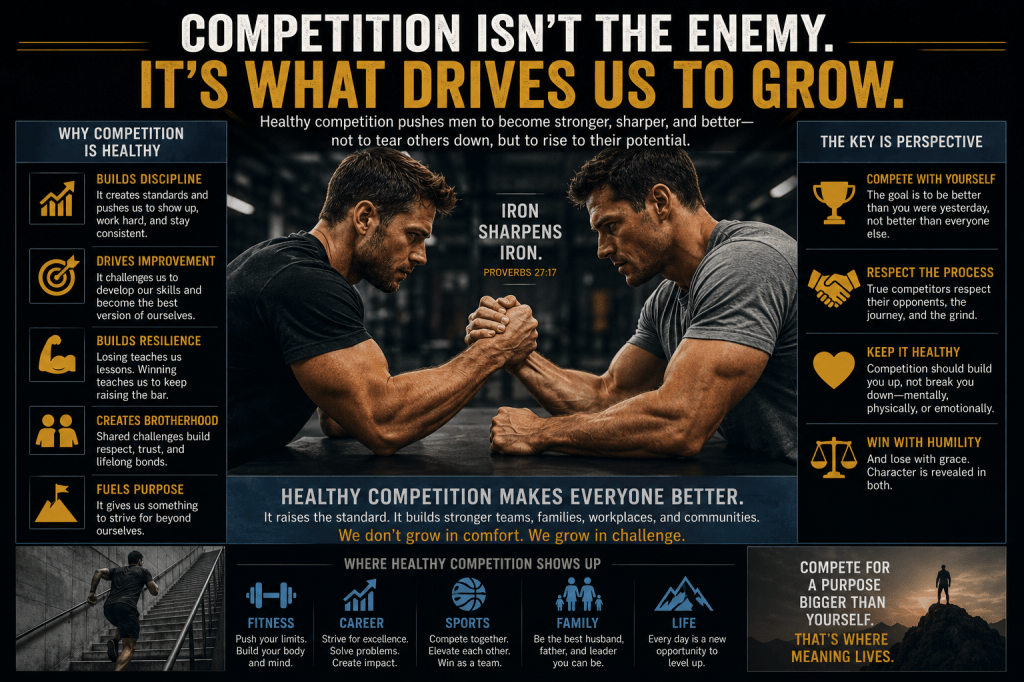
    Competition Is Not the Enemy

    Competition often receives a bad reputation.

    Yet healthy competition has driven human progress for thousands of years.

    Competition pushes athletes to become stronger.

    Scientists to make discoveries.

    Businesses to innovate.

    Students to work harder.

    Communities to improve.

    For many men, competition isn’t about making someone else feel small.

    It’s about discovering their own potential.

    The healthiest men compete less against other people and more against the person they were yesterday.

    That mindset transforms competition into growth.

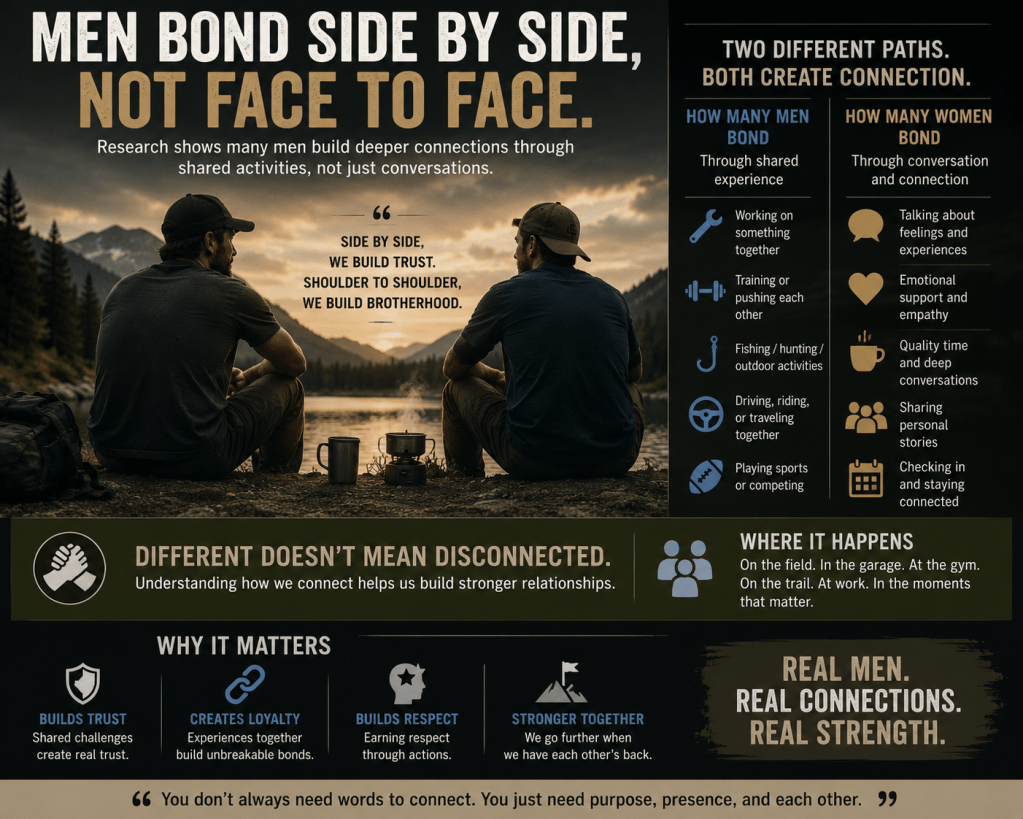
    Why Many Men Bond Side by Side

    One fascinating difference researchers have observed is how many men build relationships.

    Women often strengthen friendships through conversation.

    Many men strengthen friendships through shared experiences.

    Working on a project.

    Fishing.

    Hunting.

    Playing basketball.

    Lifting weights.

    Watching football.

    Building something together.

    Driving for hours without saying much at all.

    To an outsider, it may look like there is very little emotional connection.

    But for many men, those shared experiences are the conversation.

    Trust develops shoulder to shoulder long before it develops face to face.

    Understanding this helps explain why some men feel closest to the people they’ve worked alongside, competed with, or struggled beside—even if they’ve never had a deep emotional discussion.

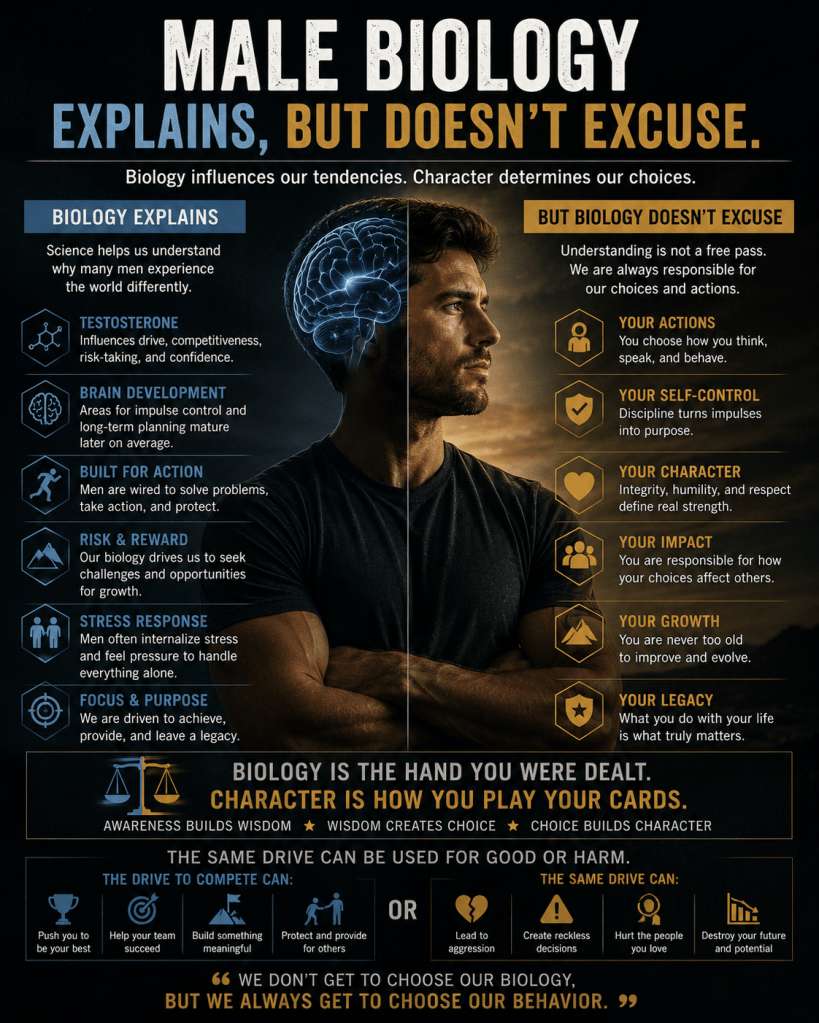
    Biology Explains—It Doesn’t Excuse

    It’s important to keep returning to this point.

    Biology provides context.

    It does not remove responsibility.

    A tendency toward risk-taking does not excuse recklessness.

    Higher testosterone does not excuse violence.

    A problem-solving mindset does not excuse emotional neglect.

    Every man is responsible for his choices.

    Character, maturity, self-awareness, and discipline ultimately matter far more than biology alone.

    Understanding biology simply helps us recognize where some of our natural tendencies originate, so we can manage them wisely rather than pretend they don’t exist.

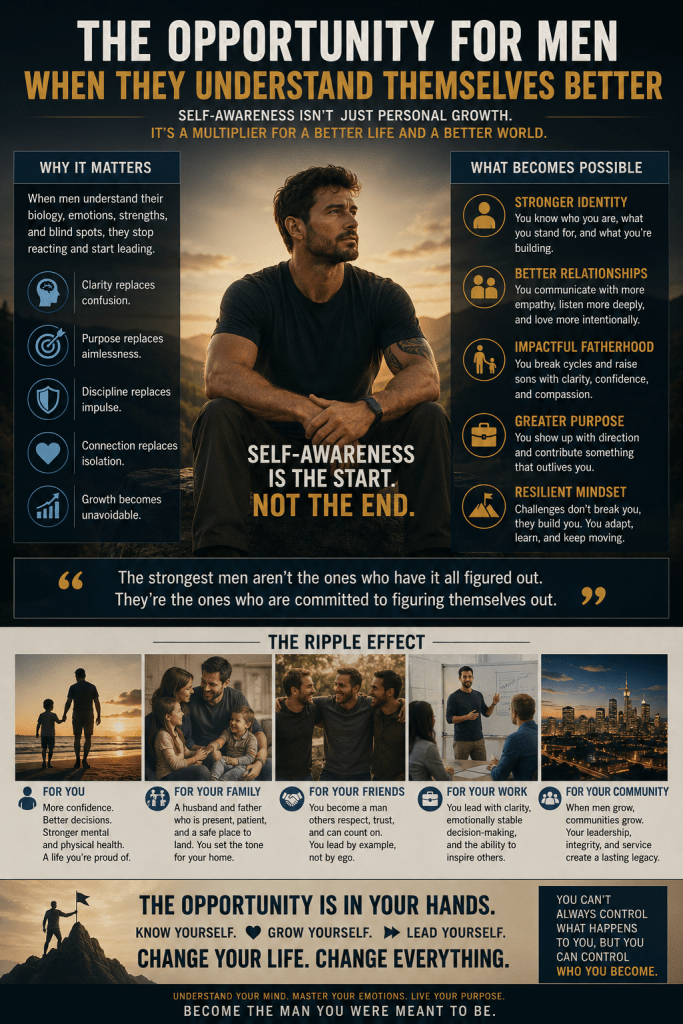
    The Opportunity

    When men understand themselves better, they become better husbands, fathers, brothers, coaches, leaders, and friends.

    When women understand these tendencies, communication often becomes more compassionate and less adversarial.

    And when boys are taught that biology gives them strengths to develop—not excuses to hide behind—they grow into men who are both resilient and emotionally mature.

    Perhaps that’s the goal.

    Not raising tougher men.

    Not raising softer men.

    But raising healthier men.

    Men who possess both courage and compassion.

    Strength and humility.

    Confidence and self-awareness.

    Because the world doesn’t simply need stronger men.

    It needs good men.

    About John J. Schessler, M.S.

    John J. Schessler, M.S. is a Mental Performance Coach, Behavior Interventionist, speaker, and founder of Athlete Mindset HQ, a high-performance platform dedicated to helping people become the strongest version of themselves—mentally, emotionally, and physically.

    John earned his Master of Science in Sport Psychology from Capella University and his Bachelor of Arts in Child & Adolescent Psychology from Southern New Hampshire University. His work combines evidence-based psychology with practical coaching to help athletes, students, professionals, and individuals facing life’s challenges develop resilience, confidence, discipline, and lasting mental strength.

    His passion for this work is deeply personal. Having overcome significant adversity early in life, John understands that real strength isn’t measured by what happens to us—it’s measured by how we respond. That perspective shapes every conversation, coaching session, presentation, and piece of content he creates.

    Through Athlete Mindset HQ and The Follow Through Podcast, John shares practical strategies, meaningful conversations, and real-world tools that empower people to perform at their best—not only in competition, but in everyday life. Whether discussing sports psychology, behavioral health, leadership, men’s mental health, or personal growth, his goal remains the same: to educate, encourage, and equip others with the mindset needed to overcome obstacles and pursue excellence with purpose.

    Because success isn’t built by what you intend to do.

    It’s built by what you follow through on.
    #malemind #sportspsychology #athleticperformance #athletemindsetHQ #behavioralhealth #leadership #mensmentalhealth #personalgrowth

  • If you ask many men how they’re doing, you’ll likely hear the same familiar response:

    “I’m good.”

    “I’m fine.”

    “Can’t complain.”

    Sometimes those words are true.

    Many times, they aren’t.

    For countless men, those phrases have become less of an honest answer and more of a survival strategy. They end the conversation before anyone asks a second question. They keep the focus off the internal battles that so often remain hidden from the people closest to them.

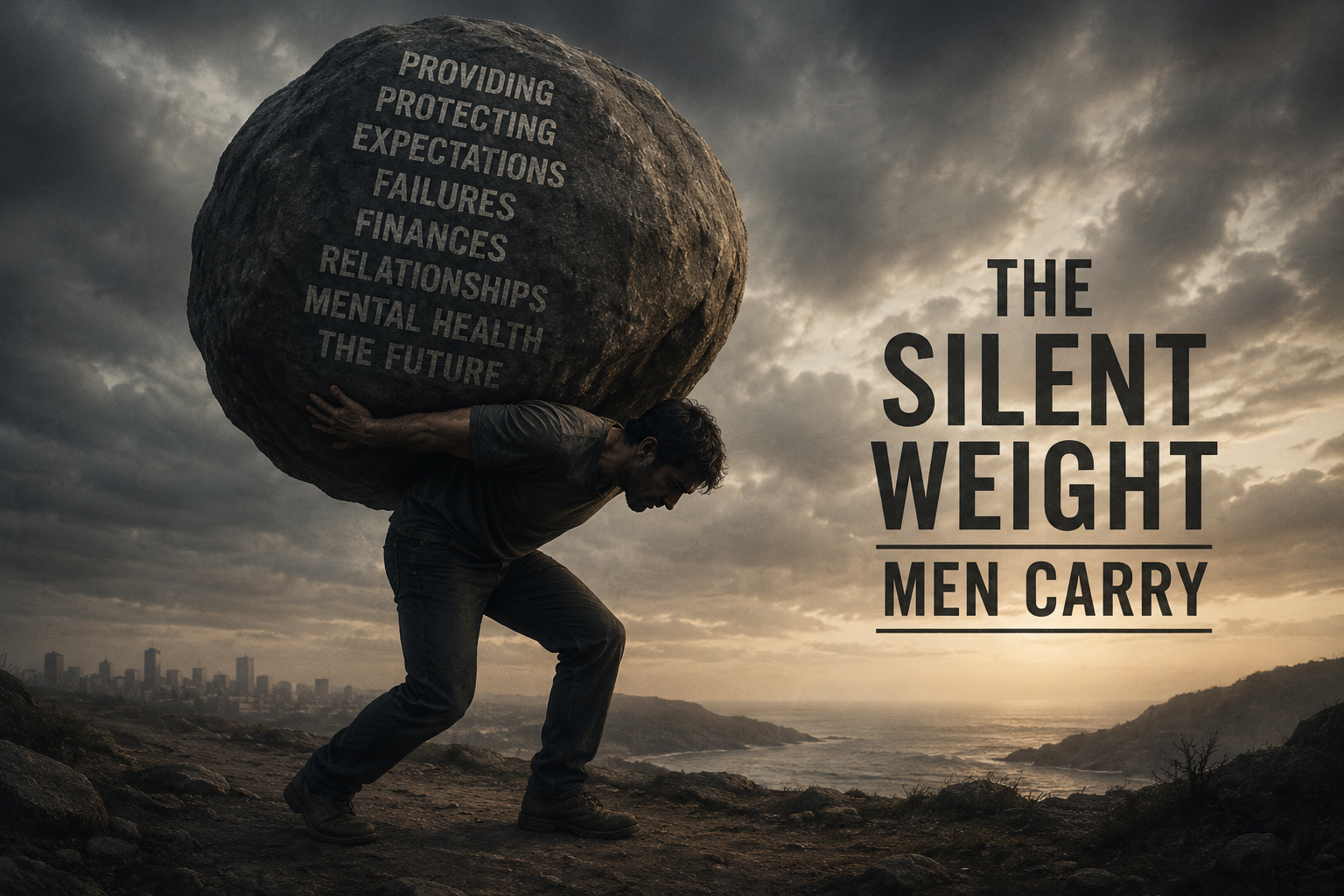
    The truth is, many men become experts at carrying heavy things.

    Not just physically.

    Emotionally.

    Financially.

    Mentally.

    Spiritually.

    And they often carry those burdens without ever believing they have permission to set them down.

    The Provider Mindset

    For much of human history, survival depended on division of labor. Men often hunted, defended territory, built shelter, and accepted physically dangerous work because those roles increased the chances of survival for their families and communities. While society has changed dramatically, many of those deeply rooted psychological drives remain.

    Many men still instinctively ask themselves questions like:

    “Can I protect the people I love?”

    “Can I provide enough?”

    “Am I useful?”

    “Would my family be better off without me if I can’t fulfill those responsibilities?”

    Those questions aren’t always spoken aloud. In fact, many men have never consciously recognized them. Yet they quietly influence confidence, relationships, career choices, and mental health.

    This is one reason why job loss, financial instability, or an inability to work can be so devastating. To many men, it isn’t simply a paycheck that’s disappearing.

    It’s purpose.

    It’s identity.

    It’s the feeling that they matter.

    The Loneliness Nobody Talks About

    Here’s an uncomfortable reality:

    Many adult men are profoundly lonely.

    As boys, friendships often revolve around activities—sports, school, video games, hobbies, or shared adventures. As adulthood arrives, careers expand, marriages begin, children are born, responsibilities multiply, and those friendships slowly fade into occasional text messages or holiday greetings.

    Years pass.

    Without realizing it, many men find themselves with very few people they can call when life falls apart.

    Not because nobody cares.

    But because they’ve spent decades becoming the person everyone else depends on.
    The dependable one.

    The fixer.

    The protector.

    The strong one.

    Ironically, the stronger a man appears on the outside, the less likely others are to ask whether he’s struggling on the inside.

    Strength can become its own kind of invisibility.

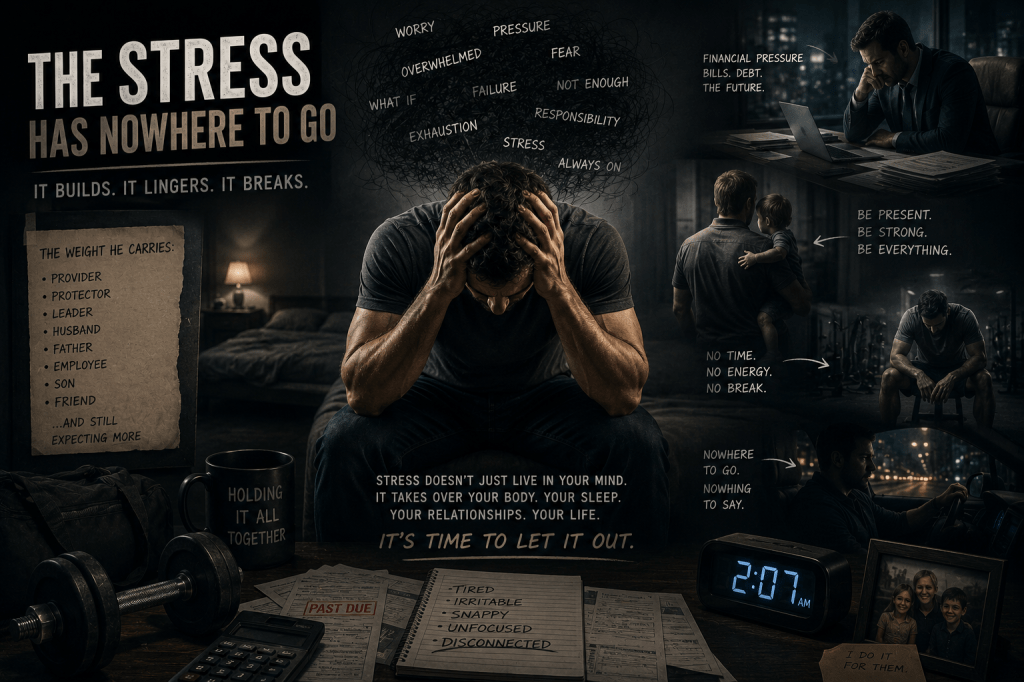
    When Stress Has Nowhere to Go

    The human body was never designed to remain under constant stress.

    When challenges arise, the brain activates a survival response. Heart rate increases. Muscles tighten. Stress hormones flood the bloodstream. In short bursts, this response is remarkably effective.

    The problem is that many men never truly leave survival mode.

    They worry about paying bills.

    Taking care of aging parents.

    Being a good husband.

    Being a present father.

    Keeping their career afloat.

    Maintaining their health.

    Meeting expectations that seem to grow larger every year.

    Eventually, the body begins paying the price.

    Sleep suffers.

    Blood pressure rises.

    Weight increases.

    Motivation disappears.

    Patience shortens.

    Joy becomes harder to find.

    Many men don’t recognize these as signs of emotional distress. Instead, they assume they’re simply exhausted, overworked, or “getting older.”

    In reality, chronic stress doesn’t just affect the mind—it changes the body. Left unchecked, it can contribute to cardiovascular disease, weakened immunity, chronic pain, depression, anxiety, and burnout.

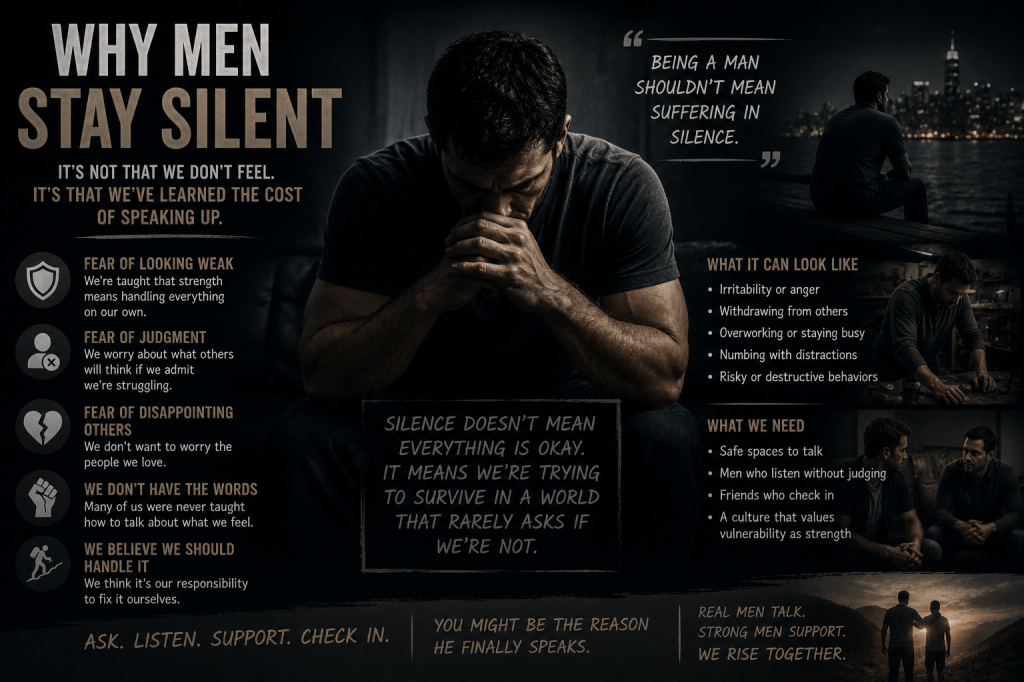
    Why Men Stay Silent

    Perhaps the most misunderstood question is this:

    “If he’s struggling, why doesn’t he just ask for help?”

    The answer is rarely simple.

    For some men, asking for help feels like admitting failure.

    For others, it feels like becoming a burden.

    Some fear they’ll disappoint the people counting on them.

    Others simply don’t have the language to describe what they’re feeling because no one ever taught them how.

    Silence, then, becomes a learned form of protection.
    It protects pride.

    It protects identity.

    It protects the image they’ve spent years building.

    Unfortunately, it also protects pain.

    Pain hidden long enough rarely disappears.
    It simply changes shape.

    Sometimes it becomes irritability.

    Sometimes emotional distance.

    Sometimes perfectionism.

    Sometimes compulsive work.

    Sometimes substance use.

    Sometimes reckless behavior.

    And sometimes, it becomes despair that no one ever sees coming.

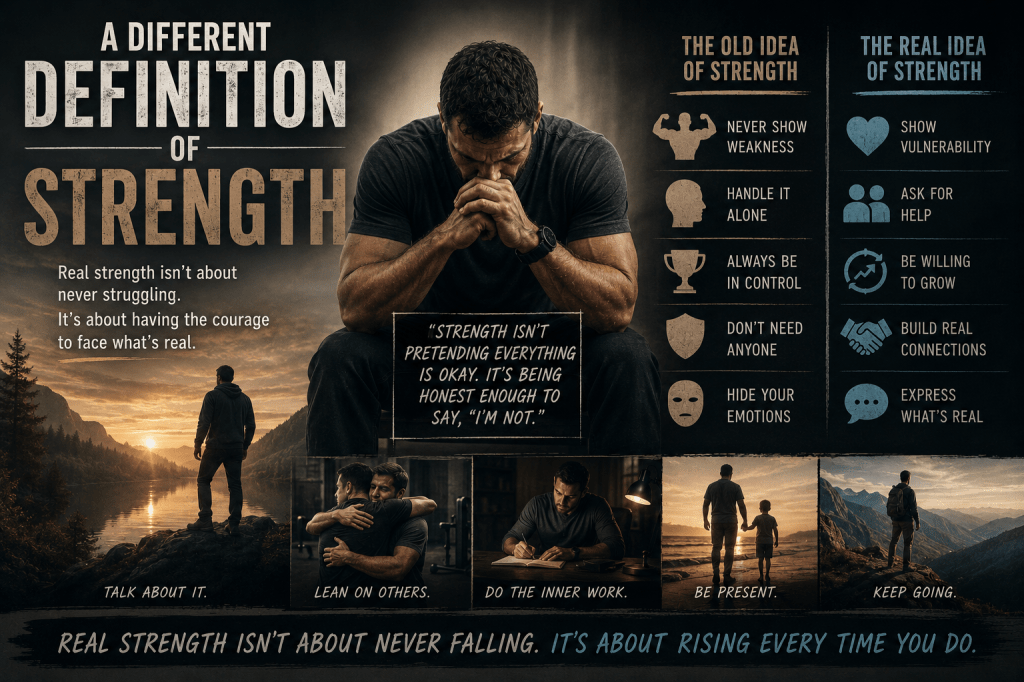
    A Different Definition of Strength

    Perhaps it’s time we redefine strength.

    Real strength isn’t pretending everything is okay.

    Real strength is having the courage to admit when it isn’t.

    It’s asking for help before a crisis develops.

    It’s allowing trusted people to carry part of the burden.

    It’s understanding that vulnerability and courage are not opposites—they often walk hand in hand.

    The strongest men I’ve ever known weren’t the ones who never struggled.

    They were the ones who chose to keep growing despite their struggles.

    Maybe that’s the kind of strength our sons need to witness.

    Maybe that’s the kind of strength our daughters deserve to recognize.

    And maybe that’s the kind of strength our culture has been waiting to celebrate all along.

    About Me — Coach John Schessler Jr.

    I’m Coach John — the mind behind AthleteMindsetHQ — and my mission is simple: help athletes build the kind of mental toughness, confidence, and resilience that shows up long after the final whistle blows.

    I coach from experience, education, and heart. As a Sports Psychology Coach and Behavior Interventionist, I’ve spent years working with athletes and students who carry big potential but also big pressure. My job? Teach them how to channel that pressure into power.

    As a recent I can support athletes at an even higher level. Every day, I study how mindset, emotion, and performance work together — and every day, I bring that knowledge straight to the athletes and readers who trust me.

    This blog is your locker room talk for the mind.
    Here, we break limits.
    We train confidence.
    We learn how to stay locked in when it matters most.

    Because winning isn’t just physical — it’s mental.
    And when you master your mind, the rest follows.

    If you’re ready to grow, challenge yourself, and build an unshakeable mental edge… welcome to the team. Let’s get to work.

  • Understanding Men from Mars….

    This is not going to be one of those “boys will be boys” articles. In fact, it’s quite the opposite. The goal isn’t to excuse unhealthy behavior, reinforce outdated stereotypes, or suggest that men should avoid accountability for their actions. Instead, my hope is to create understanding. Too often, conversations about men become polarized—either portraying men as emotionally detached and invulnerable or reducing them to harmful stereotypes that overlook the complexity of who they really are.

    This article is written for both women and men. For women, it offers an opportunity to better understand some of the biological, psychological, and social factors that shape the male experience. For men, it’s an invitation to reflect, to feel seen, and perhaps to recognize that many of the struggles they’ve quietly carried are shared by countless others. We’ll explore why many men communicate differently, why asking for help can feel so difficult, how identity and purpose often become deeply intertwined with self-worth, and how physical and mental health influence nearly every aspect of a man’s life.

    We’ll also examine the unique strengths men bring to their families, relationships, workplaces, and communities. Men are often driven by a desire to protect, provide, build, mentor, solve problems, and leave something meaningful behind. While every man is different, there are common experiences that deserve thoughtful discussion rather than assumptions or criticism.

    If we’re going to improve the mental health of men, strengthen relationships, and raise healthier generations of boys, we first have to understand the world through a man’s eyes. Understanding doesn’t mean agreeing with every behavior or decision—it simply means recognizing that every person has a story shaped by biology, experience, expectations, successes, failures, and pain. My hope is that this article encourages empathy, sparks meaningful conversations, and reminds us that supporting men and supporting women are not competing goals. When we understand one another better, everyone benefits.

    Understanding the Male Experience

    From the moment many boys enter the world, they begin receiving messages about what it means to “be a man.” Some of those lessons are spoken directly:

    “Big boys don’t cry.”

    “Toughen up.”

    “Handle it yourself.”

    Others are far more subtle. Boys quickly learn that praise often comes when they are strong, athletic, fearless, successful, or emotionally composed. Vulnerability, uncertainty, and fear are frequently met with discomfort—or worse, ridicule. Over time, many boys begin to internalize a simple equation:

    My value comes from what I do, not who I am.

    While this isn’t true for every family or every boy, it is common enough to shape generations of men.

    As boys grow into adolescence and adulthood, the expectations only become more complex. Society often expects men to be confident without being arrogant, emotionally available without appearing weak, ambitious without neglecting their families, physically strong while somehow ignoring their own pain, and successful enough to provide security for those they love.

    It’s a balancing act that many men quietly struggle to maintain.

    What often goes unseen is the enormous pressure many men carry every day. For countless men, self-worth becomes closely tied to their ability to solve problems, earn a living, protect the people they love, and remain dependable regardless of what is happening internally. When life begins to unravel—a lost job, financial hardship, divorce, chronic illness, injury, or emotional trauma—it isn’t simply an event. It can feel like a direct challenge to their identity.

    Unlike many women, who are generally socialized to seek emotional support from close friendships, many men have remarkably small emotional support networks. Research consistently shows that men are less likely to discuss emotional distress, less likely to seek counseling, and more likely to suffer in silence until problems become overwhelming. Unfortunately, silence doesn’t eliminate pain—it simply changes where that pain goes.

    Sometimes it becomes anxiety.

    Sometimes it becomes depression.

    Sometimes it becomes anger.

    Sometimes it becomes addiction.

    And sometimes, heartbreakingly, it becomes hopelessness.

    This isn’t because men are incapable of expressing emotion. Quite the opposite. Men experience the same range of emotions as women. The difference is often found in how those emotions have been shaped by years of conditioning and expectation. Many men haven’t been taught that vulnerability is a strength—they’ve been taught it’s a liability.

    That doesn’t mean men don’t want connection.

    It means many simply don’t know how to ask for it.

    Understanding this distinction is one of the first steps toward healthier relationships, stronger families, and better mental health for everyone involved. When we stop asking, “What’s wrong with him?” and instead begin asking, “What has he learned about being a man?” we open the door to empathy instead of judgment.

    Because behind nearly every man is a story—one filled with victories, disappointments, expectations, fears, and hopes that often remain hidden beneath a calm exterior.

    And perhaps that’s where this conversation truly begins.

  • Talent might get you noticed.

    Hard work might get you opportunities.

    But integrity is what earns trust.

    Integrity isn’t about making the right choice when people are watching.

    It’s about making the right choice when no one would ever know if you didn’t.

    It’s showing up to practice with purpose.

    It’s giving your best effort, even on the days you don’t feel like it.

    It’s being honest about your weaknesses so you can grow stronger.

    It’s treating teammates, opponents, officials, and yourself with respect.

    At Athlete Mindset HQ, we believe that character is built through the small decisions we make every day—not the big moments everyone applauds.

    Your habits become your standards.

    Your standards become your reputation.

    And your reputation is built one decision at a time.

    So today, ask yourself:

    What is one choice I can make today that reflects the person I want to become—even if no one else ever sees it?

    Because in the end…

    How you do one thing is how you do everything.

    💙 Train Your Body. Strengthen Your Mind. Live Your Purpose.

    #AthleteMindsetHQ #Integrity #MentalPerformance #Character #Leadership #SportsPsychology #Mindset #Resilience #HighPerformance #Purpose #Trust #StudentAthlete #CoachLife #BeBetterEveryDay #StrongerMindsBetterAthletesBetterPeople

    About John Schessler

    John J. Schessler, MS, CMT, SPC is the founder of Athlete Mindset HQ, a high-performance institute dedicated to helping athletes, coaches, leaders, and everyday high performers strengthen the mindset needed to succeed in sport, work, and life.

    With a background in sport psychology, mental performance coaching, fitness, education, and intervention support, John brings a practical and deeply personal approach to performance development. His work focuses on confidence, resilience, focus, leadership, emotional well-being, and the ability to perform under pressure.

    John’s passion for mindset coaching is rooted in his own journey through adversity, growth, and purpose. He believes that true performance is not just about winning, talent, or physical ability — it is about who you become through the process.

    Through Athlete Mindset HQ, John provides evidence-informed strategies, educational content, coaching tools, and motivational resources designed to help people develop stronger minds, better habits, and greater self-belief.

    His mission is simple:

    Stronger Minds. Better Athletes. Better People.

    Train Your Body. Strengthen Your Mind. Live Your Purpose.