
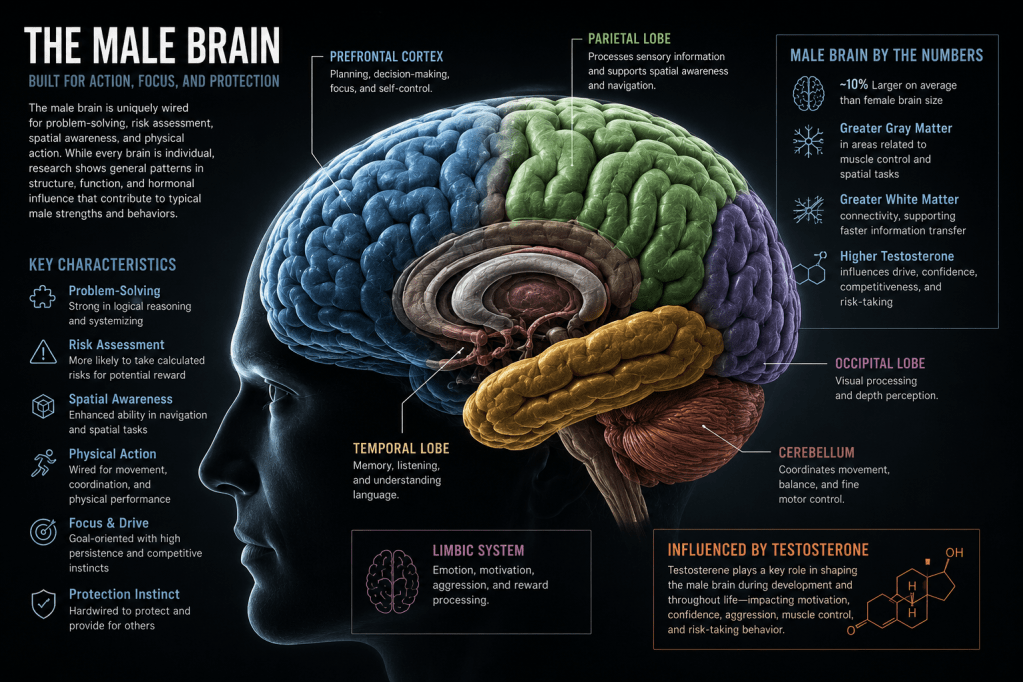
If we’re going to have an honest conversation about men, we need to begin with a simple truth:
Men and women are far more alike than they are different.
We all experience joy, fear, grief, love, hope, disappointment, and pain. We all long to belong, to matter, and to be loved. Those are fundamentally human experiences.
At the same time, biology isn’t meaningless.
Our hormones, brain development, genetics, and evolutionary history all influence how we experience the world. They don’t dictate our choices or determine our character, but they do create tendencies that deserve to be understood rather than ignored.
Understanding those tendencies isn’t about giving men a free pass.
It’s about giving everyone a clearer picture of why certain patterns emerge—and how greater awareness can lead to healthier lives and stronger relationships.
More Similar Than Different
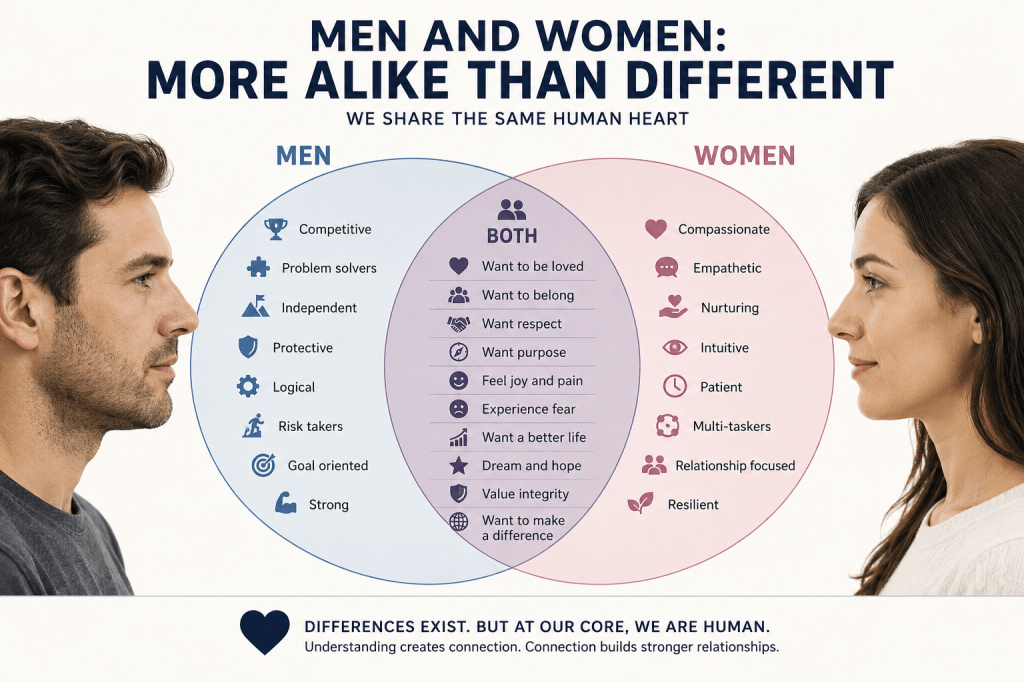
One of the biggest misconceptions in popular culture is that men and women are so fundamentally different that they might as well be different species.
The science doesn’t support that.
Psychological research consistently shows that men and women overlap on most personality traits, cognitive abilities, and emotional experiences. The differences that do exist are often averages, not absolutes. There are highly nurturing men, highly competitive women, emotionally expressive men, and emotionally reserved women.
Every individual is exactly that—an individual.
Still, averages matter because they help us understand patterns across large groups of people.
That’s where biology enters the conversation.
Testosterone: More Than an “Aggression Hormone”
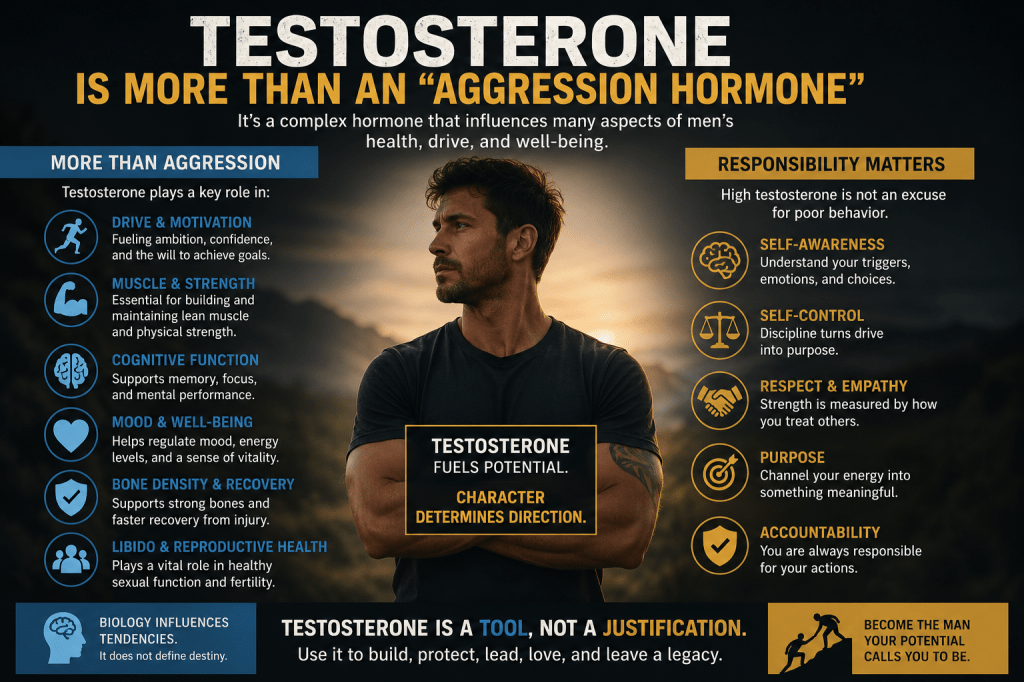
Few hormones have been misunderstood more than testosterone.
When most people hear the word, they immediately think of aggression.
The reality is much more nuanced.
Testosterone certainly influences competitiveness and assertiveness, but it also affects confidence, motivation, energy, muscle development, libido, recovery, and even aspects of mood and cognition.
Think of testosterone less as an “anger hormone” and more as a status-seeking hormone.
It often amplifies the drive to achieve, protect, build, compete, and overcome challenges.
That drive can be expressed in remarkably healthy ways.
A father working overtime to provide for his family.
A firefighter running toward danger.
A coach inspiring young athletes.
A teacher staying late to help struggling students.
An entrepreneur risking everything to build a business.
The same biological drive that fuels competition can also fuel service.
The hormone itself isn’t good or bad.
Character determines how it’s expressed.
A Brain Built for Action
Researchers have spent decades studying differences in brain development. While there is tremendous overlap between men and women, some patterns appear consistently across populations.
On average, boys develop the brain regions responsible for impulse control and long-term planning more slowly than girls. This helps explain why adolescent boys often engage in more risk-taking, impulsive behavior, and sensation-seeking.
This isn’t because boys are less intelligent.
It’s because different parts of the brain mature on different timelines.

As adulthood approaches, those differences narrow, but traces of those developmental patterns can remain.
Many men naturally gravitate toward solving problems by taking action.
When something is broken, they often ask:
“How do we fix it?”
When someone they love is hurting, their instinct may be to seek solutions rather than simply sit with the pain.
That impulse comes from a place of care.
Yet it can create misunderstandings.
A wife may say, “I just needed you to listen.”
A husband may think, “I was trying to help.”
Neither person is wrong.
They’re simply approaching the same problem from different angles.
Competition Is Not the Enemy
Competition often receives a bad reputation.
Yet healthy competition has driven human progress for thousands of years.
Competition pushes athletes to become stronger.
Scientists to make discoveries.
Businesses to innovate.
Students to work harder.
Communities to improve.
For many men, competition isn’t about making someone else feel small.
It’s about discovering their own potential.
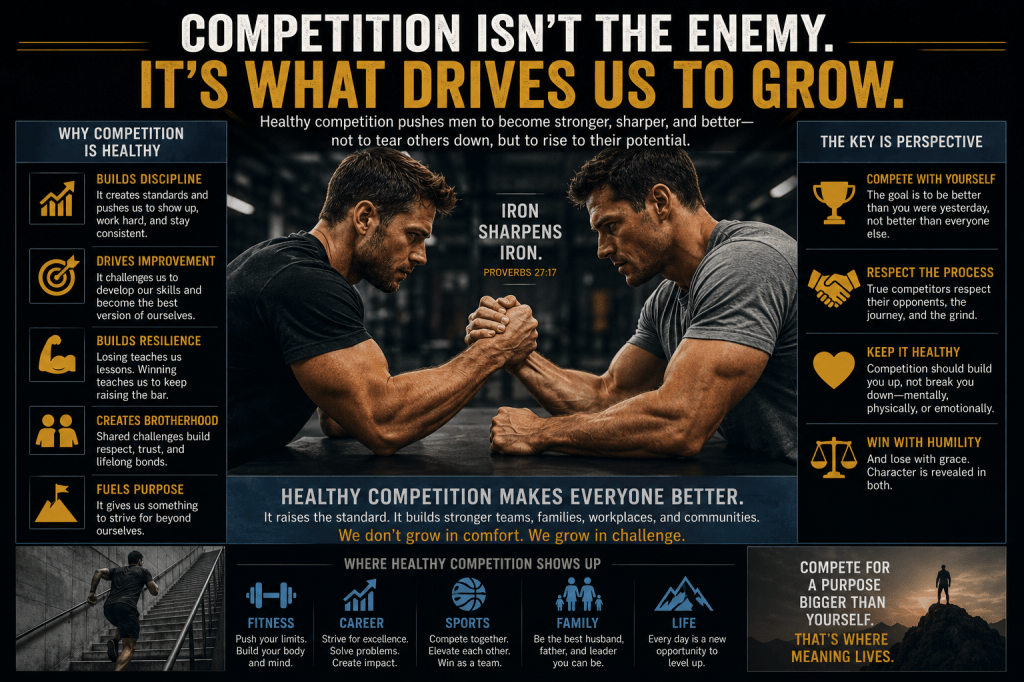
The healthiest men compete less against other people and more against the person they were yesterday.
That mindset transforms competition into growth.
Why Many Men Bond Side by Side
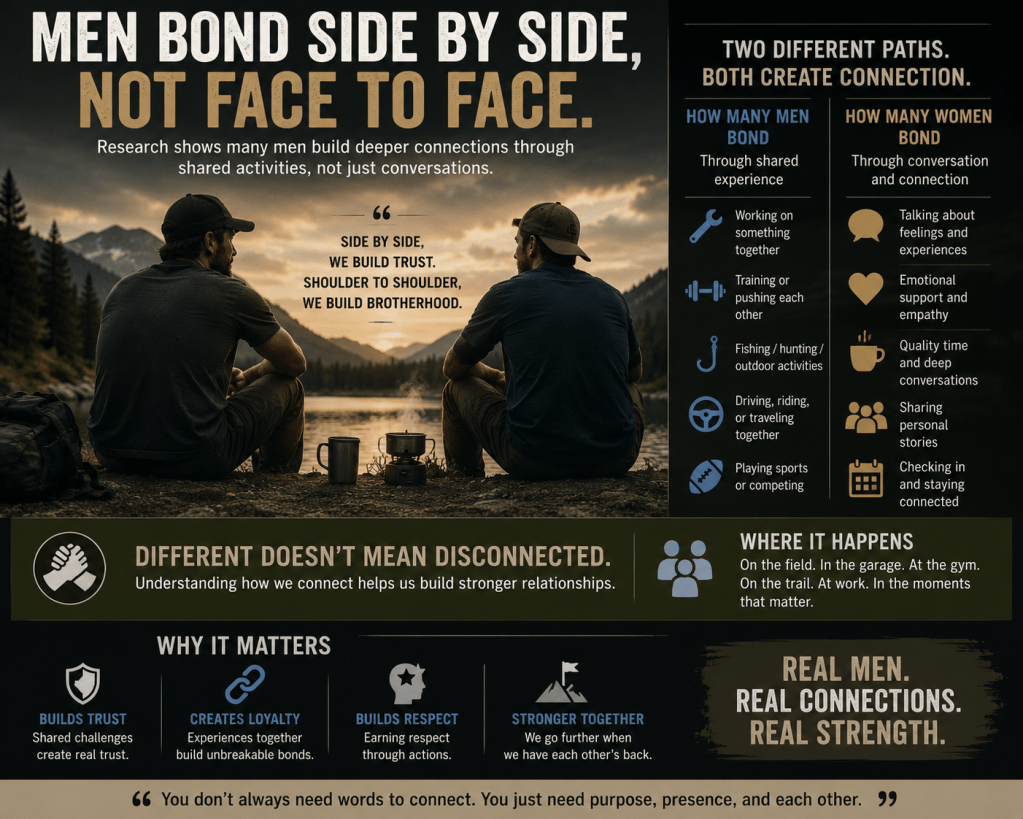
One fascinating difference researchers have observed is how many men build relationships.
Women often strengthen friendships through conversation.
Many men strengthen friendships through shared experiences.
Working on a project.
Fishing.
Hunting.
Playing basketball.
Lifting weights.
Watching football.
Building something together.
Driving for hours without saying much at all.
To an outsider, it may look like there is very little emotional connection.
But for many men, those shared experiences are the conversation.
Trust develops shoulder to shoulder long before it develops face to face.
Understanding this helps explain why some men feel closest to the people they’ve worked alongside, competed with, or struggled beside—even if they’ve never had a deep emotional discussion.
Biology Explains—It Doesn’t Excuse
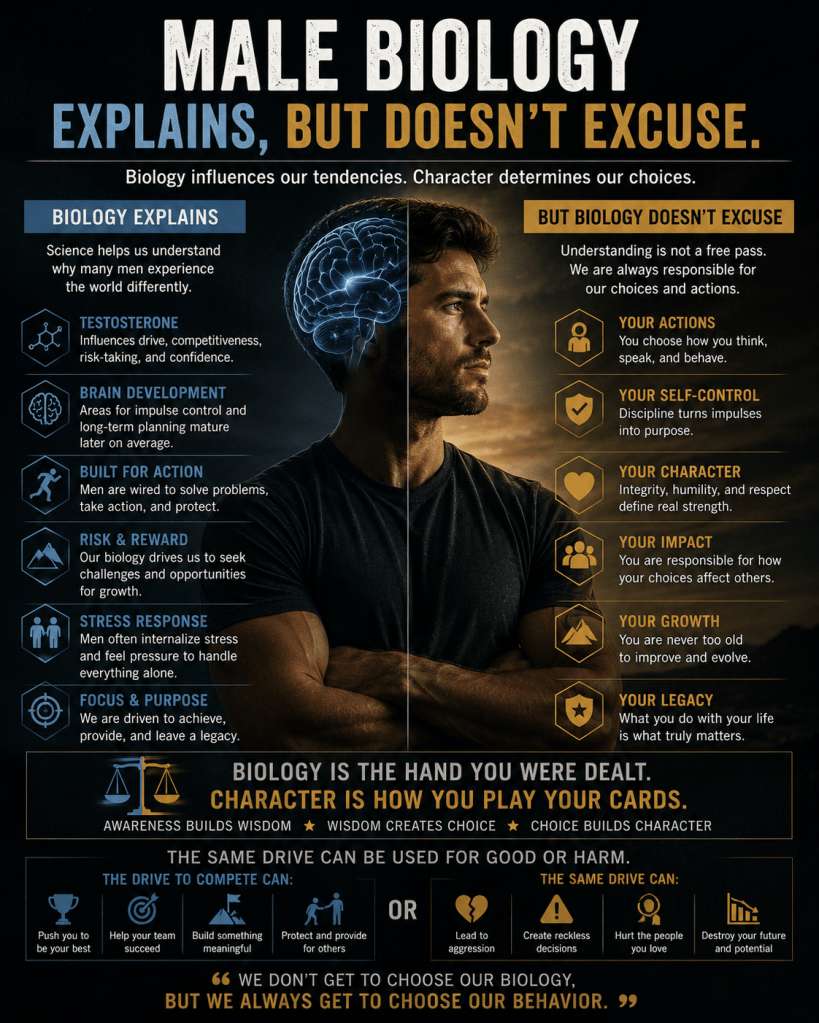
It’s important to keep returning to this point.
Biology provides context.
It does not remove responsibility.
A tendency toward risk-taking does not excuse recklessness.
Higher testosterone does not excuse violence.
A problem-solving mindset does not excuse emotional neglect.
Every man is responsible for his choices.
Character, maturity, self-awareness, and discipline ultimately matter far more than biology alone.
Understanding biology simply helps us recognize where some of our natural tendencies originate, so we can manage them wisely rather than pretend they don’t exist.
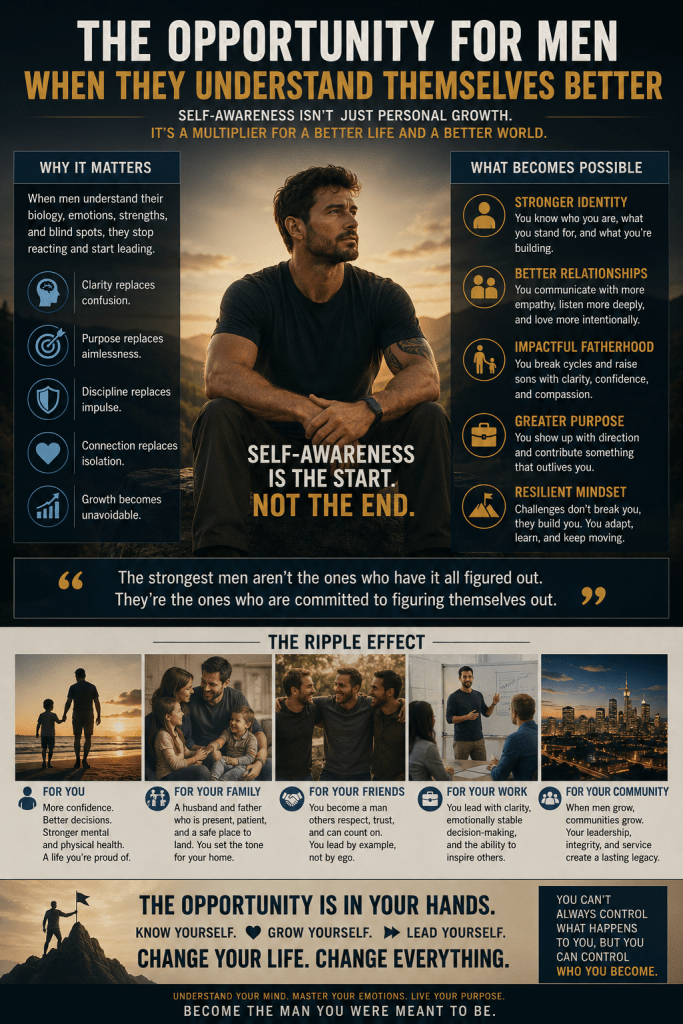
The Opportunity
When men understand themselves better, they become better husbands, fathers, brothers, coaches, leaders, and friends.
When women understand these tendencies, communication often becomes more compassionate and less adversarial.
And when boys are taught that biology gives them strengths to develop—not excuses to hide behind—they grow into men who are both resilient and emotionally mature.
Perhaps that’s the goal.
Not raising tougher men.
Not raising softer men.
But raising healthier men.
Men who possess both courage and compassion.
Strength and humility.
Confidence and self-awareness.
Because the world doesn’t simply need stronger men.
It needs good men.
About John J. Schessler, M.S.

John J. Schessler, M.S. is a Mental Performance Coach, Behavior Interventionist, speaker, and founder of Athlete Mindset HQ, a high-performance platform dedicated to helping people become the strongest version of themselves—mentally, emotionally, and physically.
John earned his Master of Science in Sport Psychology from Capella University and his Bachelor of Arts in Child & Adolescent Psychology from Southern New Hampshire University. His work combines evidence-based psychology with practical coaching to help athletes, students, professionals, and individuals facing life’s challenges develop resilience, confidence, discipline, and lasting mental strength.
His passion for this work is deeply personal. Having overcome significant adversity early in life, John understands that real strength isn’t measured by what happens to us—it’s measured by how we respond. That perspective shapes every conversation, coaching session, presentation, and piece of content he creates.
Through Athlete Mindset HQ and The Follow Through Podcast, John shares practical strategies, meaningful conversations, and real-world tools that empower people to perform at their best—not only in competition, but in everyday life. Whether discussing sports psychology, behavioral health, leadership, men’s mental health, or personal growth, his goal remains the same: to educate, encourage, and equip others with the mindset needed to overcome obstacles and pursue excellence with purpose.
Because success isn’t built by what you intend to do.
It’s built by what you follow through on.
#malemind #sportspsychology #athleticperformance #athletemindsetHQ #behavioralhealth #leadership #mensmentalhealth #personalgrowth


Leave a Reply