
by John J. Schessler MS, CPT, SPC

Long before an athlete takes the shot, steps onto the mat, approaches the starting line, or enters the weight room, a conversation has already begun.
It is not happening between the athlete and the coach. It is not coming from the crowd, an opponent, or a teammate.
It is happening inside the athlete’s own mind.
That internal conversation—known as self-talk—can influence confidence, concentration, emotional control, motivation, and performance. It can help an athlete respond to pressure with purpose, or it can allow one mistake to become a complete mental collapse.
The most important voice an athlete hears during competition is often their own.
What Is Self-Talk?

Self-talk refers to the words, thoughts, and internal messages athletes direct toward themselves. Sometimes it is deliberate:
“I am prepared for this.”
“Stay patient.”
“Next play.”
Other times, it happens automatically:
“I always mess this up.”
“I’m not good enough.”
“Everyone can see me failing.”
These thoughts may seem harmless because they remain inside the athlete’s mind, but the brain and body often respond to internal language as if it were an instruction.
When an athlete repeatedly thinks, “Don’t mess up,” attention becomes centered on the possibility of failure. Muscles may tighten, breathing may become shallow, and decision-making may become hesitant. The athlete is no longer fully responding to the competition—they are responding to the threat created within their own mind.
Self-talk is not simply background noise. It helps shape the athlete’s emotional and physical state.
Self-Talk Influences Attention

Athletic performance requires athletes to focus on information that matters while filtering out everything that does not.
Effective self-talk can serve as an attentional cue. Short phrases such as “eyes up,” “quick feet,” “breathe,” or “finish strong” direct the athlete toward a controllable action.
Ineffective self-talk does the opposite.
After making a mistake, an athlete may begin thinking:
“I can’t believe I did that.”
“What is my coach thinking?”
“What if I do it again?”
At that point, the athlete’s attention is no longer in the present. It is trapped between the mistake that already happened and the mistake they fear might happen next.
A strong performance cue brings the athlete back to the current moment:
“Reset.”
“Next possession.”
“Win this point.”
These phrases are powerful because they give the mind somewhere productive to go.
Self-Talk and Confidence

Confidence is not the absence of doubt. It is the belief that you can still respond effectively when doubt appears.
Athletes sometimes believe confident self-talk means making exaggerated statements such as:
“I am unstoppable.”
“I am the greatest athlete here.”
Those phrases may work for some people, but self-talk is usually most effective when it is believable, specific, and connected to preparation.
Instead of saying, “I cannot fail,” an athlete might say:
“I have prepared for this moment.”
“I can handle the pressure.”
“Trust the work.”
“I know how to respond.”
This type of language creates grounded confidence. It does not deny the difficulty of the situation. It reminds the athlete that they possess the preparation and skills required to face it.
The goal is not to convince yourself that competition will be easy. The goal is to remind yourself that you are capable when competition becomes difficult.
The Problem With Negative Self-Talk

Negative self-talk is not always loud or dramatic. It often appears in subtle statements:
“I’m having a bad day.”
“Nothing is working.”
“I always choke under pressure.”
“I’m just not confident.”
The danger is that these statements turn temporary experiences into permanent identities.
There is a major psychological difference between saying, “I made a mistake,” and saying, “I am a failure.”
One describes an event. The other defines the person.
When athletes repeatedly label themselves according to their worst moments, they strengthen a negative mental pattern. The brain begins searching for evidence that supports the belief. One missed shot becomes proof that the athlete “cannot perform under pressure.” One poor practice becomes evidence that they are “losing their ability.”
That is how one thought can become a belief—and how a belief can begin influencing behavior.
Productive Self-Talk Is Not Toxic Positivity

Developing better self-talk does not mean athletes must ignore frustration, disappointment, fear, or pain.
An athlete does not need to pretend that everything is fine when it is not.
Productive self-talk acknowledges reality while directing the athlete toward an effective response:
“That mistake was frustrating, but I can recover.”
“I feel nervous because this matters. Breathe and begin.”
“This is difficult, but I can stay composed.”
“I do not control the result. I control my next action.”
This is not fake positivity. It is psychological flexibility—the ability to experience difficult thoughts and emotions without allowing them to dictate the next decision.
Athletes do not need to win every internal argument. They need to stop giving every thought authority.
A thought can be present without being followed.
Three Types of Self-Talk Athletes Can Use
1. Instructional Self-Talk
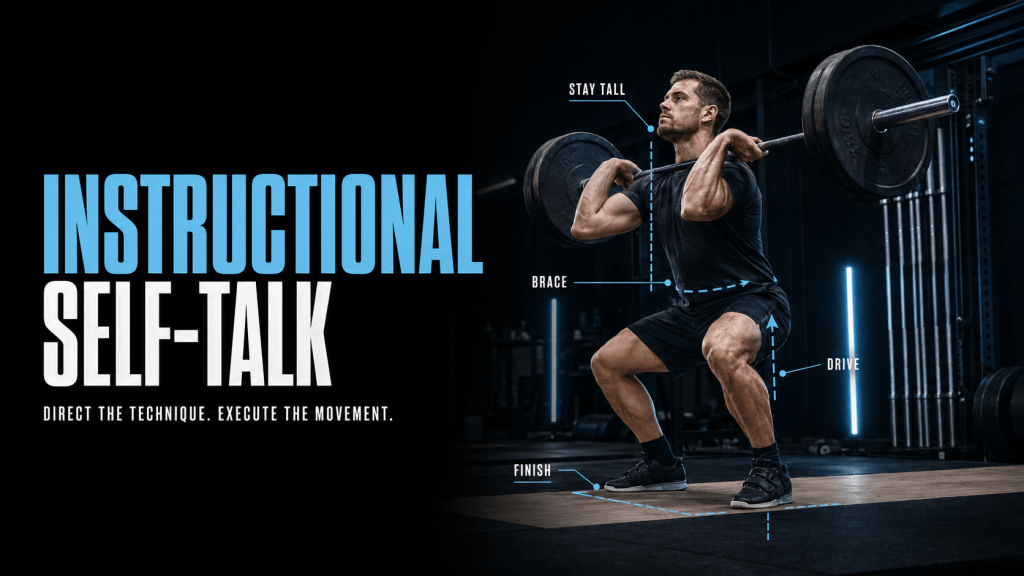
Instructional self-talk directs attention toward technique, positioning, or execution.
Examples include:
- “Keep your hands up.”
- “Drive through the floor.”
- “Stay low.”
- “Follow through.”
- “See the target.”
This type of self-talk is especially useful when learning a skill or correcting technique. During competition, however, cues should remain short. Too much technical thinking can create paralysis by analysis and interrupt automatic movement.
2. Motivational Self-Talk

Motivational self-talk helps athletes maintain effort, confidence, and intensity.
Examples include:
- “Keep pushing.”
- “You are ready.”
- “One more rep.”
- “Stay aggressive.”
- “Finish strong.”
These statements can be especially effective during fatigue, adversity, or moments when an athlete’s energy begins to drop.
3. Reset Self-Talk
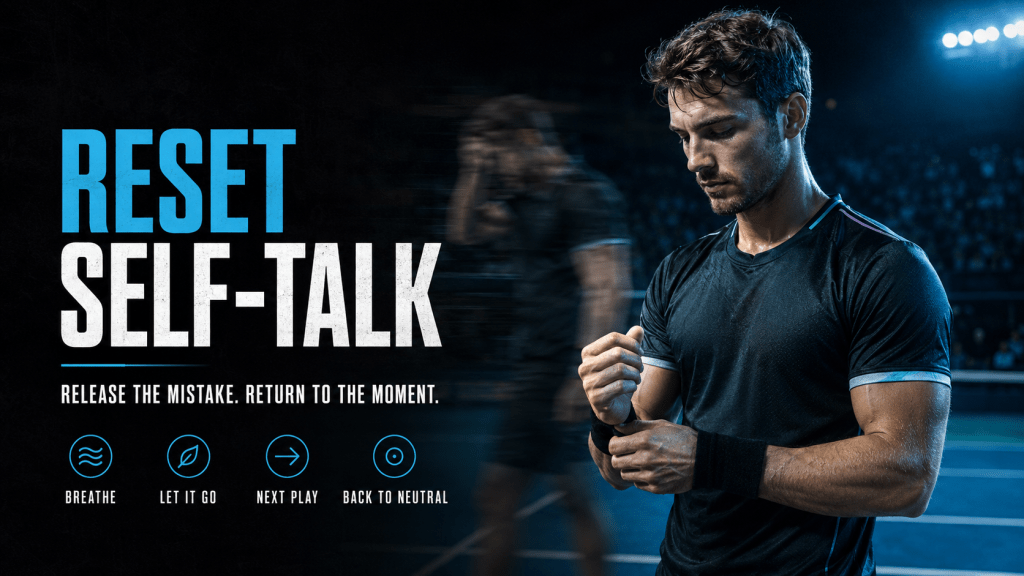
Reset self-talk helps athletes recover after mistakes, setbacks, or emotional reactions.
Examples include:
- “Next play.”
- “Let it go.”
- “Reset and respond.”
- “Back to neutral.”
- “Control the next moment.”
Every athlete makes mistakes. Mentally strong athletes are not necessarily those who make fewer mistakes—they are often the ones who recover more quickly.
The Self-Talk Reset
Athletes can use a simple process when they notice their internal dialogue becoming destructive.
Step 1: Recognize the Thought

Pay attention to the exact language running through your mind.
What are you saying to yourself?
Would you speak to a teammate this way?
Step 2: Challenge the Message

Ask whether the thought is completely accurate or simply an emotional reaction.
“I missed that shot” is a fact.
“I always fail when it matters” is an interpretation.
Learning to separate facts from interpretations prevents one moment from controlling the entire performance.
Step 3: Replace It With a Performance Cue

Choose a phrase that is believable, brief, and actionable.
Instead of “Don’t mess up,” use “Trust your technique.”
Instead of “I’m terrible today,” use “Adjust and compete.”
Instead of “I can’t handle this pressure,” use “Breathe and execute.”
Step 4: Reconnect With the Body
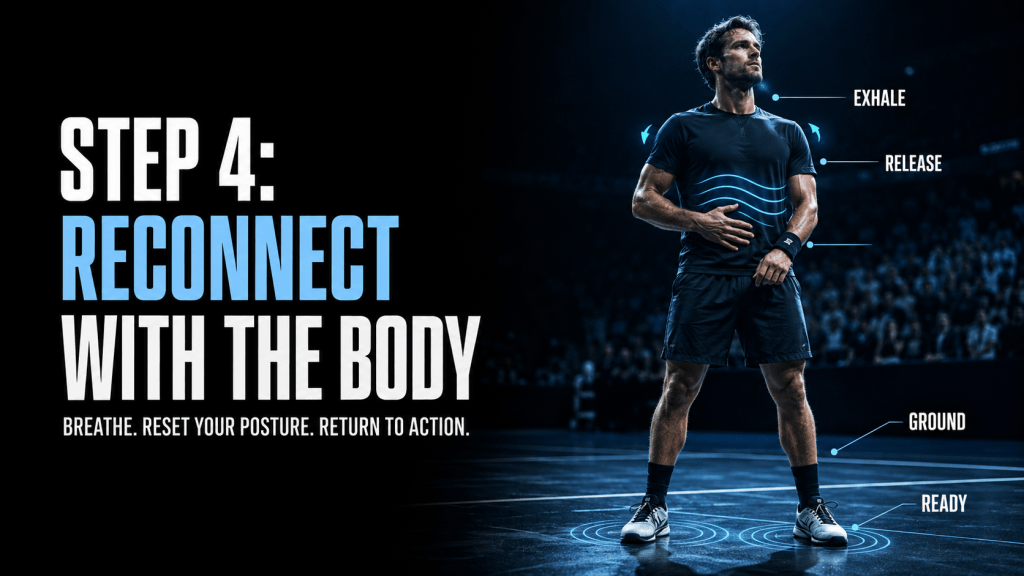
Combine the new phrase with a physical reset—a deep breath, a shoulder release, an equipment adjustment, or a return to the starting position.
This connects the mental cue to a consistent action and helps the athlete transition back into the present.
Coaches Shape an Athlete’s Inner Voice
Athletes do not develop self-talk in isolation.
Over time, the voices of coaches, parents, teammates, and other influential people can become part of an athlete’s internal dialogue. If an athlete is repeatedly told that mistakes are unacceptable, they may eventually begin punishing themselves for every error. If they are taught that mistakes provide information, they are more likely to respond with curiosity and adjustment.
This does not mean coaches should avoid accountability or difficult feedback. Athletes need honesty. But effective feedback addresses behavior without attacking identity.
“You lost focus on that possession” encourages correction.
“You are mentally weak” creates a label.
One teaches. The other wounds.
Strong coaching helps athletes develop an internal voice that is demanding without being destructive, confident without being unrealistic, and compassionate without eliminating accountability.
Train Your Inner Voice

Athletes train strength, speed, endurance, and technique. Self-talk deserves the same intentional practice.
Do not wait until the championship game to decide what you need to hear.
Write down the negative phrases that appear most often during practice and competition. Then develop a specific replacement for each one. Practice those new phrases during training so they become familiar under pressure.
Your self-talk will not always be perfect. Negative thoughts will still appear. Doubt will still show up. Pressure will still challenge you.
Mental strength is not controlling every thought that enters your mind.
It is choosing which thoughts deserve to guide your actions.
The voice within can become your harshest critic or one of your strongest competitive tools. Train it with the same discipline you bring to your body and your sport.
Because when the pressure rises, the crowd gets louder, and the outcome remains uncertain, your inner voice may be the one that determines what happens next.
You do not have to believe every thought you have. But you do have the power to choose the voice you follow.
About John J. Schessler, M.S.

John J. Schessler, M.S., is a Mental Performance Coach, Behavior Interventionist, speaker, and founder of Athlete Mindset HQ—a high-performance coaching platform dedicated to helping athletes, professionals, and everyday individuals develop the mindset needed to thrive under pressure and perform at their highest potential.
John earned his Master of Science in Sport Psychology from Capella University and his Bachelor of Arts in Child & Adolescent Psychology from Southern New Hampshire University. His work bridges the gap between psychology, human performance, behavioral science, and personal development, combining evidence-based strategies with practical coaching that people can immediately apply in sport, work, and everyday life.
His passion for helping others is rooted in his own journey. As a child, John survived Guillain-Barré Syndrome, spending weeks in a coma before fighting through rehabilitation to reclaim his life. That experience shaped his belief that resilience isn’t something you’re born with—it’s something you build through adversity, discipline, and purpose.
Today, John works with individuals from all walks of life, helping them strengthen confidence, improve emotional resilience, overcome obstacles, and develop the habits that lead to lasting success. Whether coaching athletes, mentoring students, speaking to organizations, or creating educational content, his mission remains the same: to help people become mentally stronger than the challenges they face.
John is also the host of The Follow Through Podcast, where he explores sports psychology, leadership, men’s mental health, motivation, resilience, and human performance through practical conversations that inspire listeners to move beyond intention and into action.
His philosophy is simple:
Mental strength isn’t about never struggling. It’s about developing the confidence, discipline, and resilience to keep moving forward—especially when life gets difficult.
Because success isn’t built by what you intend to do.
It’s built by what you follow through on.

 Athlete Mindset HQ Institute
Leave a comment