
My Story. Our Lessons. | Part Three
By John J. Schessler, M.S., CPT, SPC
There’s a sentence I sometimes use to end a conversation with myself before it has really begun.
“I should just be grateful.”
I feel frustrated, and there it is. I feel disappointed, and it appears again. I have a difficult day, and suddenly my brain convenes a committee to determine whether my circumstances justify complaining.
Apparently, I have an internal Department of Emotional Eligibility.
The paperwork is exhausting.
I am grateful for my life. When I think about developing Guillain-Barré syndrome at ten years old, spending six weeks in a coma, and going through rehabilitation, I think about the people who helped me. I think about my family, the medical professionals, and the support that made recovery possible.
But appreciating my life raises a question I’m still learning to answer:
Can I be grateful that I survived and still admit that some days are difficult?
I believe I can. And I suspect other people need room for that same answer.
When Gratitude Becomes Another Expectation

In the first part of this series, The Life I Almost Didn’t Get to Live, I shared my childhood recovery story, including the blue mashed potatoes that became such a meaningful memory.
In the second, I Survived. So Why Am I Still So Hard on Myself? I explored the uncomfortable gap between the compassion I feel for that little boy and the criticism I sometimes direct toward the man he became.
This is another layer of that conversation.
Even when I recognize that I’m being hard on myself, I can introduce another demand:
“You know how fortunate you are. You should be more positive.”
Now I’m disappointed in myself for feeling disappointed.
My inner critic has hired an assistant.
Gratitude can be meaningful. Remembering the people who helped me can bring perspective and appreciation. But when “I’m grateful” becomes “I’m not allowed to struggle,” I stop being honest about what I’m experiencing.
I can appreciate what my body allows me to do and still wish something felt easier. I can value my work and come home exhausted. I can be proud of an accomplishment and uncertain about what comes next.
Those feelings belong to the same life.
“At Least You Survived”
“At least” is a small phrase that can close a large conversation.
At least you survived.
At least you have a job.
At least things aren’t worse.
Sometimes these reminders help. Sometimes we offer them because we care and want someone to feel better. I’ve probably reached for that kind of reassurance myself.
But there are moments when perspective arrives before understanding.
Someone says they’re tired, and we remind them how fortunate they are. Someone admits they’re frustrated, and we point to everything they have going for them.
The good things may be real. So is the difficulty they were trying to describe.
When I’m struggling, I don’t always need an immediate inventory of my blessings. Sometimes I need a moment to say, “This is hard,” without feeling that I’ve failed a character test.

I want to offer myself that same courtesy.
Acknowledging difficulty doesn’t erase appreciation.
It gives me a more honest place to begin.
Pain Doesn’t Need a Ranking System
“Other people have it worse.”
Of course they do. Somewhere, someone is experiencing something more difficult than whatever I’m facing.
But if that means only the person suffering most is allowed to speak, we’ve created a very strange system.
Do we find the person having the worst day on Earth and give them exclusive complaining rights? Does everyone else have to remain pleasant until further notice?
I wouldn’t ask a friend to prove that their exhaustion outranked somebody else’s before listening. Yet I sometimes expect that proof from myself.
Recognizing another person’s suffering can deepen my compassion. It doesn’t require dismissing my own experience.
A more useful question might be:
“What would help me respond to this well?”
That question gives me something to work with. Perhaps I need rest, support, a practical adjustment, or time to acknowledge disappointment. None of those needs becomes less real because someone else also needs care.
The Pressure to Be Inspirational

Sharing a recovery story can be meaningful. It can also create expectations, including expectations I place on myself.
People may describe the story as inspiring. They may use words such as strong or resilient. I can appreciate those words while being careful about what I ask them to mean.
I don’t want “resilient” to become a rule that says I’m never allowed to feel discouraged. I don’t want “strong” to mean I should manage everything alone.
And I don’t want “inspirational” to become a position I have to clock into every morning.
Some mornings, I’m simply looking for my keys.
The lesson is usually that I should put them in the same place.
My life includes meaningful experiences. It also includes laundry, errands, unfinished tasks, and ordinary days when I have nothing especially profound to say.
I want room for those days, too.
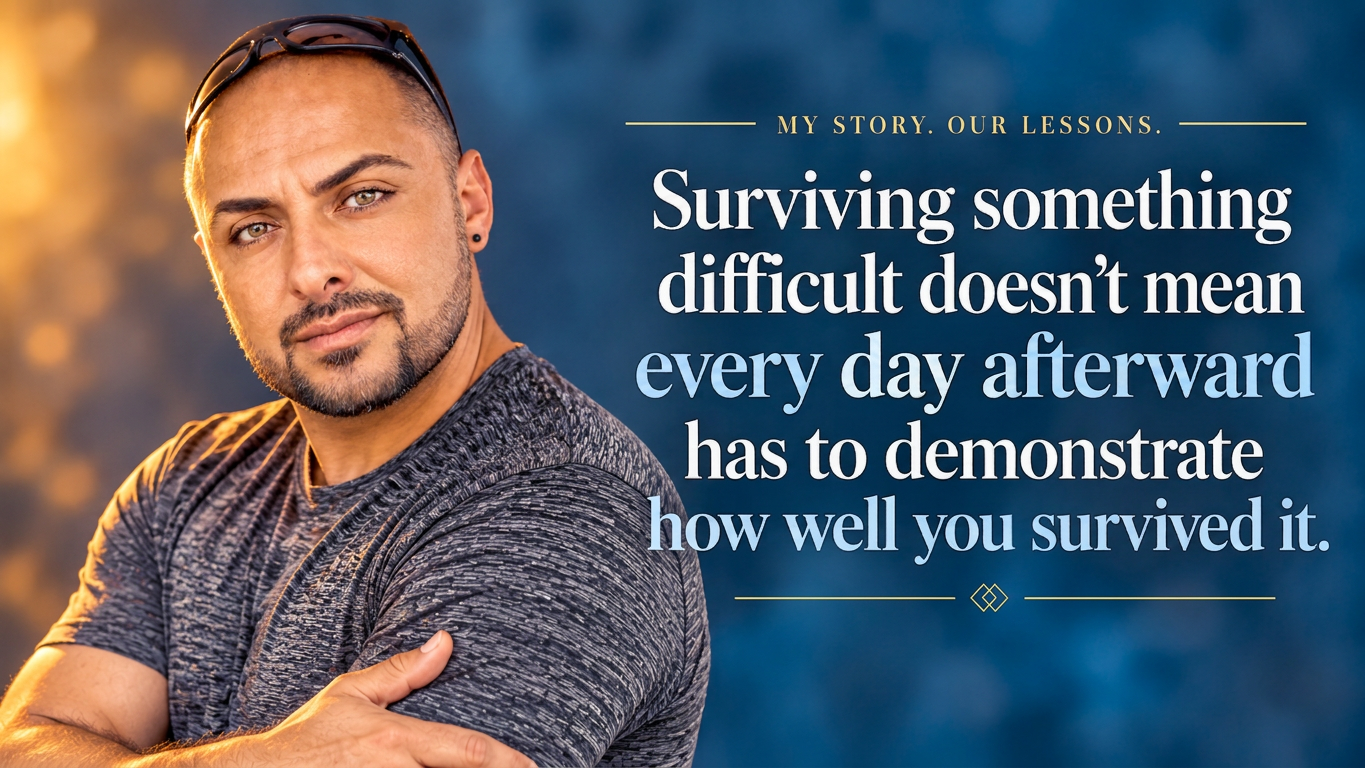
Surviving something difficult doesn’t mean every day afterward has to demonstrate how well you survived it.
I can share what I’ve learned while continuing to need encouragement myself.
Gratitude Can Sit Beside Loss

Recovery is part of my story. So are the difficulties that came before it and the challenges I continue navigating.
Appreciating what I regained doesn’t require pretending that everything became easy. I can recognize progress while acknowledging experiences I wish had been different.
I don’t need to conclude that everything happened for a reason.
What happened was difficult. People helped me. Rehabilitation required effort and support. My life continued, and over time, I found meaning in parts of that experience.
That meaning matters to me. It doesn’t make every part of the experience something I would have chosen.
I think we can allow ourselves that complexity.
Someone can appreciate their family and feel overwhelmed by responsibilities. They can welcome an opportunity and feel anxious about change. They can be proud of progress and tired of how much effort the next step requires.
We don’t always need to correct one feeling with another. Sometimes we can listen long enough to understand both.
Making Room for the Word “And”

One small change I’m practicing is replacing some of my internal arguments with the word “and.”
“I’m grateful, and this is difficult.”
“I’m proud of myself, and I’m disappointed.”
“I care about my work, and I need a break.”
“I appreciate my body, and I’m frustrated today.”
That word gives me breathing room. I don’t have to remove half the sentence to make the other half acceptable.
It also helps me move toward a decision. Once I acknowledge what I’m experiencing, I can ask what the situation calls for.
Is there something I can change? Do I need help? Would a different expectation make more sense? Am I trying to solve a problem when I first need to rest?
Acknowledgment doesn’t answer every question. It helps me stop adding another layer of judgment before I’ve considered what might help.
Letting Gratitude Be Something I Feel

I want gratitude to have a place in my life without making it a performance.
Sometimes appreciation comes through a conversation, a person checking in, or a moment that went better than expected. It can be quiet and specific.
I don’t have to turn it into a declaration that everything is wonderful.
I can enjoy something good while another part of my life remains unresolved. I can appreciate one moment without asking it to justify the entire day.
And when gratitude feels distant, I can begin with honesty.
“Today has been demanding.”
“I’m disappointed.”
“I need some support.”
Those statements leave room for a response. They help me understand where I am instead of where I think I should be.
What I’d Tell That Little Boy

If the ten-year-old version of me said he was tired of rehabilitation, I hope I would listen before reminding him how fortunate he was to receive help.
I would want him to know that it made sense to be tired. That he could care about getting better and still need encouragement. That he could appreciate the people helping him while wishing he didn’t have to go through any of it.
His feelings wouldn’t make him ungrateful.
They would tell me something about what he was experiencing and the support he needed.
The adult version of him deserves that same consideration.
In the previous article, I wrote:
“You don’t have to spend the rest of your life proving that you deserved to survive.”
Part of living that message is allowing a difficult day to be a difficult day.
It doesn’t need to become evidence that I’ve forgotten how fortunate I am. It doesn’t need an uplifting conclusion before I’m allowed to talk about it.
Sometimes I can acknowledge it, take care of myself, and see what tomorrow brings.
A Question to Carry With You

The next time you hear yourself say, “I should just be grateful,” pause for a moment.
Is that thought helping you appreciate something meaningful?
Or is it asking you to stop feeling something you haven’t had the opportunity to understand?
You can recognize the good in your life and acknowledge that you’re having a hard time. You can appreciate your progress and ask for help with what comes next.
Being grateful to be alive doesn’t mean you have to love every moment of being human.
Some days, you’ll feel thankful. Some days, you’ll feel tired. Some days, you’ll feel both.
There’s room for all of that.
John J. Schessler, M.S., CPT, SPC, is the founder of Athlete Mindset HQ, a mental performance coach, certified personal trainer, and behavioral interventionist. My Story. Our Lessons. explores personal experiences and the lessons they offer about identity, resilience, and meaningful growth.


Leave a Reply