
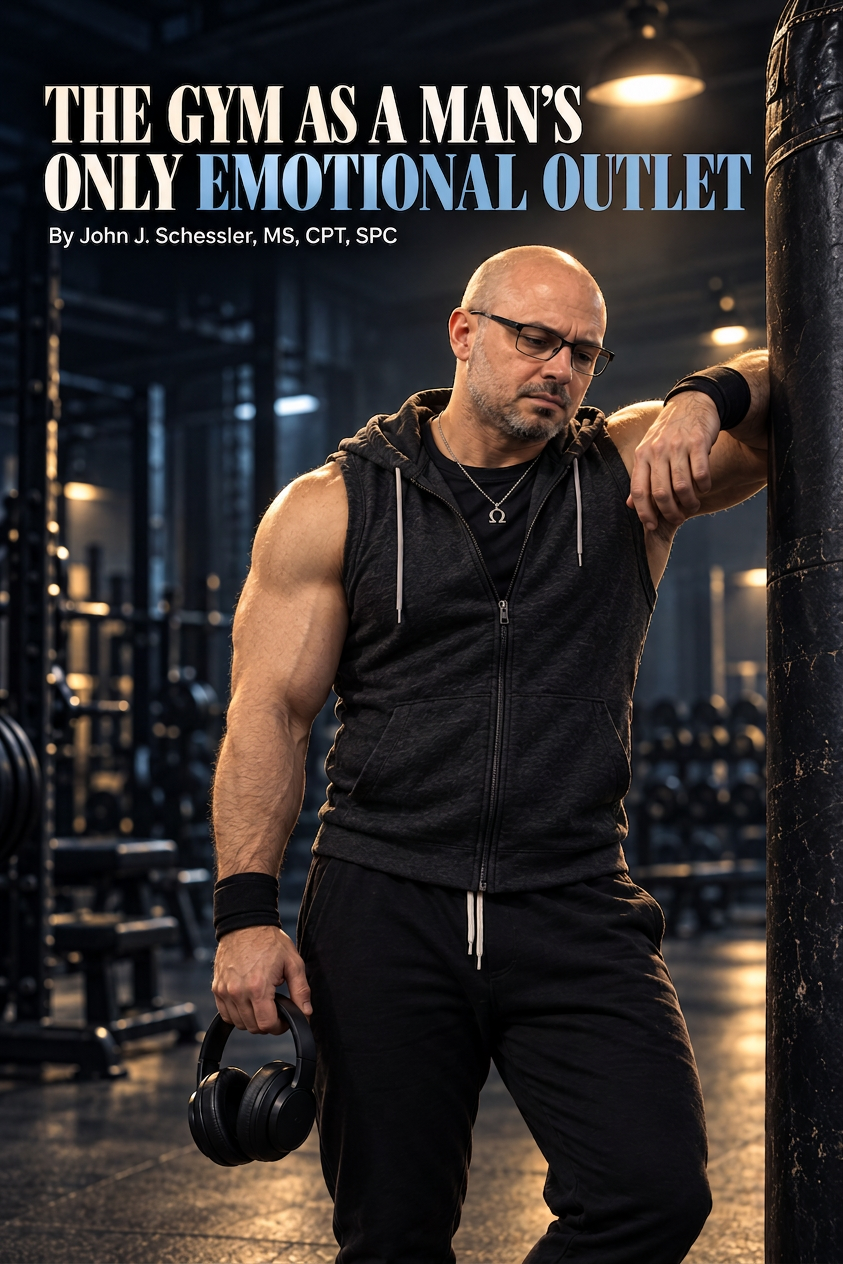
Men, Muscle & Mind: The Psychology Behind How Men Train
By John J. Schessler, MS, CPT, SPC
There are men who will tell you that the gym saved their lives.
They may not be exaggerating.
Training can provide structure during chaos, movement during depression, and a sense of control when everything else feels uncertain. The weight room does not ask a man to explain himself. It gives him something concrete to do with his frustration, anxiety, loneliness, grief, or anger.
Load the bar. Put on the headphones. Complete the set.
For an hour, everything becomes simpler.
There is nothing wrong with relying on exercise during difficult periods. Physical activity can regulate stress, improve mood, interrupt rumination, and restore a sense of personal agency. The gym can become a refuge—a place where a man reconnects with his body and remembers that he is capable of doing hard things.
But what happens when it becomes the only place he knows how to feel?
What happens when training is not one emotional outlet, but the only emotional outlet he permits himself to have?
The gym gives emotions somewhere to go

Many men learn early that certain emotions are acceptable only after they have been converted into action.
Fear becomes preparation. Sadness becomes silence. Insecurity becomes competition. Rejection becomes self-improvement. Anger becomes intensity.
The gym welcomes all of those transformations.
A man does not have to say, “I feel powerless.” He can add another plate to the bar.
He does not have to admit, “I feel rejected.” He can begin a physical transformation.
He does not have to explain that he is overwhelmed. He can train until his mind becomes quiet.
Exercise gives emotional energy somewhere to go physically. The heart rate increases. Muscles contract. Breathing becomes purposeful. Thoughts that felt unmanageable begin organizing themselves around the next repetition.
For some men, this may be the only time they experience genuine emotional relief.
That relief is real. It matters. But relief is not always the same as resolution.
Movement can regulate what words cannot yet reach

Not every emotional experience needs to begin with a conversation.
Sometimes the body needs movement before the mind can make sense of what happened. A difficult workout may help a man move through the initial intensity of an emotion until he can think more clearly.
This is one reason advice like “just talk about it” can feel incomplete.
Talking requires a person to recognize what he feels, trust someone with it, and find language for an experience that may still feel confusing. Training requires none of those things. It offers immediate action and predictable feedback.
The weight moves, or it does not. The set ends. The breathing settles.
That simplicity can be especially appealing to men who feel responsible for remaining calm, capable, and dependable in other parts of life. The gym becomes the one place where tension can be released without explanation.
The problem is not that a man uses exercise to regulate his emotions.
The problem begins when exercise replaces every other way of relating to them.
Emotional release is not emotional processing
A workout can reduce the intensity of anger without addressing its source.
It can temporarily quiet loneliness without creating connection. It can interrupt anxious thoughts without helping a man understand what he fears. It can exhaust the body enough to make grief less noticeable for the evening.
That can be useful. Sometimes reducing emotional intensity is exactly what a person needs.
But if the same emotion returns every time the body becomes still, the workout may be releasing pressure without resolving what continues to create it.
Imagine a pressure valve. Opening it prevents the system from becoming overwhelmed, but it does not repair the conditions causing the pressure to build.
For some men, training functions in the same way.
They leave the gym calmer, but the relationship remains strained. The loss remains unacknowledged. The loneliness remains unnamed. The fear remains hidden beneath productivity and discipline.
The body feels better, but the underlying experience has not been fully met.
Why the gym can feel safer than another person
Weights are predictable in ways people are not.
A barbell does not interrupt. A treadmill does not judge. A workout does not misunderstand what you meant or respond with discomfort when you become vulnerable.
People can disappoint us. They may minimize what we feel, offer unwanted advice, change the subject, or use something personal against us later. Some men have learned through experience that emotional openness is not always received safely.
The gym offers control.
You decide when to arrive, what to train, how hard to push, and when to leave. Progress can be measured. Effort is usually rewarded. The expectations are clear.
Human relationships are much less orderly.
This may be one reason a man can walk into a crowded gym without hesitation but struggle to send one honest message:
“I’m having a hard time. Can we talk?”
The workout feels productive. The conversation feels exposed.
When the gym becomes avoidance

Using exercise to cope does not automatically mean a man is avoiding his emotions. The distinction often depends on flexibility.
Healthy coping allows a person to train—and also rest, talk, reflect, connect, or ask for help when needed.
Avoidance is more rigid. The workout begins to feel mandatory because being still would allow uncomfortable emotions to surface.
Possible signs include:
- Becoming highly anxious or irritable when a workout is missed
- Training while injured because rest feels emotionally intolerable
- Extending workouts mainly to avoid returning home
- Using exhaustion to prevent thinking or feeling
- Withdrawing from relationships while increasing time in the gym
- Believing that emotional pain should always be handled alone
- Responding to every setback by increasing training intensity
- Feeling calm only during or immediately after exercise
- Refusing support because training is viewed as the only acceptable solution
These behaviors do not necessarily indicate a mental-health disorder. They may simply suggest that one coping strategy is being asked to carry more emotional weight than it can safely hold.
The question is not, “Do I use the gym to cope?”
Most people do in some form.
The better question is:
“What happens to me when I cannot train?”
The identity of the man who always handles it

For some men, the gym supports an identity built around endurance.
He is the disciplined one. The strong one. The man who keeps going. Other people may admire his consistency without realizing how much emotional responsibility has been placed on it.
Training becomes evidence that he is still functioning.
Even when a relationship ends, he trains. When work becomes overwhelming, he trains. When he feels lonely, ashamed, or uncertain, he trains.
There is something admirable in that persistence.
But the identity can become restrictive when the man believes that coping well means never needing anything from another person. He may accept physical struggle while refusing emotional support. He can ask someone to spot a heavy lift but cannot ask them to stay with him during a difficult night.
His discipline is genuine. So is his isolation.
Strength begins to mean managing everything privately.
Training harder cannot solve every kind of pain
The fitness world often presents effort as a universal answer.
Feeling insecure? Work harder.
Experiencing rejection? Improve yourself.
Feeling anxious? Push through it.
Feeling lost? Become more disciplined.
Effort is powerful, but it is not a complete emotional philosophy.
Some problems require action. Others require grief, acceptance, communication, boundaries, forgiveness, or support. A workout may help a man prepare for those experiences, but it cannot complete them on his behalf.
You cannot deadlift your way through an apology you need to make.
You cannot outrun a conversation you need to have.
You cannot build enough muscle to guarantee that you will never feel rejected again.
Training can make you stronger for life. It cannot replace living it.
Expanding the emotional toolbox
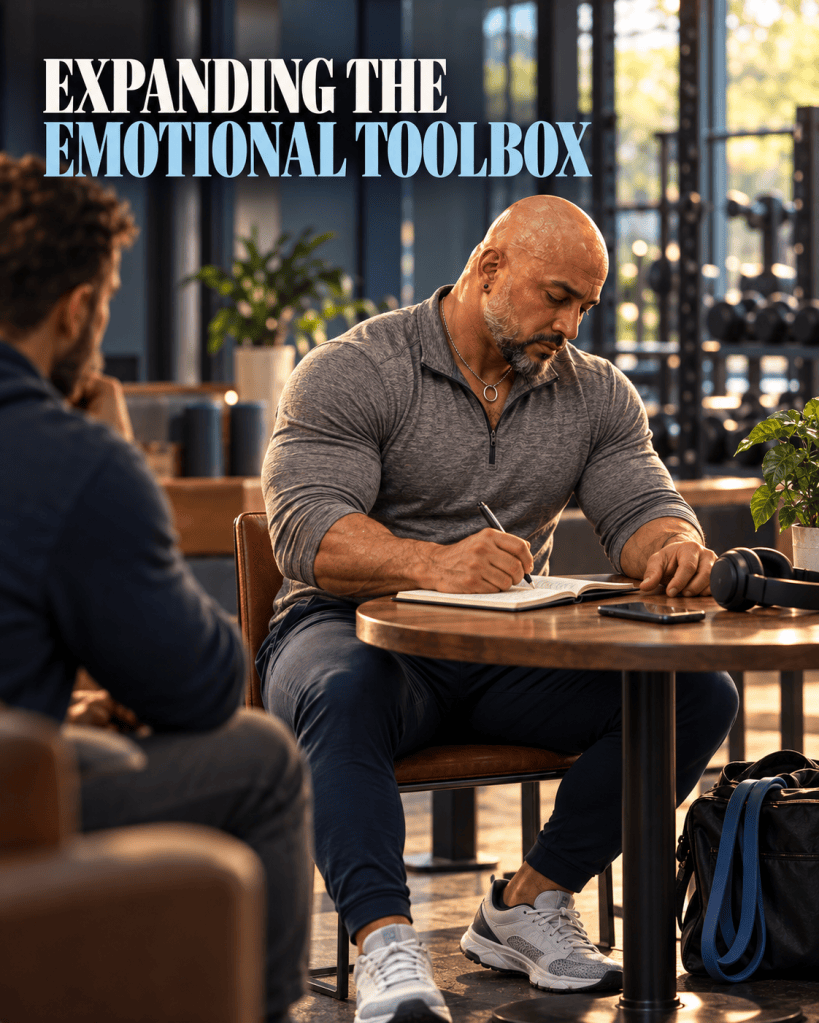
The goal is not to take the gym away from men.
For many, it is one of the healthiest and most stabilizing parts of life. The goal is to ensure that training remains a resource rather than becoming an emotional requirement.
A broader coping system might include:
- Talking honestly with a trusted friend
- Writing down what happened before deciding what to do about it
- Taking a quiet walk without tracking pace or calories
- Spending time with people without needing to perform or compete
- Naming an emotion instead of immediately trying to eliminate it
- Allowing a rest day without interpreting it as weakness
- Speaking with a counselor or qualified mental-health professional
- Participating in a men’s group, support group, or meaningful community
- Using breathing, mindfulness, prayer, or reflection to tolerate stillness
- Setting boundaries around situations that repeatedly create distress
None of these practices makes exercise less valuable.
They prevent exercise from having to do every job.
Let the workout open the door

The gym can become the beginning of emotional processing rather than the end of it.
After training, when the nervous system feels calmer, a man may be more capable of asking himself what the workout helped him carry.
What was I feeling before I arrived?
What changed while I trained?
What is still waiting for me now that the workout is over?
Does something need to be accepted, communicated, changed, or grieved?
The answer may be simple. Sometimes a difficult day genuinely needs nothing more than movement, food, sleep, and another attempt tomorrow.
Other times, the workout creates enough internal space for a man to recognize that something deeper requires his attention.
That recognition is not failure.
It is awareness.
Between the Reps
During your next rest period, resist the urge to immediately reach for your phone or distract yourself.
Take one breath and ask:
“What did I bring into the gym with me today?”
Anger? Loneliness? Pressure? Rejection? Fear? A need to feel capable again?
You do not have to solve it between sets.
Just practice recognizing that it is there.
The goal is not to become less focused on your workout. It is to understand the person completing it.
Mindset Reframe
Old belief: The gym is where I go so I do not have to feel any of this.
New belief: The gym can help me regulate what I feel so I can respond to it more honestly.
The Final Rep
The gym can be a sanctuary.
It can hold a man through periods when he does not yet have the words to explain what he is experiencing. It can provide discipline when motivation disappears, routine when life becomes chaotic, and proof of capability when confidence feels distant.
That should not be dismissed.
But even a sanctuary becomes limiting if a man never allows himself to leave it emotionally.
Strength is not measured only by how effectively you convert pain into performance. Sometimes strength means allowing another person to understand what the performance has been carrying.
Keep training.
Let the gym remain one of the places where you find relief, clarity, confidence, and control.
Just do not make it the only place where you are allowed to be human.
ABOUT THE AUTHOR

John earned his Master of Science in Sport Psychology from Capella University and his Bachelor of Arts in Child & Adolescent Psychology from Southern New Hampshire University. His work bridges the gap between psychology, human performance, behavioral science, and personal development, combining evidence-based strategies with practical coaching that people can immediately apply in sport, work, and everyday life.
John J. Schessler, M.S., is a Mental Performance Coach, Behavior Interventionist, speaker, and founder of Athlete Mindset HQ—a high-performance coaching platform dedicated to helping athletes, professionals, and everyday individuals develop the mindset needed to thrive under pressure and perform at their highest potential.
His passion for helping others is rooted in his own journey. As a child, John survived Guillain-Barré Syndrome, spending weeks in a coma before fighting through rehabilitation to reclaim his life. That experience shaped his belief that resilience isn’t something you’re born with—it’s something you build through adversity, discipline, and purpose.
Today, John works with individuals from all walks of life, helping them strengthen confidence, improve emotional resilience, overcome obstacles, and develop the habits that lead to lasting success. Whether coaching athletes, mentoring students, speaking to organizations, or creating educational content, his mission remains the same: to help people become mentally stronger than the challenges they face.
John is also the host of The Follow Through Podcast, where he explores sports psychology, leadership, men’s mental health, motivation, resilience, and human performance through practical conversations that inspire listeners to move beyond intention and into action.
His philosophy is simple:
Mental strength isn’t about never struggling. It’s about developing the confidence, discipline, and resilience to keep moving forward—especially when life gets difficult.
Because success isn’t built by what you intend to do.
It’s built by what you follow through on.
Personal Brand Statement
John J. Schessler, M.S. is dedicated to helping people unlock their potential by strengthening the one asset that influences every area of life—the mind. Through education, coaching, and authentic conversation, he empowers others to develop confidence, resilience, and the discipline to follow through on their goals.


Leave a comment