
by John J. Schessler, MS

Two men can spend three hours together, barely discuss their personal lives, insult each other repeatedly, compete over something completely meaningless, and leave feeling closer than when they arrived.
From the outside, that can look strange.
From the inside?
It can make perfect sense.
Male friendship often has its own language.
It isn’t always spoken through long conversations, emotional disclosures, or obvious expressions of affection. Sometimes it happens through a fist bump. A joke. A challenge. A workout. Sitting next to each other, watching a game. Helping someone move on a Saturday morning.
Or simply asking:
“You good, man?”
Understanding male-to-male behavior requires us to look beyond what men say and pay attention to what they do.
Men Often Bond Shoulder-to-Shoulder

One of the most recognizable patterns in male friendship is what we might call “shoulder-to-shoulder” connection.
Men frequently develop relationships while participating in a shared activity.
Training.
Playing sports.
Working.
Fishing.
Gaming.
Watching football.
Building something.
Driving somewhere.
The activity gives the relationship somewhere to exist.
This doesn’t mean men are incapable of sitting face-to-face and discussing emotions. Of course they are.
But for many men, emotional connection develops more naturally when conversation isn’t the only thing happening.
Think about the conversations that happen during a long drive.
You’re both looking forward.
There’s no intense eye contact.
There isn’t necessarily pressure to respond immediately.
And suddenly someone says:
“Things haven’t been great lately.”
That’s the opening.
The activity creates psychological breathing room for vulnerability.
Banter Can Be Affection in Disguise
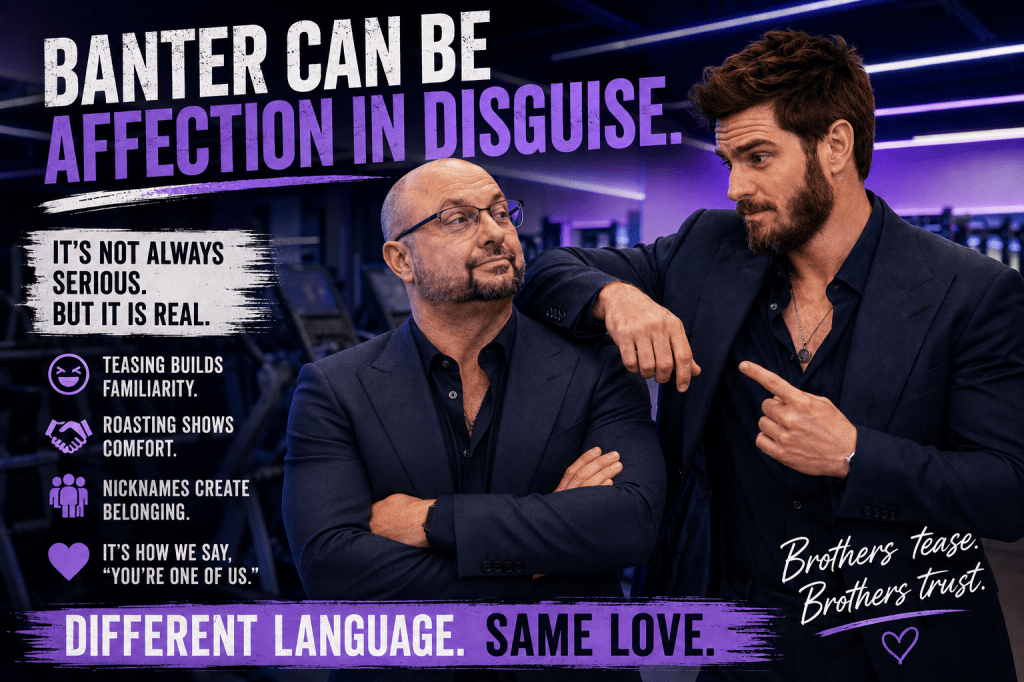
Male friendships can sound absolutely brutal to outsiders.
Friends roast each other.
Nicknames appear.
Old mistakes become permanent material.
Someone gets a new haircut and immediately regrets walking into the room.
Yet within healthy friendships, this behavior can serve an important social function.
Banter can communicate familiarity.
There is an implied message underneath it:
I know you.
You belong here.
We’re comfortable enough with each other that we can play.
Psychologically, humor can also reduce tension and make emotionally uncomfortable situations easier to approach.
A man might not know how to say:
“I’m really glad you’re okay.”
So instead, after his friend recovers from something difficult, he says:
“Good. Now quit being dramatic.”
Both men laugh.
And somehow they both understand what was actually being communicated.
Context matters, of course. Humor that humiliates, isolates, or repeatedly targets someone’s insecurities isn’t healthy bonding.
But affectionate teasing between friends can become part of their shared language.
Competition Doesn’t Always Mean Conflict
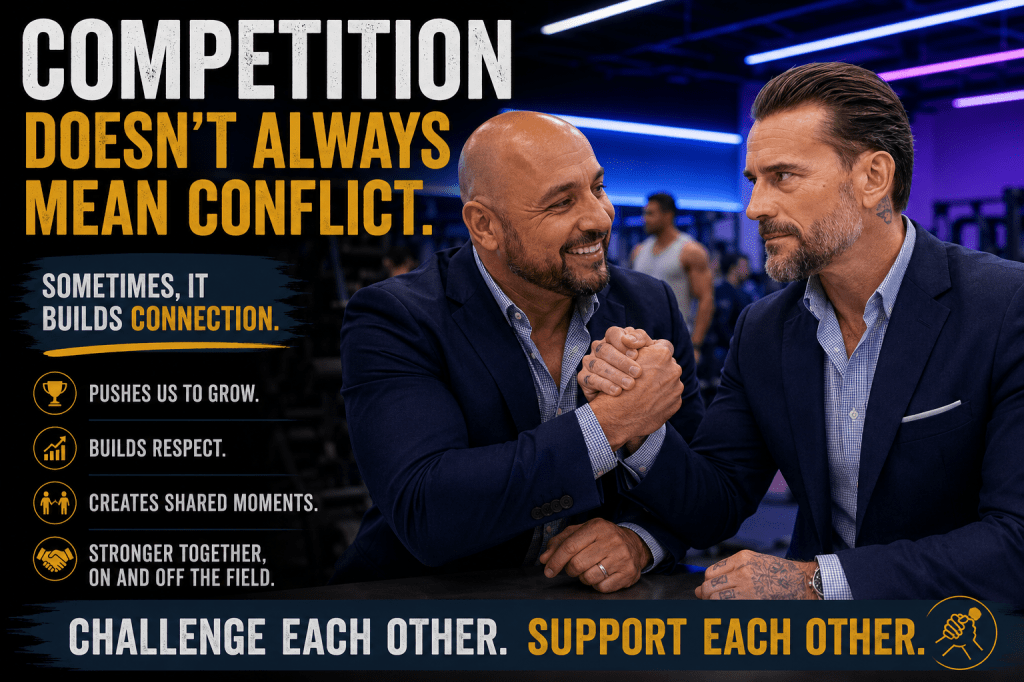
Put a group of men together long enough, and eventually somebody turns something into a competition.
Who can lift more?
Who can run faster?
Who knows more sports trivia?
Who grills the better steak?
Who can parallel park in one attempt?
Sometimes the competition is objectively ridiculous.
That’s part of the fun.
Healthy competition can create opportunities for men to test themselves against one another without threatening the relationship.
It can also communicate something deeper:
“I think you’re capable.”
When one man challenges another, the underlying message may be:
I believe you can rise to this.
That’s why teammates can compete intensely during practice and still walk out together afterward.
Competition and connection aren’t necessarily opposites.
Sometimes competition creates connection.
Respect Can Come Before Vulnerability

We often assume relationships become close through personal disclosure.
Sometimes they do.
But many male relationships follow another pathway:
Reliability → Respect → Trust → Vulnerability
A man watches how another man behaves.
Does he keep his word?
Does he show up?
Does he stay calm when things get difficult?
Can he admit when he’s wrong?
Does he treat people well when there’s nothing to gain?
Can he be trusted with information?
Over time, those observations create something important:
psychological safety.
Only then might the deeper conversations begin.
This is why two men may know each other for years before suddenly having an incredibly personal conversation.
The relationship wasn’t necessarily shallow before that moment.
Trust was being built behaviorally.
Showing Up Is Sometimes the Male Version of “I Love You”

Ask a man about one of his closest friends and you may hear something like:
“If I called him at 2:00 in the morning, he’d be there.”
That sentence says almost everything.
Male affection is often communicated through reliability.
Your car breaks down?
He’s coming.
You’re moving?
He shows up.
Your relationship falls apart?
There’s suddenly food sitting in front of you.
You’re going through something?
He might not know exactly what to say.
But he’s there.
This is instrumental support—helping through actions, problem-solving, resources, or practical assistance.
For some men, doing something for someone feels much more natural than explaining how much that person means to them.
The behavior becomes the message.
“You’re important enough for me to show up.”
Men Sometimes Check on Each Other Without Saying They’re Checking

A male friend might never text:
“I’ve noticed you’ve seemed withdrawn lately and I’m concerned about your emotional well-being.”
He might text:
“Gym tomorrow?”
Or:
“You watching the game?”
Or:
“Beer?”
Or simply:
“Where the hell have you been?”
The invitation may look casual.
But sometimes there’s another message underneath it:
I haven’t seen you.
I’ve noticed.
Come around.
This matters when we talk about men’s mental health.
Connection doesn’t always arrive looking like a mental-health conversation.
Sometimes it looks like an invitation.
Silence Doesn’t Always Mean Disconnection
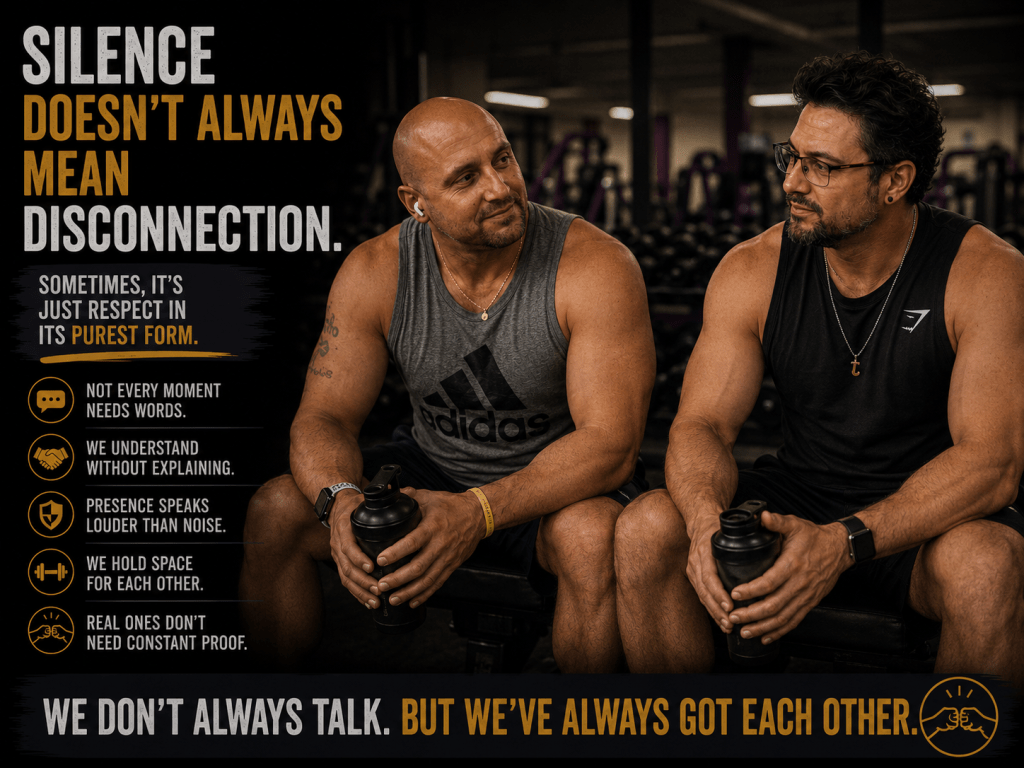
Silence is often interpreted as social discomfort.
Not necessarily between men.
Two friends can sit in a car for twenty minutes without talking.
They can watch an entire game while exchanging only occasional commentary.
They can fish for hours.
They can work on something together with almost no conversation.
And neither person feels pressure to fill the silence.
That’s because intimacy isn’t measured solely by verbal communication.
Sometimes comfort is demonstrated by not needing to perform socially around another person.
You don’t need to entertain me.
I don’t need to entertain you.
We can simply exist in the same space.
That’s a surprisingly powerful form of trust.
Vulnerability Often Comes in Windows

Men absolutely experience fear, grief, insecurity, loneliness, shame, love, uncertainty, and emotional pain.
The question is often not whether those emotions exist.
It’s when and where they feel safe enough to reveal them.
Male vulnerability can appear in small windows.
A conversation after training.
A late-night phone call.
A long drive.
Sitting around after everyone else leaves.
A quiet moment after a game.
Someone finally says:
“Can I tell you something?”
The window opens.
A good friend recognizes it.
He doesn’t make a joke immediately.
He doesn’t change the subject.
He listens.
And when the conversation ends?
They might go straight back to talking about football.
That doesn’t diminish what happened.
Sometimes returning to normal is precisely what makes vulnerability feel safe.
The friendship hasn’t changed.
The man hasn’t suddenly become fragile.
He’s still one of the guys.
Advice Can Be a Form of Care

There’s a familiar situation:
One man tells another man about a problem.
Within thirty seconds:
“Okay, here’s what you need to do.”
This tendency sometimes gets criticized as men trying to “fix everything.”
And sometimes that’s exactly what’s happening.
But there can also be something compassionate underneath it.
Problem-solving creates agency.
The friend is essentially saying:
“Your problem matters enough to me that my brain is now working on it too.”
That’s care.
The challenge is learning when someone wants solutions and when he simply needs someone beside him.
Sometimes the better response isn’t:
“Here’s what you should do.”
It’s:
“Damn, man. That sucks. I’m here.”
Knowing the difference is emotional intelligence.
Male Groups Naturally Develop Roles

Spend enough time around a group of men and you’ll notice something else.
Roles emerge.
There’s often a leader.
A comedian.
A challenger.
A mediator.
A storyteller.
An expert.
A protector.
A quiet observer.
The guy everybody calls when something goes wrong.
The guy everyone messes with.
And interestingly, these roles can change depending on the situation.
The loudest man isn’t necessarily the leader.
The physically strongest man isn’t necessarily the protector.
The funniest man may actually be the person most sensitive to tension within the group.
Male social groups become small ecosystems.
Every person contributes something.
And understanding your role—and whether you’ve become trapped inside it—can reveal a lot about your psychology.
Men Create Shared Mythology

Close male friendships accumulate stories.
Remember that road trip?
Remember that coach?
Remember when you tried to do that?
Remember when we almost got thrown out?
Remember that game?
Those stories get repeated endlessly.
Everyone already knows how they end.
Nobody cares.
Because they’re no longer simply stories.
They are evidence of shared history.
They reinforce the identity of the group:
We were there together.
Shared experiences become emotional landmarks.
Sometimes men don’t say:
“We’ve been friends for twenty years and that relationship means a lot to me.”
They say:
“Remember that night in 2009?”
Same message.
Different language.
The Hidden Language of Male Friendship
When we only measure emotional connection through verbal disclosure, we risk misunderstanding how many men actually communicate.
Because male friendship can have an entire vocabulary built from behavior.
Banter can mean: I like you.
Competition can mean: I respect you.
Advice can mean: I want you to succeed.
An invitation can mean: I’ve been thinking about you.
Showing up can mean: You matter.
Comfortable silence can mean: I trust you.
Remembering an old story can mean: Our history matters to me.
“You good?” can mean: I’m worried about you.
And sometimes:
“Love you, brother.”
really does just mean:
I love you, brother.
The Skill Men Need to Develop

None of this means men shouldn’t become better at directly expressing emotion.
We should.
Behavioral communication shouldn’t replace emotional vocabulary.
It should complement it.
There is enormous strength in being able to tell another man:
“I’m struggling.”
“I appreciate you.”
“I need help.”
“I’m proud of you.”
“I miss you.”
“I love you.”
The goal isn’t to eliminate the traditional language of male friendship.
It’s to expand it.
Keep the jokes.
Keep the competition.
Keep the workouts.
Keep the ridiculous stories you’ve told 300 times.
Keep showing up.
But add something else.
Say the thing occasionally.
Because one of the most powerful developments in a man’s life happens when he realizes that strength and emotional honesty don’t have to compete for the same space.
They can exist together.
One Question Worth Asking
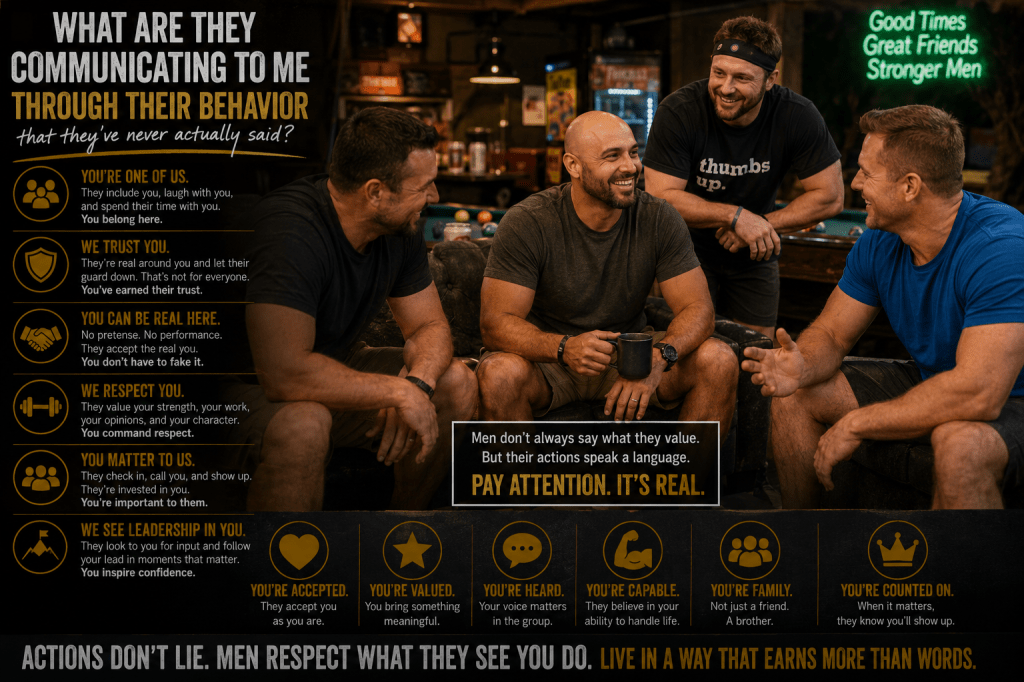
Think about the men closest to you.
Your friends.
Your brothers.
Your teammates.
Your coworkers.
Your training partners.
Your mentors.
Now ask yourself:
What are they communicating to me through their behavior that they’ve never actually said?
Then turn the question around:
What have I been trying to communicate to them without saying it?
Maybe there’s something worth finally putting into words.
Because sometimes the strongest thing one man can say to another isn’t complicated at all.
“Hey, man. I appreciate you.”
And then, naturally, you can immediately make fun of him afterward.
We can’t make this too weird.
About John J. Schessler, M.S.

John J. Schessler, M.S., is a Mental Performance Coach, Behavior Interventionist, speaker, and founder of Athlete Mindset HQ—a high-performance coaching platform dedicated to helping athletes, professionals, and everyday individuals develop the mindset needed to thrive under pressure and perform at their highest potential.
John earned his Master of Science in Sport Psychology from Capella University and his Bachelor of Arts in Child & Adolescent Psychology from Southern New Hampshire University. His work bridges the gap between psychology, human performance, behavioral science, and personal development, combining evidence-based strategies with practical coaching that people can immediately apply in sport, work, and everyday life.
His passion for helping others is rooted in his own journey. As a child, John survived Guillain-Barré Syndrome, spending weeks in a coma before fighting through rehabilitation to reclaim his life. That experience shaped his belief that resilience isn’t something you’re born with—it’s something you build through adversity, discipline, and purpose.
Today, John works with individuals from all walks of life, helping them strengthen confidence, improve emotional resilience, overcome obstacles, and develop the habits that lead to lasting success. Whether coaching athletes, mentoring students, speaking to organizations, or creating educational content, his mission remains the same: to help people become mentally stronger than the challenges they face.
John is also the co-host of The Follow Through Podcast along with Ericka Reid (@mamalovesmacros on IG and Facebook), where they explore sports psychology, leadership, mental health, motivation, resilience, and human performance through practical conversations that inspire listeners to move beyond intention and into action.
His philosophy is simple:
Mental strength isn’t about never struggling. It’s about developing the confidence, discipline, and resilience to keep moving forward—especially when life gets difficult.
Because success isn’t built by what you intend to do.
It’s built by what you follow through on.
Personal Brand Statement
John J. Schessler, M.S. is dedicated to helping people unlock their potential by strengthening the one asset that influences every area of life—the mind. Through education, coaching, and authentic conversation, he empowers others to develop confidence, resilience, and the discipline to follow through on their goals.


Leave a comment