
Why becoming healthier doesn’t always mean becoming lighter
By John J. Schessler, MS
There is a moment almost everyone who has tried to lose weight knows.
You’ve been exercising.
You’re eating differently.
Your clothes are fitting better.
You’re getting stronger.
Maybe you have more energy than you’ve had in months.
Then you step onto the scale.
Nothing.
Or worse — the number has gone up.
Suddenly, all of those positive changes don’t seem to matter.
“I’m not making progress.”
But are you sure?
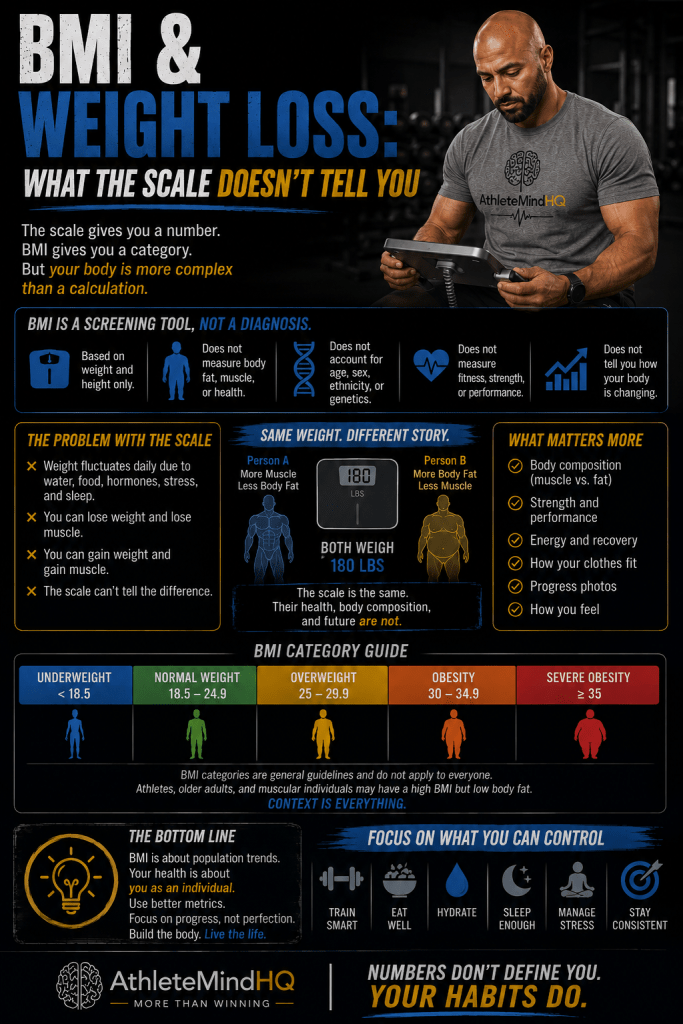
One of the biggest problems with the way we approach weight loss is that we’ve been conditioned to reduce an incredibly complicated biological process to a single number.
Body weight.
And right beside it sits another number that has influenced healthcare and fitness conversations for decades:
BMI.
Neither number is useless.
But neither number tells your entire story.
And understanding that distinction can completely change the way you approach weight loss.
What Exactly Is BMI?
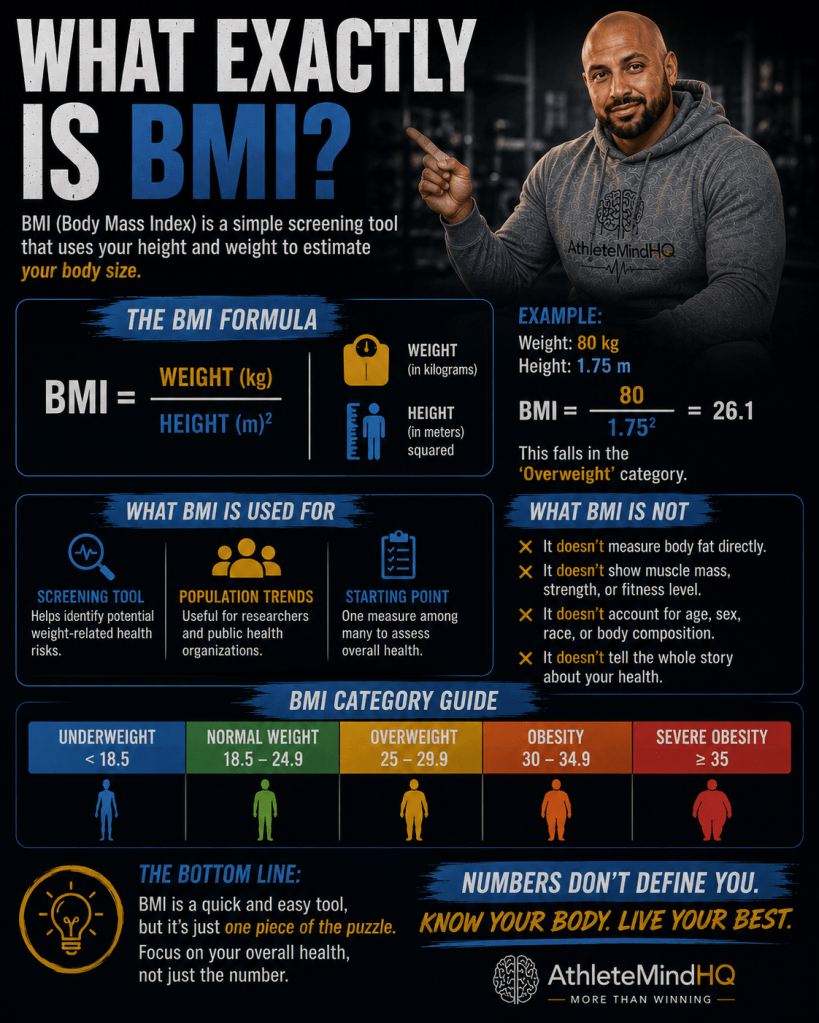
BMI stands for Body Mass Index.
For adults, it compares a person’s weight relative to their height and places the result into commonly used categories:
- Below 18.5: Underweight
- 18.5–24.9: Healthy weight
- 25.0–29.9: Overweight
- 30.0 and above: Obesity
BMI has an important advantage:
It’s incredibly easy to calculate.
Researchers and healthcare professionals can use it as a quick screening measurement when examining large groups of people and potential health risks associated with body weight.
But the word screening matters.
BMI is not a direct measurement of body fat.
And that’s where things get complicated.
BMI Knows Two Things About You

Your height.
And your weight.
That’s essentially it.
BMI does not directly know:
How much muscle you have.
How much body fat you have.
Where that fat is located.
Your waist circumference.
Your cardiovascular fitness.
Your strength.
Your blood pressure.
Your cholesterol.
Your blood glucose.
Your nutritional habits.
Your sleep quality.
Your exercise history.
Or how physically capable you are.
Yet we sometimes treat BMI as though it somehow knows all of those things.
It doesn’t.
Imagine Two People
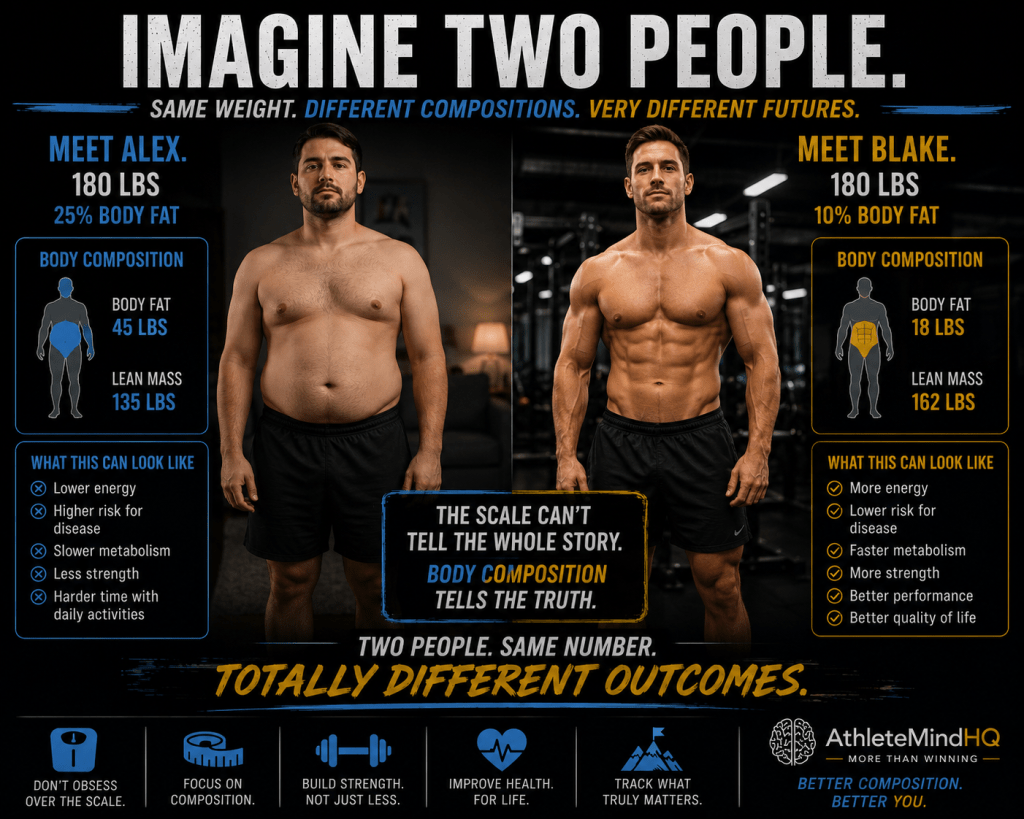
Let’s say two men are exactly the same height.
They’re also exactly the same weight.
Their BMI will therefore be identical.
But let’s look closer.
One exercises regularly, resistance trains several days per week, carries significant skeletal muscle, and has relatively low body fat.
The other is sedentary, carries considerably less muscle and has a much higher percentage of body fat.
Same height.
Same weight.
Same BMI.
But certainly not the same body composition.
And potentially not the same health profile.
That’s one of the fundamental limitations of relying too heavily on BMI when evaluating an individual.
Weight Loss and Fat Loss Are Not the Same Thing
This distinction might be even more important.
When someone tells me:
“I need to lose weight.”
What they usually mean is something closer to:
“I want to reduce excess body fat.”
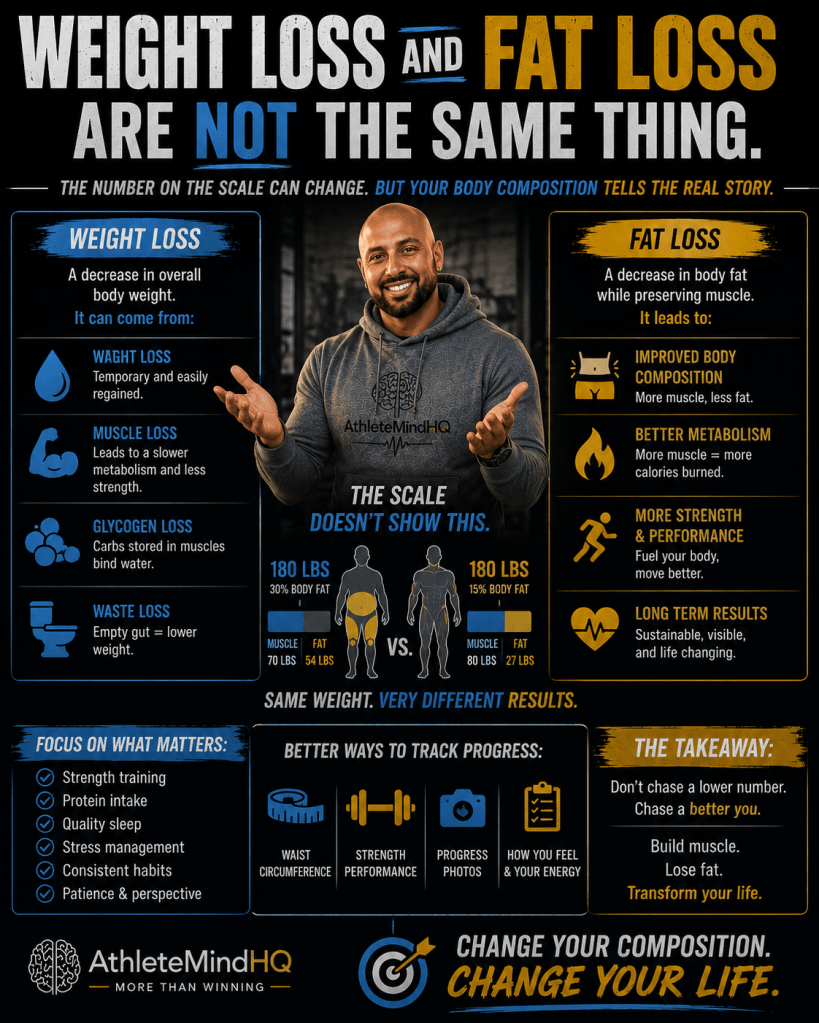
Those aren’t necessarily the same goal.
Your body weight represents much more than fat.
It includes:
- Fat mass
- Skeletal muscle
- Bone
- Organs
- Water
- Glycogen
- Food and fluids currently being digested
So when the scale changes, it isn’t automatically telling you that body fat changed.
This is also why your weight can fluctuate considerably from one day to another.
You didn’t suddenly gain several pounds of body fat overnight.
Your body is constantly changing.
The Scale Is Noisy

Think about everything that can affect your body weight.
A salty meal can increase water retention.
Carbohydrate intake can affect glycogen storage and the water stored alongside it.
Hydration changes your weight.
Food still moving through your digestive system changes your weight.
Hormonal fluctuations can affect it.
Exercise can temporarily influence fluid balance.
Even the time of day matters.
So imagine this situation.
You weigh yourself Monday morning.
185 pounds.
Wednesday morning:
187 pounds.
And immediately:
“I gained two pounds!”
Maybe.
But probably not two pounds of body fat.
That’s why individual weigh-ins can be misleading.
Trends are much more informative than isolated measurements.
Enter Body Composition
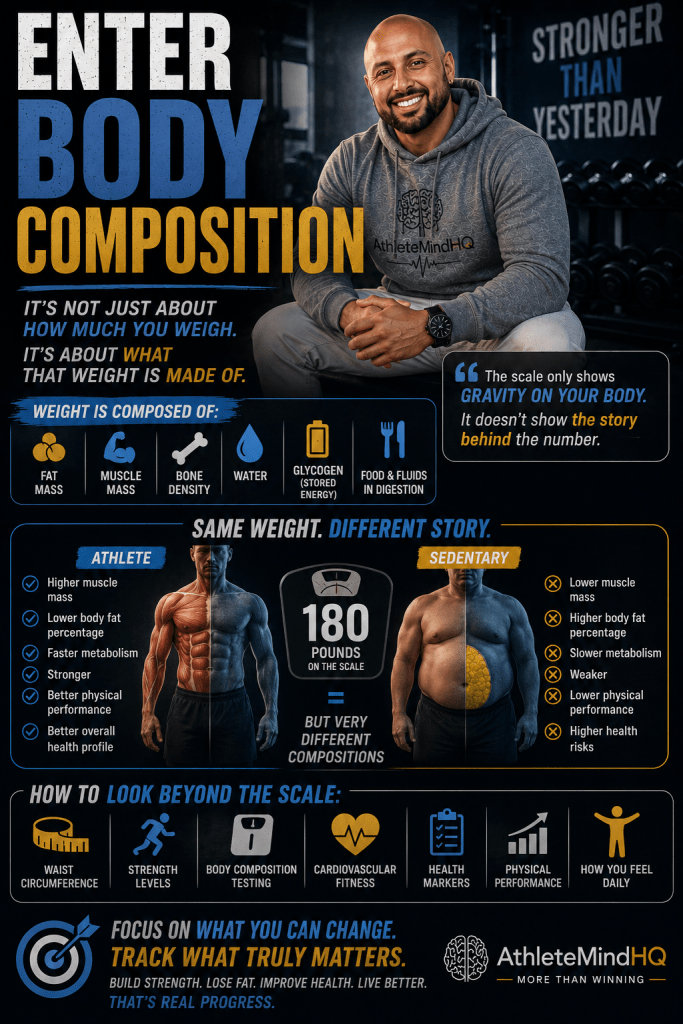
Instead of asking only:
“How much do I weigh?”
We can ask a much more useful question:
“What is my weight made of?”
That’s the basic idea behind body composition.
Two people weighing 180 pounds can have dramatically different proportions of fat mass and fat-free mass.
And those differences matter.
This becomes especially important when resistance training enters the picture.
Imagine someone begins strength training while improving their nutrition.
Over the next several months they lose fat while maintaining — or potentially gaining — muscle.
Their scale weight might change relatively slowly.
But their body could look dramatically different.
Their waist may shrink.
Their strength may increase.
Their clothes may fit differently.
Their physical performance may improve.
This is commonly discussed as body recomposition.
And it’s one of the reasons the bathroom scale can sometimes underestimate just how much progress someone is actually making.
The Psychology of the Scale
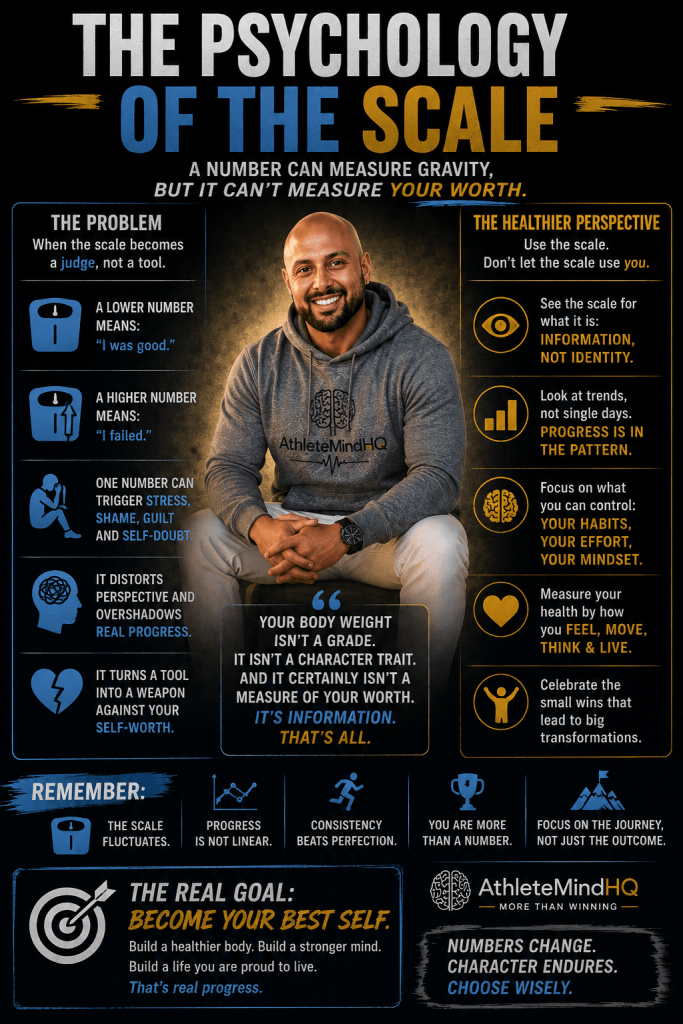
There’s another piece of this conversation that doesn’t get nearly enough attention.
What does that number do to your mind?
For some people, stepping onto a scale isn’t simply collecting information.
It becomes judgment.
A lower number means:
“I was good.”
A higher number means:
“I failed.”
Now we’ve taken a measurement of gravitational force acting on the body and turned it into a measurement of self-worth.
That’s a dangerous psychological leap.
Your body weight isn’t a grade.
It isn’t a character trait.
And it certainly isn’t a measure of your worth as a human being.
It’s information.
That’s all.
The question is what you do with that information.
Measure Progress From Multiple Angles

This doesn’t mean you need to throw away your bathroom scale.
And it doesn’t mean BMI should never be used.
It means we need context.
If you’re pursuing fat loss, fitness or improved health, consider looking at multiple indicators of progress rather than allowing one measurement to dominate the entire conversation.
1. Body-Weight Trends
Track changes across weeks and months rather than emotionally reacting to individual days.
2. Waist Circumference
Changes around the waist can provide useful additional information that body weight alone cannot.
3. Body Composition
Methods such as DEXA, air-displacement plethysmography, bioelectrical impedance and skinfold measurements can provide estimates of body composition, although each method has advantages and limitations.
4. Strength
Are you getting stronger?
Can you lift more than you could three months ago?
That’s progress.
5. Cardiovascular Fitness
Can you walk farther?
Run longer?
Recover faster?
Climb stairs without becoming as winded?
That’s progress too.
6. Health Markers
Work with qualified healthcare professionals to monitor appropriate measures such as blood pressure, blood glucose, cholesterol and other relevant health indicators.
7. Daily Function
This one gets overlooked constantly.
Can you move more easily?
Do everyday activities feel easier?
Do you have more energy?
Can you participate in activities you previously avoided?
That’s real-world performance.
Your Body Is Not a Math Problem

Numbers are incredibly useful.
I love data.
But human beings are not spreadsheets.
Health exists at the intersection of physiology, psychology, behavior, environment, and lifestyle.
That’s why two people can follow the exact same program and experience different results.
It’s also why sustainable weight management isn’t simply about telling someone:
“Eat less and move more.”
Energy balance absolutely matters.
But so do things such as:
Sleep.
Stress.
Food environment.
Exercise habits.
Recovery.
Access to nutritious food.
Medication.
Age.
Behavioral patterns.
Psychological relationships with food.
Social support.
And perhaps most importantly:
Consistency.
The human body is considerably more complicated than the motivational memes make it sound.
So, is BMI Bad?
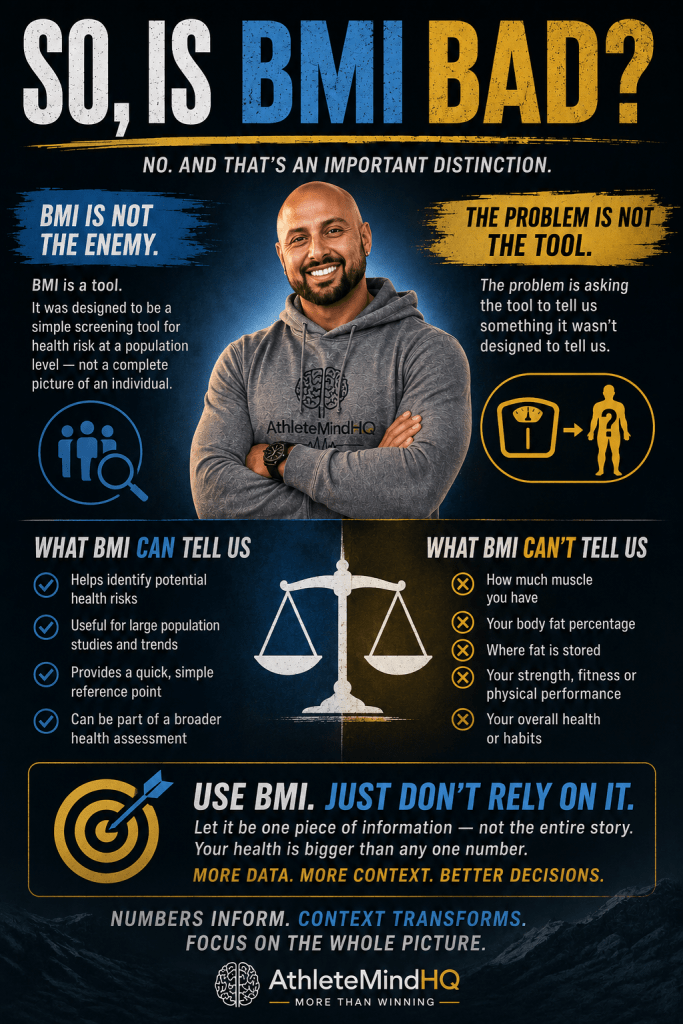
No.
And I think this is an important distinction.
BMI doesn’t need to be either completely embraced or completely rejected.
It’s a tool.
The problem isn’t necessarily the tool.
The problem is asking the tool to tell us something it wasn’t designed to tell us.
BMI can provide useful information when examining health risk, particularly at a population level, and clinicians may appropriately consider it alongside other information.
But when we’re evaluating an individual person, we need a wider lens.
Your BMI can be part of your health picture.
It should not automatically become the entire picture.
Change the Goal
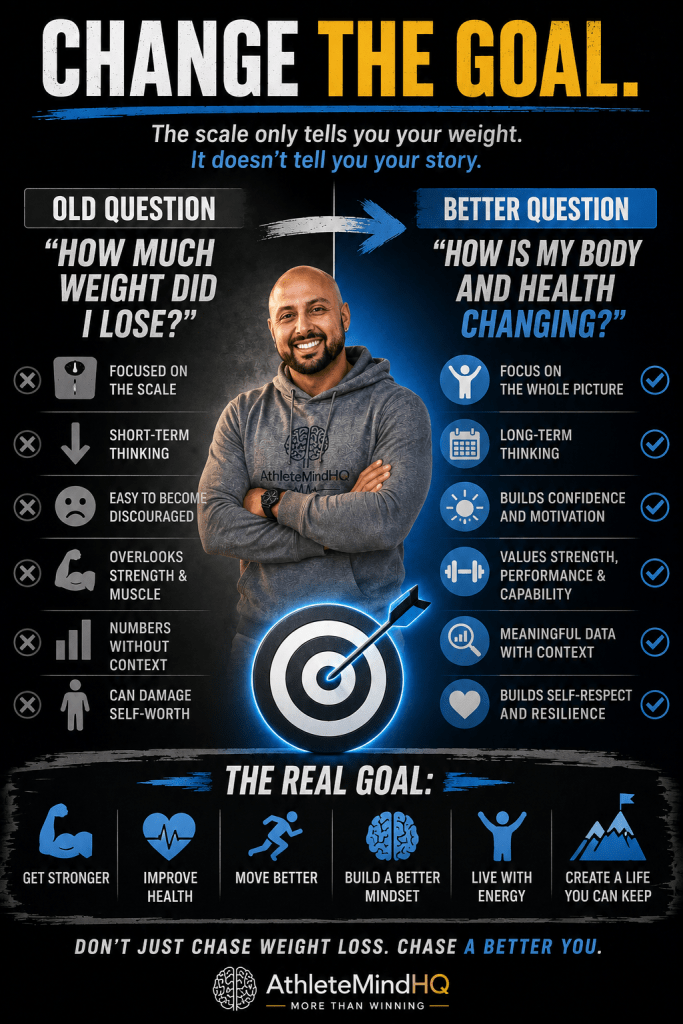
Maybe one of the biggest changes we can make in fitness is changing the question.
Instead of constantly asking:
“How much weight did I lose?”
Try asking:
“How is my body changing?”
And then go further.
Am I getting stronger?
Am I losing excess body fat?
Is my cardiovascular health improving?
Am I sleeping better?
Do I have more energy?
Are my health markers improving?
Can I move better?
Are my eating habits sustainable?
Do I feel more capable inside my own body?
Those questions tell us something a bathroom scale never could.
The Bigger Goal

There is nothing inherently wrong with wanting to lose weight.
For some people, reducing body weight is an appropriate and meaningful health goal.
But I want us to think beyond simply making the number smaller.
Because ultimately, the goal shouldn’t just be:
Make the body lighter.
It should be:
Make the body healthier.
Make it stronger.
Make it more capable.
Improve its cardiovascular capacity.
Preserve muscle.
Improve mobility.
Develop sustainable eating behaviors.
Build confidence in what your body can do, not simply how little it can weigh.
And perhaps most importantly, create habits that you can actually maintain after the “diet” is over.
Because the most impressive transformation isn’t necessarily the person who loses the most weight.
It’s the person who builds a healthier relationship with their body while creating behaviors they can carry into the rest of their life.
So use BMI.
Use the scale.
Use the data.
Just remember what those numbers are.
Information.
Not judgment.
Not identity.
And never the entire story.
Athlete Mindset HQ
More Than Winning.
Where psychology, human performance, health, and everyday life meet.
ABOUT JOHN SCHESSLER, M.S.

John J. Schessler, M.S., is a Mental Performance Coach, Behavior Interventionist, speaker, and founder of Athlete Mindset HQ—a high-performance coaching platform dedicated to helping athletes, professionals, and everyday individuals develop the mindset needed to thrive under pressure and perform at their highest potential.
John earned his Master of Science in Sport Psychology from Capella University, his Bachelor of Arts in Child & Adolescent Psychology from Southern New Hampshire University, and an Associate of Science in Social Work from the Community College of Allegheny County. His work bridges the gap between psychology, human performance, behavioral science, and personal development, combining evidence-based strategies with practical coaching that people can immediately apply in sport, work, and everyday life.
His passion for helping others is rooted in his own journey. As a child, John survived Guillain-Barré Syndrome, spending weeks in a coma before fighting through rehabilitation to reclaim his life. That experience shaped his belief that resilience isn’t something you’re born with—it’s something you build through adversity, discipline, and purpose.
Today, John works with individuals from all walks of life, helping them strengthen confidence, improve emotional resilience, overcome obstacles, and develop the habits that lead to lasting success. Whether coaching athletes, mentoring students, speaking to organizations, or creating educational content, his mission remains the same: to help people become mentally stronger than the challenges they face.
John is also the host of The Follow Through Podcast, where he explores sports psychology, leadership, men’s mental health, motivation, resilience, and human performance through practical conversations that inspire listeners to move beyond intention and into action.
His philosophy is simple:
Mental strength isn’t about never struggling. It’s about developing the confidence, discipline, and resilience to keep moving forward—especially when life gets difficult.
Because success isn’t built by what you intend to do.
It’s built by what you follow through on.


Leave a comment