
By John J. Schessler, MS, CMT
Walk into almost any gym today and you’ll hear the same conversation.
“Everyone’s doing it.”
“You only live once.”
“What’s the difference between steroids and cosmetic surgery?”
“People are just jealous.”
When the topic of anabolic steroids comes up, opinions are rarely neutral. Some people condemn them outright. Others defend them passionately. As someone who works in performance, psychology, and fitness, I’ve become increasingly interested in a deeper question:
Why do some men defend steroid use so strongly, even when the risks are well documented?
The answer has less to do with the drugs themselves and more to do with what they represent.
The Appeal Is Easy to Understand
Let’s start with honesty.
Steroids work.
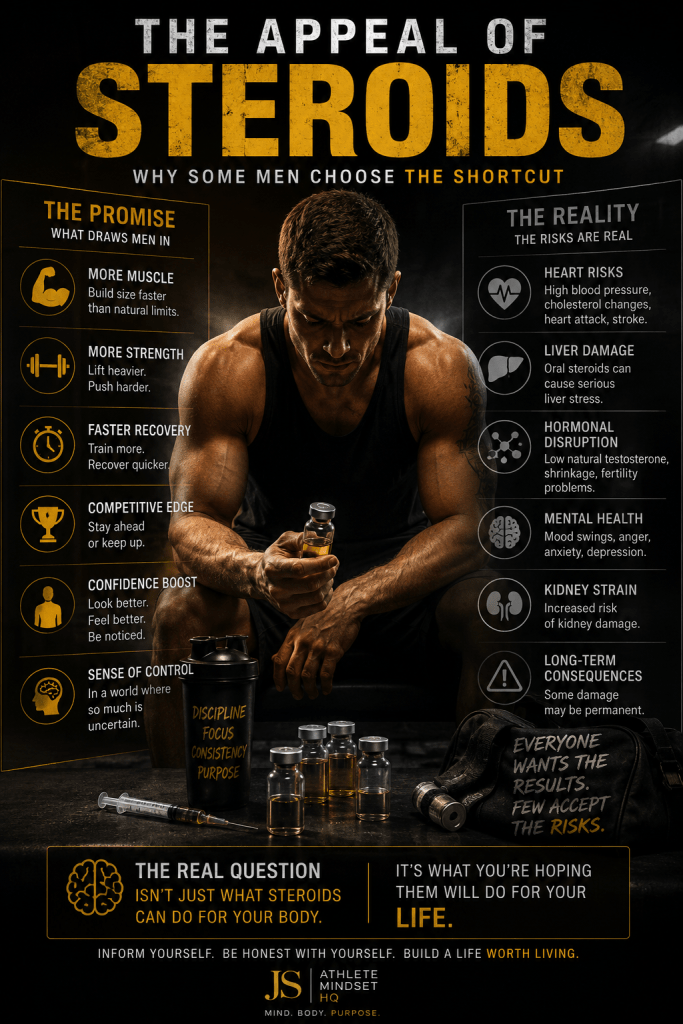
They can increase muscle mass, strength, recovery, and training capacity at levels that are difficult or impossible to achieve naturally. For a man who has spent years training hard with limited results, the appeal is obvious.
Many users report feeling:
- More confident.
- More attractive.
- More respected.
- More powerful.
- More capable in the gym and in life.
For some men, steroids become associated with the first time they truly felt comfortable in their own skin.
That’s a powerful experience.
The Conversation We Rarely Have
Most discussions about steroids focus on biology.
We talk about hormones, cholesterol, blood pressure, liver enzymes, and cardiovascular risk.
Those conversations matter.
But there is another conversation that often gets ignored:
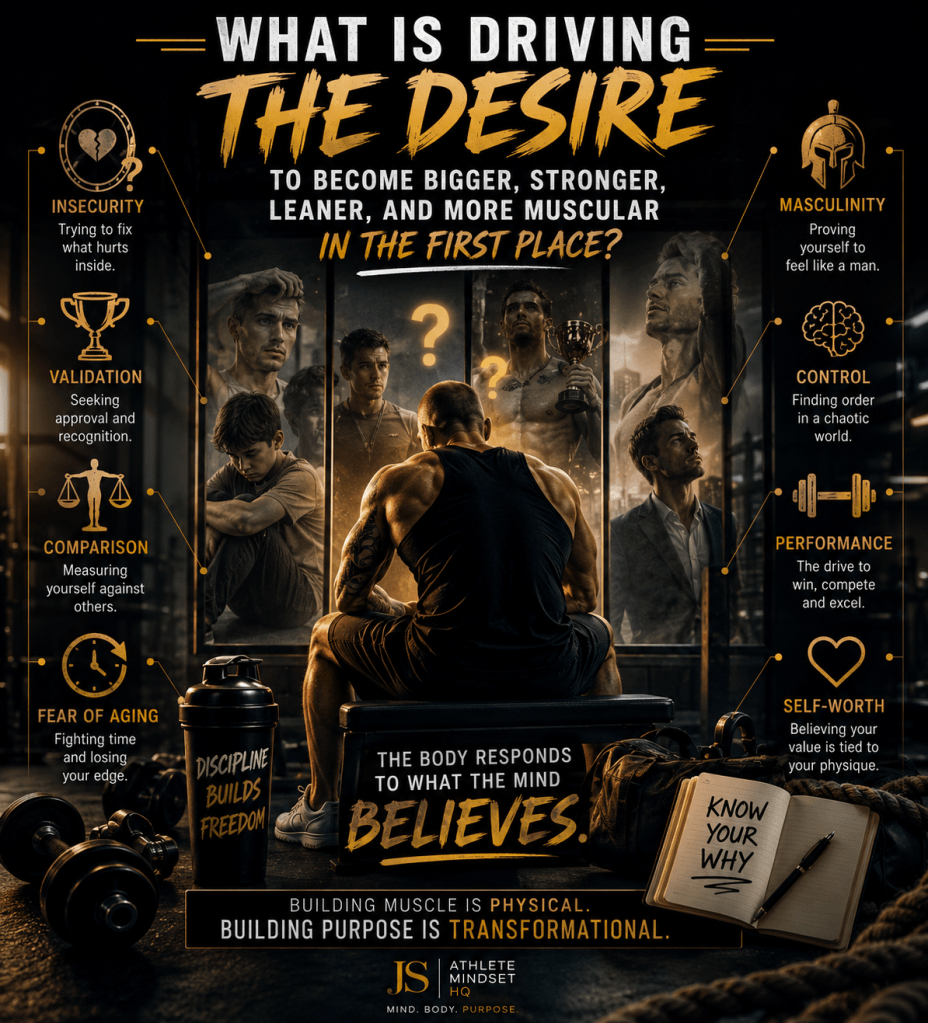
What is driving the desire to become bigger, stronger, leaner, and more muscular in the first place?
For many men, the answer is complicated.
Some are chasing athletic performance.
Some are trying to keep up with unrealistic social media standards.
Some are attempting to regain youth.
Some are looking for validation.
Others are trying to outrun feelings of inadequacy, rejection, loneliness, or insecurity.
The muscle isn’t always the goal.
Sometimes it’s what the muscle represents.
The Hidden Cost
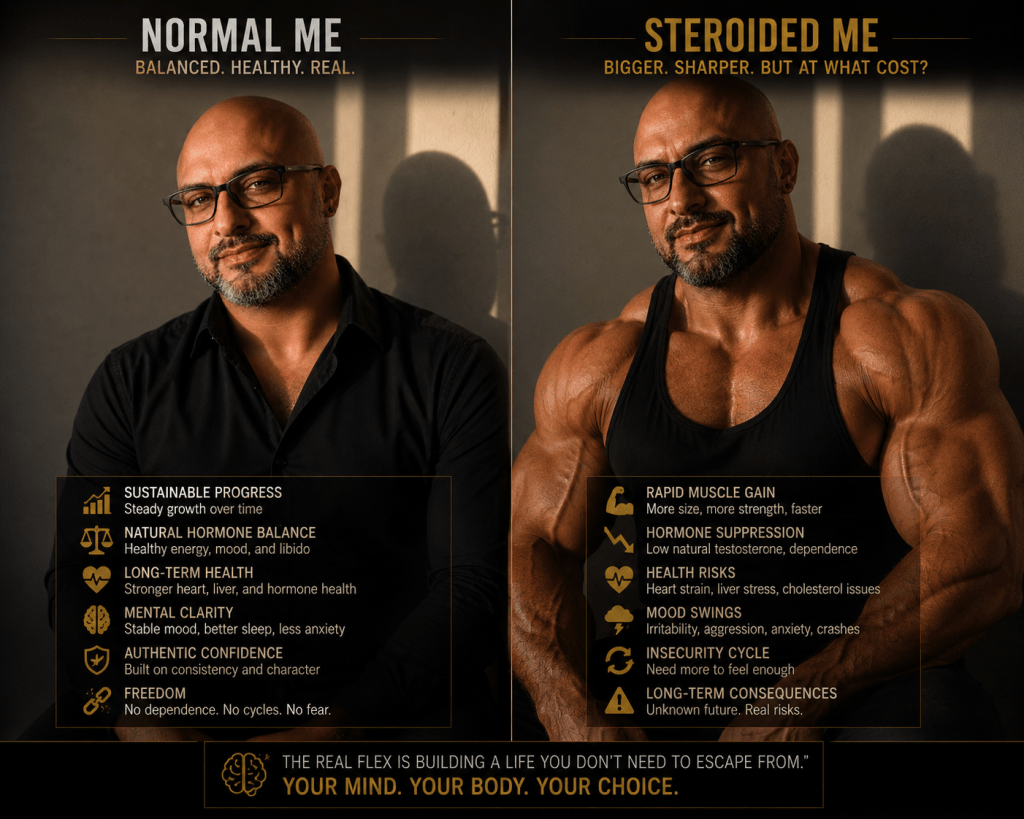
One reason steroid use concerns many health professionals is that the risks often develop gradually.
Unlike many substances that produce immediate life-threatening consequences, steroid-related complications may emerge years later.
Potential risks include:
- Heart enlargement.
- High blood pressure.
- Elevated cholesterol.
- Increased risk of heart attack and stroke.
- Hormonal dysfunction.
- Fertility problems.
- Liver damage.
- Kidney stress.
- Mood disturbances.
- Depression after cycling off.
Not everyone who uses steroids experiences these complications.
However, pretending the risks do not exist is just as irresponsible as exaggerating them.
The reality lies somewhere in the middle.
Social Media Changed the Game
Twenty years ago, elite physiques were mostly seen on bodybuilding stages.
Today they appear on our phones every few minutes.
Many young men compare themselves to influencers, fitness models, and athletes without realizing how many of those physiques are enhanced.
As a result, perfectly healthy and athletic men increasingly view themselves as inadequate.
The standard keeps moving.
The comparison never ends.
And for some men, steroids begin to feel less like an option and more like a requirement.
When Confidence Depends on a Physique
One of the biggest concerns from a psychological perspective is when self-worth becomes attached exclusively to appearance.
If confidence only exists when body fat is low, muscles are full, veins are visible, and compliments are flowing, confidence becomes fragile.
True confidence is built from:
- Character.
- Competence.
- Consistency.
- Relationships.
- Purpose.
- Personal values.
A muscular body can enhance confidence.
It cannot replace these foundations.
A Better Question
Instead of asking whether steroid users are good or bad, disciplined or weak, maybe we should ask a different question:
What are men searching for when they pursue extreme physiques?
For some, it’s performance.
For some, it’s belonging.
For some, it’s confidence.
For some, it’s acceptance.
For some, it’s control.
Understanding those motivations allows us to have more productive conversations than simply arguing about the drugs themselves.
Final Thoughts
This is not an anti-steroid article.
It is not a pro-steroid article.
It is an invitation for honesty.
Every man has the right to make decisions about his own body. However, every decision comes with consequences.
Before asking whether steroids can make you bigger, stronger, or leaner, ask yourself a more important question:
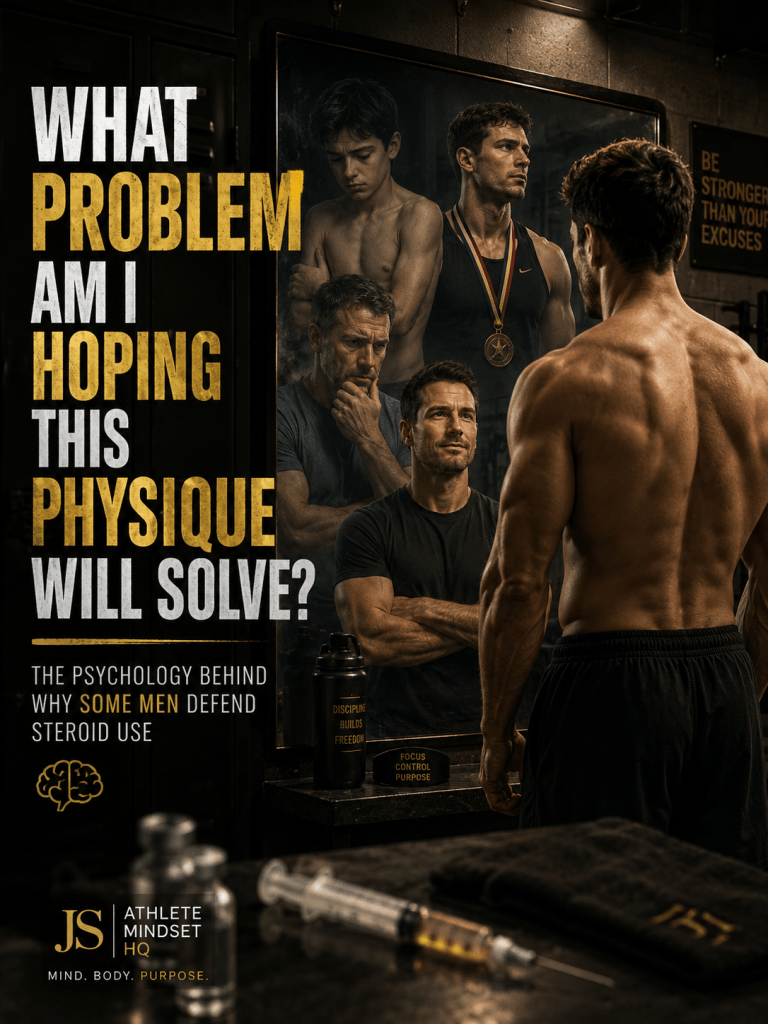
What problem am I hoping this physique will solve?
Because sometimes the greatest transformation doesn’t happen in the mirror.
It happens in the mind.
And no drug can do that work for you.
ABOUT ME

I’m Coach John — the mind behind AthleteMindsetHQ — and my mission is simple: help athletes build the kind of mental toughness, confidence, and resilience that shows up long after the final whistle blows.
I coach from experience, education, and heart. As a Sports Psychology Coach and Behavior Interventionist, I’ve spent years working with athletes and students who carry big potential but also big pressure. My job? Teach them how to channel that pressure into power.
Right now, I’m finishing up my graduate degree in Sports Psychology so I can support athletes at an even higher level. Every day, I study how mindset, emotion, and performance work together — and every day, I bring that knowledge straight to the athletes and readers who trust me.
This blog is your locker room talk for the mind.
Here, we break limits.
We train confidence.
We learn how to stay locked in when it matters most.
Because winning isn’t just physical — it’s mental.
And when you master your mind, the rest follows.
If you’re ready to grow, challenge yourself, and build an unshakeable mental edge… welcome to the team. Let’s get to work.


Leave a comment